4,068 posters, 219 videos, 101 topics, 69 sessions, 14,365 authors, 6,128 institutions
ePostersLive by SciGen Technologies S.A. All rights reserved.
Alzheimer's Association International Conference 2026
July 12-15, 2026 | London, United Kingdom, and Online

5001
Association of self-reported hearing loss and tinnitus with brain structure and cognitive function: a population-based cross-sectional sub-cohort analysis from the Study of Health in Pomerania (SHIP)
Poster Presenter
Authors
Claudia Schwarz, Stefan Frenzel, Till Ittermann, Ulrike Grittner, Silke Wortha, Tina Brzoska, Hans Grabe, Agnes Flöel, Friedrich Ihler
Affiliations
Department of Neurology, University Medicine Greifswald, Germany, Department of Psychiatry, University Medicine Greifswald, Germany, Institute for Community Medicine, University Medicine Greifswald, Germany, Institute of Biometry and Clinical Epidemiology, Charité – Universitätsmedizin Berlin, Germany,, Centre for Early Mathematics Learning, Loughborough University, United Kingdom, Department of Otorhinolaryngology, Head and Neck Surgery, University Medicine Greifswald, Germany
Part of Topic
BACKGROUND
Hearing loss is a major and potentially modifiable risk factor for dementia and is frequently accompanied by tinnitus, another prevalent auditory dysfunction. Both conditions have been linked to cognitive decline and brain health; however, evidence from large population-based studies remains limited. This study investigated associations of self-reported hearing loss and tinnitus with cognitive performance and brain structure in a large population-based cohort from northeastern Germany.
METHODS
• 4,420 participants (age 20-84 years, [52±15], 51% females, 12±3 years of education) from the SHIP-TREND cohort
• Self-assessment for hearing (N=4,400) and tinnitus (N=3,937)
• Assessment of verbal memory (N=3,978) and executive function (N=3,653)
• T1-weighted MRI: data on global and regional volumes, cortical thickness, and white matter hypointensity (WMH) volume (N=2,144)
• Linear regression and mediation models adjusted for age, sex, and further risk factors for dementia
RESULTS
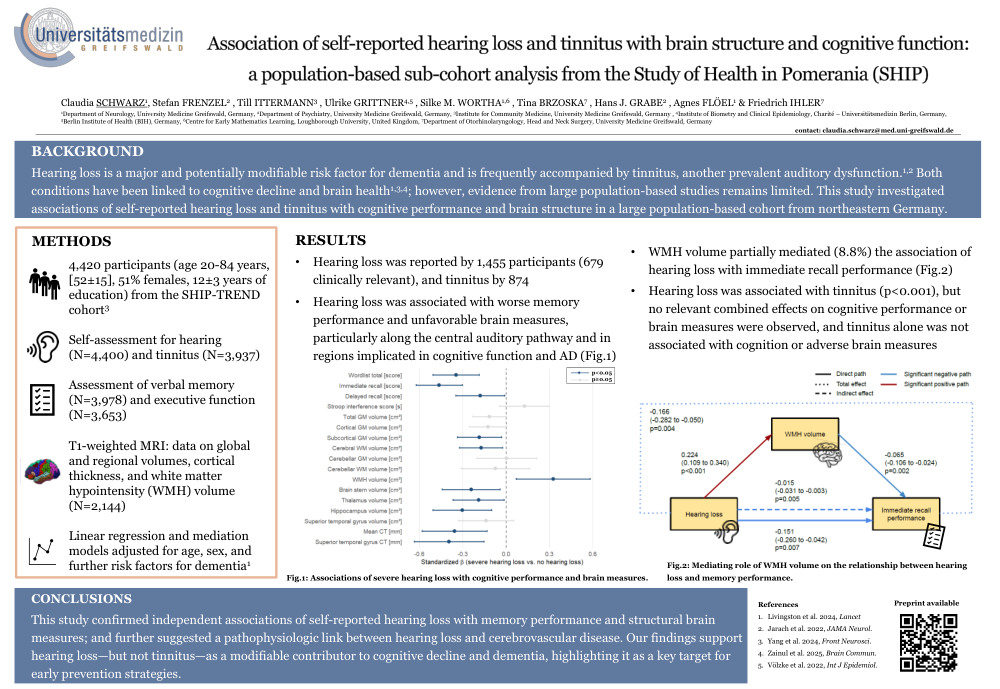
• Hearing loss was reported by 1,455 participants (679 clinically relevant), and tinnitus by 874
• Hearing loss was associated with worse memory performance and unfavorable brain measures, particularly along the central auditory pathway and in regions implicated in cognitive function and AD (Fig.1)
• WMH volume partially mediated the association of hearing loss with immediate recall performance (proportion mediated: 8.8%; Fig.2)
• Hearing loss was associated with tinnitus (p<0.001), but no relevant combined effects on cognitive performance or brain measures were observed, and tinnitus alone was not associated with cognition or adverse brain measures
CONCLUSIONS
This study confirmed independent associations of self-reported hearing loss with memory performance and structural brain measures; and further suggested a pathophysiologic link between hearing loss and cerebrovascular disease. Our findings support hearing loss—but not tinnitus—as a modifiable contributor to cognitive decline and dementia, highlighting it as a key target for early prevention strategies.
Comments
Email is required but is not shown publicly.
Loading comments...