4,068 posters, 219 videos, 101 topics, 69 sessions, 14,365 authors, 6,128 institutions
ePostersLive by SciGen Technologies S.A. All rights reserved.
Alzheimer's Association International Conference 2026
July 12-15, 2026 | London, United Kingdom, and Online

3342
Plasma Brain-derived Phospho-tau: From Pre-clinical To Clinical Cohorts
Poster Presenter
Authors
Ashvini Keshavan, Katharine Wiltshire, William Coath, David M Cash, Kirsty Lu, Melanie Hart, Michael P Lunn, Henrik Zetterberg, Jonathan M Schott
Affiliations
1. Department of Neurodegenerative Disease, Dementia Research Centre, UCL Queen Square Institute of Neurology, London, United Kingdom. 2. UK Dementia Research Institute at UCL, London, United Kingdom, 3. Department of Medicine, University of Wisconsin School of Medicine and Public Health, University of Wisconsin-Madison, Madison, Wisconsin, United States of America., 4. Neuroimmunology & CSF Laboratory, National Hospital for Neurology and Neurosurgery, University College London Hospitals NHS Foundation Trust (UCLH) Queen Square London, United Kingdom 5. Department of Neuroinflammation, UCL Queen Square Institute of Neurology, London, United Kingdom., 4. Neuroimmunology & CSF Laboratory, National Hospital for Neurology and Neurosurgery, University College London Hospitals NHS Foundation Trust (UCLH) Queen Square London, United Kingdom. 6.MRC Centre for Neuromuscular Diseases, UCL Queen Square Institute of Neurology, London, United Kingdom, 7.Department of Psychiatry and Neurochemistry, Institute of Neuroscience and Physiology, the Sahlgrenska Academy at the University of Gothenburg, Mölndal, Sweden. 8. Clinical Neurochemistry Laboratory, Sahlgrenska University Hospital, Mölndal, Sweden. 9. Hong Kong Center for Neurodegenerative Diseases, Clear Water Bay, Hong Kong Special Administrative Region, China. 10. Wisconsin Alzheimer's Disease Research Center, University of Wisconsin School of Medicine and Public Health, University of Wisconsin-Madison, Madison, Wisconsin, United States of America. 11. Department of Pathology and Laboratory Medicine, University of Wisconsin School of Medicine and Public Health, Madison, Wisconsin, United States of America. 12. Centre for Brain Research, Indian Institute of Science, Bengaluru, India
Part of Topic
Key message
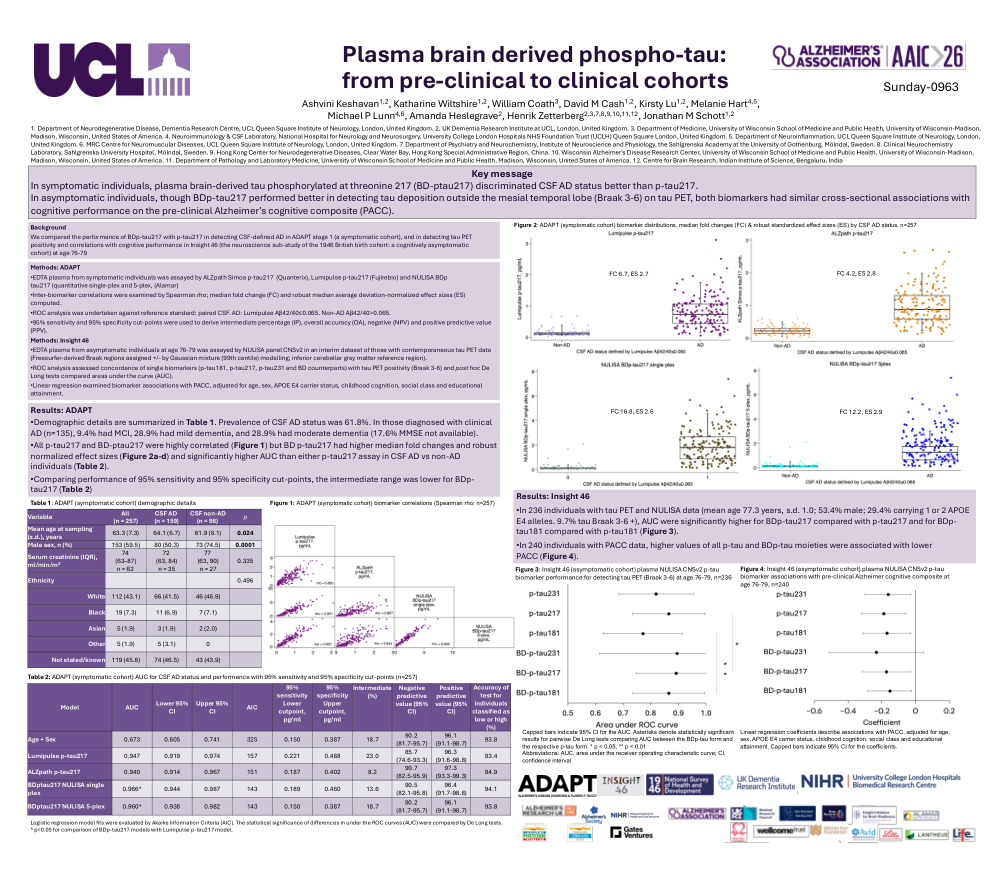
In symptomatic individuals, plasma brain-derived tau phosphorylated at threonine 217 (BD-ptau217) discriminated CSF AD status better than p-tau217.
In asymptomatic individuals, though BDp-tau217 performed better in detecting tau deposition outside the mesial temporal lobe (Braak 3-6) on tau PET, both biomarkers had similar cross-sectional associations with cognitive performance on the pre-clinical Alzheimer’s cognitive composite (PACC).
Background
We compared the performance of BDp-tau217 with p-tau217 in detecting CSF-defined AD in ADAPT stage 1 (a symptomatic cohort), and in detecting tau PET positivity and correlations with cognitive performance in Insight 46 (the neuroscience sub-study of the 1946 British birth cohort: a cognitively asymptomatic cohort) at age 76-79
Methods: ADAPT
Methods: Insight 46
Results: ADAPT
Results: Insight 46
Comments
Email is required but is not shown publicly.
Loading comments...