4,068 posters, 219 videos, 101 topics, 69 sessions, 14,365 authors, 6,128 institutions
ePostersLive by SciGen Technologies S.A. All rights reserved.
Alzheimer's Association International Conference 2026
July 12-15, 2026 | London, United Kingdom, and Online

2195
Eclipta Alba Mitigates Alzheimer’s Pathology Via Sirt1-driven Neurogenesis And Neurotrophins
Poster Presenter
Authors
Part of Topic
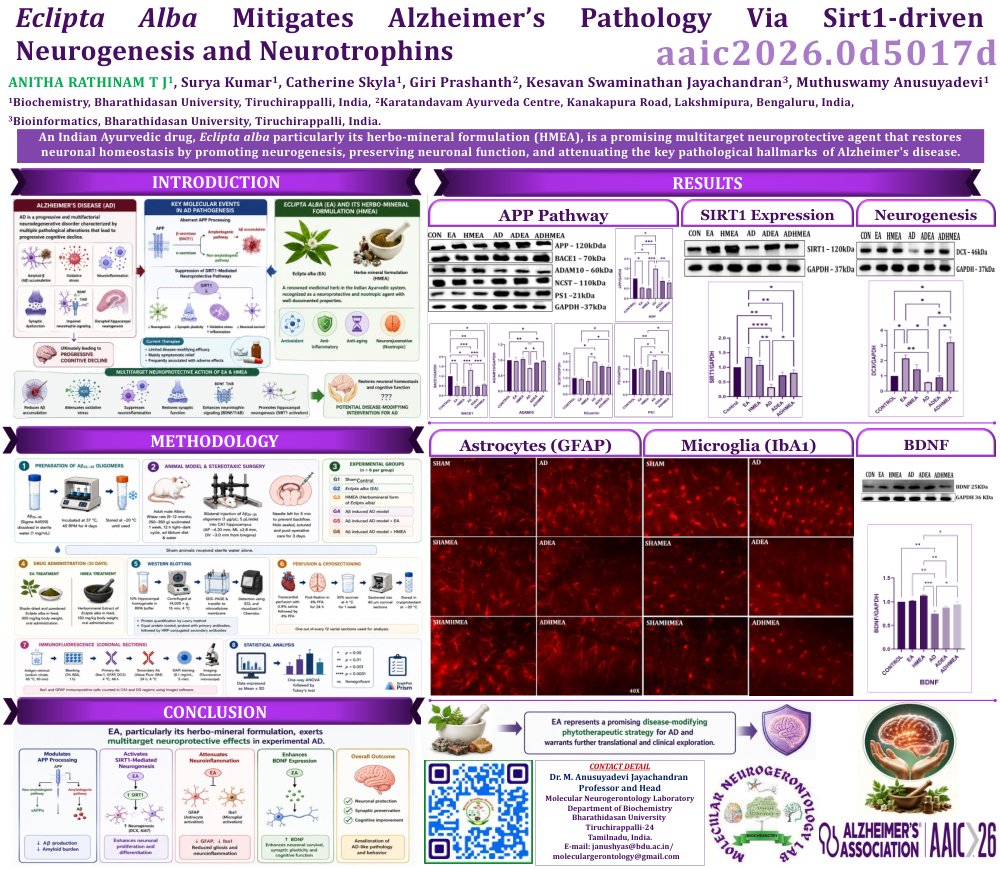
Alzheimer's disease (AD) is a progressive neurodegenerative disorder characterized by amyloid-β (Aβ) accumulation, impaired amyloid precursor protein (APP) processing, neuroinflammation, synaptic dysfunction, and defective adult hippocampal neurogenesis, ultimately leading to cognitive decline. Suppression of the Sirt1 signaling pathway is a key molecular event that contributes to reduced neuronal survival and impaired neurotrophic support in AD. The present study investigated the neuroprotective potential of Eclipta alba (EA) and its herbo-mineral formulation (HMEA) in an Aβ(25–35)-induced experimental rat model of Alzheimer's disease. Our results demonstrated that Aβ administration significantly disrupted APP processing by increasing the expression of APP and PS1 while suppressing the non-amyloidogenic processing proteins BACE1, ADAM10, and Nicastrin, indicating enhanced amyloidogenic pathology. Treatment with EA, particularly HMEA, effectively restored APP homeostasis by normalizing these molecular alterations. Furthermore, Aβ-induced AD markedly suppressed Sirt1 expression, which was significantly restored following EA and HMEA treatment, suggesting activation of endogenous neuroprotective signaling. Restoration of Sirt1 was accompanied by a significant increase in the expression of the neurogenesis marker doublecortin (DCX), indicating enhanced hippocampal neurogenesis. Immunofluorescence analysis further revealed that EA and HMEA markedly attenuated astrocytic and microglial activation, as evidenced by reduced GFAP and Iba1 immunoreactivity, demonstrating potent anti-neuroinflammatory activity. In addition, both treatments significantly enhanced the expression of brain-derived neurotrophic factor (BDNF), supporting improved neuronal survival, synaptic plasticity, and functional recovery.
Collectively, these findings demonstrate that Eclipta alba, particularly its herbo-mineral formulation (HMEA), exerts potent multitarget neuroprotective effects by restoring physiological APP processing, activating Sirt1-driven neurogenesis, suppressing neuroinflammation, and enhancing neurotrophin signaling. These coordinated molecular actions promote neuronal homeostasis and highlight HMEA as a promising disease-modifying phytotherapeutic strategy for Alzheimer's disease, warranting further translational and clinical investigation.
Comments
Email is required but is not shown publicly.
Loading comments...