4,068 posters, 219 videos, 101 topics, 69 sessions, 14,365 authors, 6,128 institutions
ePostersLive by SciGen Technologies S.A. All rights reserved.
Alzheimer's Association International Conference 2026
July 12-15, 2026 | London, United Kingdom, and Online

11009
Changing The Narrative: Outcomes From Pan-african Brain Health Advocacy And Reporting Training
Poster Presenter
Authors
Part of Topic
Changing The Narrative: Outcomes From Pan-african Brain Health Advocacy And Reporting Training:
Author Block: Wambui Karanja1, Lebohang Molete2, Ifeanyi Nsofor2, Kirsten Bobrow3.
1Brain and Mind Institute, Aga Khan University, Nairobi, Kenya, 23BCCDC, Vancouver, BC, Canada.
Abstract:
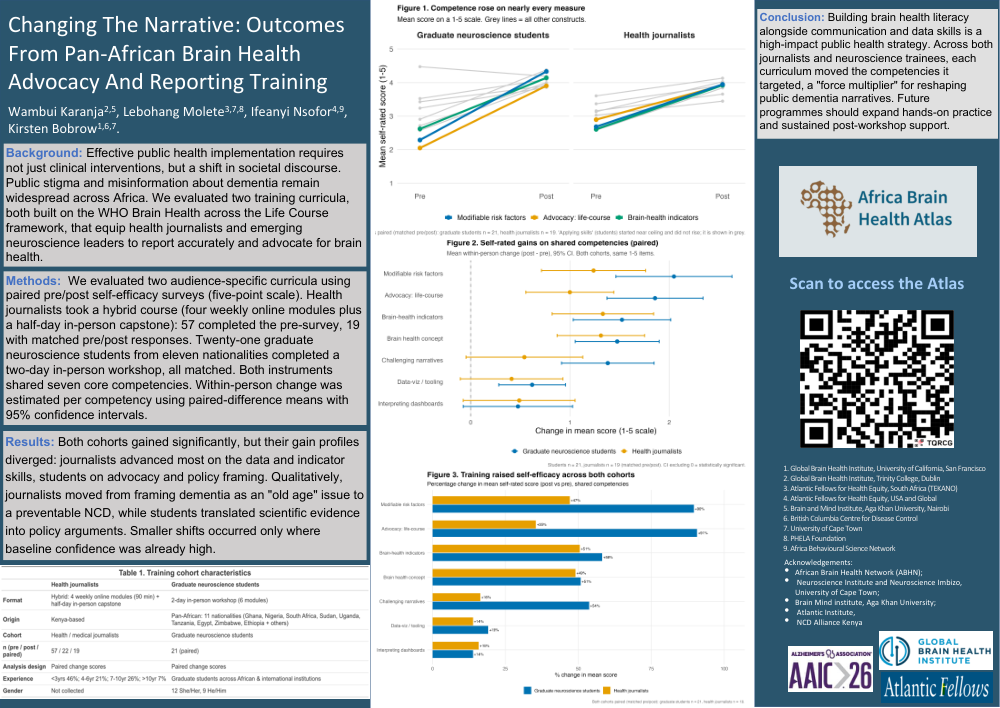
Background: Public stigma and misinformation regarding dementia remain pervasive in Africa, often driven by inaccurate media representation. Effective public health implementation requires not just clinical interventions, but a shift in societal discourse. We evaluated the impact of two targeted "Brain Health for Media" training curricula designed to equip African journalists and emerging neuroscience leaders with skills to report accurately on dementia science, leverage data visualization, and advocate for life-course brain health policies.
Methods: We delivered specialized training modules to two cohorts: 55 journalists in Kenya (virtual format) and 21 graduate neuroscience students in Cape Town (in-person format). The curricula covered dementia terminology, modifiable risk factors, and the interpretation of epidemiological data for storytelling. Outcomes were assessed using pre- and post-training surveys measuring knowledge accuracy, familiarity with brain health indicators, and self-efficacy in advocacy. Qualitative feedback was analyzed to identify barriers to effective reporting.
Results: The training yielded significant gains in advocacy capacity across both groups. Among Cape Town students, the most dramatic increase was a 90.7% gain in understanding strategies to advocate for a life-course approach to brain health . Th s group also reported an 89.6% increase in understanding modifiable risk factors for dementia . In the Kenya journalist cohort, the primary outcomes were a 66.5% increase in understanding risk factors and a 54.4% increase in familiarity with brain health indicators . Qualitative data revealed a critical distinction: while students successfully translated scientific expertise into policy frameworks, journalists bridged the gap between basic awareness and scientific literacy, moving from viewing dementia as an "old age" issue to understanding it as a preventable NCD . However, journalists identified virtual formatting as a barrier to mastering technical data skills, expressing strong preference for in-person engagement
Conclusion: Empowering communicators is a high-impact public health strategy. Our results demonstrate that targeted training can rapidly improve the quality of dementia advocacy and reporting in Africa, creating a "force multiplier" effect. To maximize impact, future programs should prioritize in-person technical training and sustained post-workshop support to foster a more informed and supportive public environment.
Comments
Email is required but is not shown publicly.
Loading comments...