4,068 posters, 219 videos, 101 topics, 69 sessions, 14,365 authors, 6,128 institutions
ePostersLive by SciGen Technologies S.A. All rights reserved.
Alzheimer's Association International Conference 2026
July 12-15, 2026 | London, United Kingdom, and Online

3918
Mapping The Egyptian Neuroexposome: Integrative Multiomics Of Genetic, Metabolic, And Environmental Dementia Risk.
Poster Presenter
Part of Topic
Mapping The Egyptian Neuroexposome: Integrative Multiomics Of Genetic, Metabolic, And Environmental Dementia Risk
Mai Othman¹, Mohamed Salama¹˒²˒³*
¹Institute of Global Health and Human Ecology (I-GHHE), The American University in Cairo, Cairo, Egypt ²Faculty of Medicine, Mansoura University, Mansoura, Egypt ³Global Brain Health Institute (GBHI), Trinity College Dublin, Dublin, Ireland
AAIC 2026 | aaic2026.83e0f40
Background & Rationale
- Dementia affects 57 million people globally, projected to reach 153 million by 2050, with the fastest growth in low- and middle-income countries (LMICs)
- Egypt — the most populous Arab nation — faces a rising dementia burden yet remains severely underrepresented in neuroepidemiology research; existing risk factor data derive almost entirely from high-income, Western populations
- The neuroexposome framework integrates internal susceptibility (genetics, metabolism) with external exposures (heavy metals, agrochemicals) to characterise Alzheimer's disease (AD) and AD-related dementia (ADRD) risk holistically
- Heavy metals (arsenic, lead, mercury) and trace elements (lithium) are plausible modifiable contributors to AD pathogenesis via oxidative stress, tau hyperphosphorylation, and amyloid processing — yet no blood metal biomonitoring study has been conducted in an Egyptian dementia cohort
- Metabolomics provides a biochemical fingerprint bridging environmental exposures and disease pathology, with potential to distinguish AD from vascular dementia (VaD) in resource-limited settings
- The Egyptian Dementia Network (EDN) — a multi-centre registry spanning six governorates — was established to enable population-representative dementia research in Egypt for the first time
Objectives
- Study 1: Characterise APOE ε2/ε3/ε4 allele and genotype frequencies in a multi-centre Egyptian AD cohort; assess associations with AD risk adjusted for age, sex, and geographical region; explore sex-specific interactions
- Study 2: Quantify blood arsenic, lead, mercury, and lithium by ICP-OES in AD patients vs. cognitively healthy controls; evaluate associations with AD diagnosis and MMSE cognitive scores using KM-imputed regression and binary detection sensitivity analyses
- Study 3: Characterise serum metabolomic profiles of clinically diagnosed AD and VaD patients vs. controls by untargeted LC-ESI-MS/MS; identify significantly altered metabolites, environmental contaminants, and enriched pathways; explore discriminatory metabolites between dementia subtypes
Methods
Study design: Cross-sectional, multi-centre observational study across 6 Egyptian governorates (Cairo, Mansoura, Beni Suef, Assiut, Aswan, Sohag) via the EDN registry | IRB-AUC #2024-2025-141
Clinical assessment: DSM-5 and ICD-10 diagnostic criteria; MMSE and MoCA for cognition; Katz ADL and Lawton-Brody IADL for function; full laboratory workup to exclude pseudodementia
Study 1 — APOE genotyping: Kompetitive Allele-Specific PCR (KASP) targeting rs429358 and rs7412; Firth's penalised logistic regression adjusted for age, sex, and geographical area; Benjamini-Hochberg FDR correction
Study 2 — Blood metals: ICP-OES (Thermo Scientific iCAP); validated nitric acid digestion; R² ≥ 0.99, spike recovery 80–120%, %RSD <10%; group-stratified Kaplan-Meier (KM) imputation as primary censored-data method; binary detection sensitivity analysis; all models adjusted for age and sex; BH-FDR correction
Study 3 — Metabolomics: Untargeted LC-ESI-MS/MS (ExionLC–SCIEX Triple Quad 5500+), positive and negative ionisation modes; MS-DIAL 4.92 peak detection (MassBank library, ≥80% score); PQN normalisation, log₁₀ transformation, Z-score scaling; GLM adjusted for age and sex; BH-FDR; ORA pathway enrichment via MetaboAnalyst 6.0 (KEGG human pathways)
Results
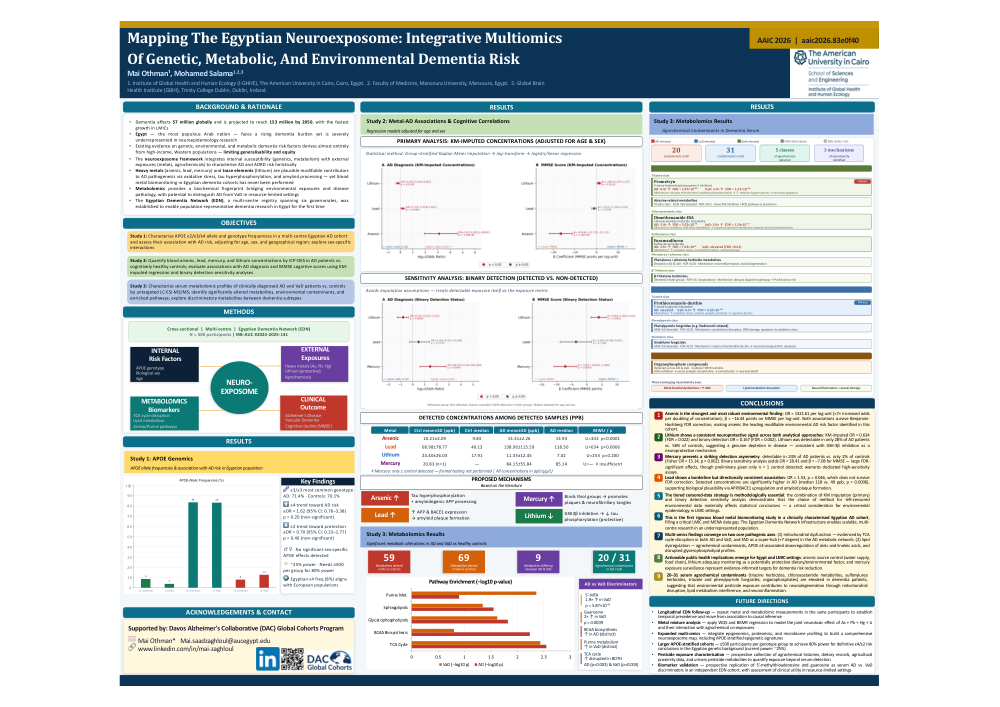
Study 1 — APOE Genomics (n = 264)
- ε3/ε3 is the most common genotype in both AD (71.4%) and controls (70.1%)
- ε4 shows a directional trend toward increased AD risk (aOR = 1.62, 95% CI: 0.76–3.38, p = 0.20) and ε2 toward protection (aOR = 0.70, 95% CI: 0.23–1.77, p = 0.46) — neither reaches significance after FDR correction
- No significant sex-specific APOE effects detected
- Egyptian ε4 allele frequency (8% in controls) aligns with European populations, lower than most African populations
- Post-hoc power: ~25%; ≥500 participants per group required for 80% power — findings are directional and hypothesis-generating
Study 2 — Blood Metal Signatures (n = 100; 50 AD, 50 controls)
Detection frequencies (Fisher's exact test):
- Arsenic: 100% AD vs. 98% controls (universal — binary analysis not applicable)
- Lead: 96% AD vs. 90% controls (OR = 2.64, p = 0.436)
- Lithium: 28% AD vs. 58% controls (OR = 0.285, p = 0.004 ✱) — significantly lower detection in AD
- Mercury: 24% AD vs. 2% controls (OR = 15.14, p = 0.002 ✱) — strikingly higher detection in AD
Primary analysis — KM-imputed concentrations (adjusted for age & sex):
| Metal | AD logistic | 95% CI | FDR | MMSE linear β | FDR |
|---|---|---|---|---|---|
| Arsenic | OR = 1321.61 | [83.50–38830.29] | 2.09×10⁻⁵ ✱✱ | β = −16.44 | 1.75×10⁻⁷ ✱✱ |
| Lithium | OR = 0.634 | [0.429–0.897] | 0.022 ✱✱ | β = +1.21 | 0.020 ✱✱ |
| Lead | OR = 1.53 | [1.03–2.40] | 0.062 ns | β = −1.01 | 0.094 ns |
| Mercury | Excluded — 98% controls below LOD | — | — | — | — |
Sensitivity analysis — binary detection (detected vs. non-detected):
- Lithium: OR = 0.167 [0.055–0.453], FDR = 0.002 ✱✱ | β = +3.96 [1.37–6.56], FDR = 0.007 ✱✱ — consistent with primary; strongest neuroprotective signal
- Mercury: OR = 28.41 [4.16–591.84], FDR = 0.008 ✱✱ | β = −7.08 [−10.84, −3.31], FDR = 0.001 ✱✱ — large FDR-significant effects; preliminary (n = 1 ctrl detected)
- Lead: OR = 3.16 [0.56–25.45], FDR = 0.218 ns — no significant binary association
Detected concentrations (median ppb among detected samples):
- Arsenic: AD 13.93 vs. Ctrl 9.83 (MWU p < 0.0001)
- Lead: AD 118.30 vs. Ctrl 49.13 (MWU p = 0.0006)
- Lithium: AD 7.02 vs. Ctrl 17.91 (MWU p = 0.200)
- Mercury: AD 85.14 vs. Ctrl 20.83 (n = 1 ctrl; formal testing not performed)
Study 3 — Metabolomic Profiling (n = 237; AD n=61, VaD n=76, controls n=100)
Significantly altered metabolites:
- 59 metabolites altered in AD vs. controls (including 20 agrochemical contaminants)
- 69 metabolites altered in VaD vs. controls (including 31 agrochemical contaminants)
- 9 metabolites significantly differ between AD and VaD
Top altered metabolites by fold-change (AD vs. controls):
- DL-2-Hydroxyvaleric acid: 4.5× ↑ (FDR = 1.99×10⁻²⁴)
- Prometryn (triazine herbicide): 4.4× ↑ (FDR = 1.07×10⁻²⁴)
- L-Norvaline: 4.0× ↑ (FDR = 9.19×10⁻¹⁹)
- Biotin: 3.6× ↑ (FDR = 5.25×10⁻¹⁶)
- Dimethenamide ESA (chloroacetamide metabolite): 3.4× ↑ (FDR = 3.02×10⁻¹³)
- L-Ornithine: 0.40× ↓ (FDR = 2.79×10⁻⁷)
Pathway enrichment (ORA — KEGG):
- TCA cycle: SHARED — AD (p = 0.0028) and VaD (p = 0.0036)
- BCAA biosynthesis: AD-specific (p = 0.0057)
- Butanoate metabolism: AD-specific (p = 0.0199)
- Purine metabolism: VaD-specific (p = 0.0044)
- Vitamin B6 metabolism: VaD-specific (p = 0.0085)
AD vs. VaD discriminatory metabolites:
- 5'-Methylthioadenosine (MTA): 1.9× higher in VaD (FDR = 5.87×10⁻⁸)
- Guanosine: 2.0× higher in VaD (FDR = 0.0009)
- cCMP: elevated in VaD (FDR = 0.0007)
- Biotin: higher in AD (FDR = 5.50×10⁻⁵)
Agrochemical contaminants detected in dementia serum:
- Triazine herbicides (Prometryn) — mitochondrial disruption, ↑ ROS
- Chloroacetamide metabolites (Dimethenamide ESA) — lipid metabolism interference
- Sulfonylurea herbicides (Foramsulfuron) — oxidative stress, neuroinflammation
- Triazole fungicide metabolites (Prothioconazole-desthio) — synaptic plasticity impairment
- Strobilurin fungicides — mitochondrial energy deficit
- Organophosphates — AChE inhibition, excitotoxicity
Conclusions
-
Arsenic is the strongest and most robust finding — OR = 1321.61 per log-unit (≈7× per doubling); β = −16.44 for MMSE — both FDR-significant. The most critical modifiable environmental AD risk factor identified in this cohort.
-
Lithium shows a consistent neuroprotective signal across both analytical approaches — KM OR = 0.634 (FDR = 0.022) and binary OR = 0.167 (FDR = 0.002) — with significantly lower detection in AD patients (28% vs. 58%).
-
Mercury is detectable in 24% of AD vs. only 2% of controls (Fisher OR = 15.14, p = 0.002); binary sensitivity yields OR = 28.41 and β = −7.08 for MMSE — large FDR-significant effects that are preliminary given n = 1 control detected.
-
Lead shows a borderline association (OR = 1.53, p = 0.046) not surviving FDR; significantly higher concentrations in AD (median 118 vs. 49 ppb, p = 0.0006). Warrants replication in larger cohorts.
-
The tiered censored-data strategy — KM imputation plus binary detection sensitivity analysis — is methodologically essential; the choice of method materially affects conclusions in environmental epidemiology.
-
First rigorous blood metal biomonitoring study in a clinically characterised Egyptian AD cohort — fills a critical LMIC and MENA data gap in dementia environmental risk research.
-
Multi-omics findings converge on two core pathogenic axes — mitochondrial dysfunction (TCA cycle disruption, FAD network super-hub) and lipid dysregulation (agrochemical contaminants, APOE ε4-associated fatty acid downregulation) — shared across AD and VaD.
-
Actionable public health implications: arsenic source control (water, food chain), lithium adequacy monitoring, and mercury exposure surveillance are evidence-informed modifiable targets for dementia risk reduction in Egypt and LMIC settings.
Future Directions
- Longitudinal EDN follow-up — repeat metal and metabolomic measurements in the same participants to establish temporal precedence and move from association to causal inference
- Metal mixture analysis — WQS and BKMR regression to model the joint neurotoxic effect of As + Pb + Hg + Li and their interaction with agrochemical co-exposures
- Expanded multi-omics — integrate epigenomics, proteomics, and microbiome profiling to build a comprehensive neuroexposome map, including APOE-stratified epigenetic signatures
- Intervention studies — RCTs targeting arsenic mitigation (water filtration, dietary modification) and lithium supplementation in MCI patients with low baseline lithium levels
- Larger APOE-stratified cohorts — ≥500 participants per genotype group to achieve 80% power for definitive ε4/ε2 conclusions in the Egyptian genetic background (current power: ~25%)
- Pesticide exposure characterisation — prospective collection of agrochemical histories, dietary records, agricultural proximity data, and urinary pesticide metabolites to move from serum detection to quantified exposure assessment
- Biomarker validation — prospective replication of 5'-MTA and guanosine as serum AD vs. VaD discriminators in an independent EDN cohort, with assessment of clinical utility in resource-limited diagnostic pathways
Acknowledgements & Funding
This project is supported by the Davos Alzheimer's Collaborative (DAC) Global Cohorts Program
✉ Mai Othman* | Mai.saadzaghloul@aucegypt.edu �� linkedin.com/in/mai-zaghloul
Comments
Email is required but is not shown publicly.
Loading comments...