4,068 posters, 219 videos, 101 topics, 69 sessions, 14,365 authors, 6,128 institutions
ePostersLive by SciGen Technologies S.A. All rights reserved.
Alzheimer's Association International Conference 2026
July 12-15, 2026 | London, United Kingdom, and Online

2707
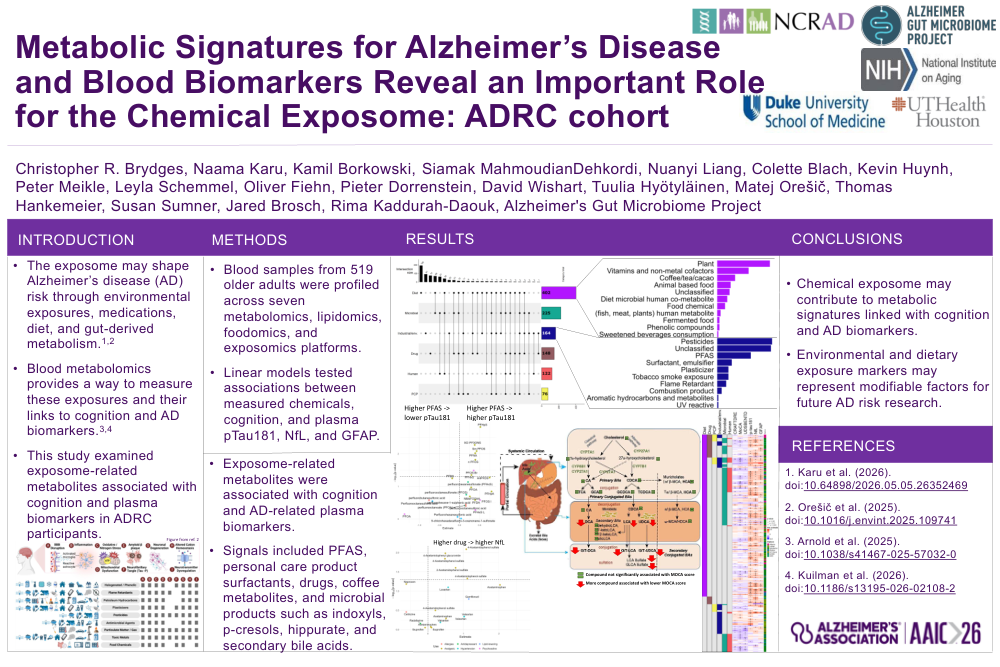
Metabolic Signatures For Alzheimer’s Disease And Blood Biomarkers Reveal An Important Role For The Chemical Exposome
Poster Presenter
Authors
Christopher Brydges, Naama Karu, Kamil Borkowski, Siamak MahmoudianDehkordi, Nuanyi Liang, Colette Blach, Kevin Huynh, Peter Miekle, Leyla Schemmel, Oliver Fiehn, Pieter Dorrenstein, David Wishart, Tuulia Hyötyläinen, Matej Orešič, Thomas Hankemeier, Susan Sumner, Jared Brosch, Rima Kaddurah-Daouk, Alzheimer's Gut Microbiome Project
Affiliations
Part of Topic
Metabolic Signatures for Alzheimer’s Disease and Blood Biomarkers Reveal an Important Role for the Chemical Exposome: ADRC cohort
Christopher R. Brydges, Naama Karu, Kamil Borkowski, Siamak MahmoudianDehkordi, Nuanyi Liang, Colette Blach, Kevin Huynh, Peter Meikle, Leyla Schemmel, Oliver Fiehn, Pieter Dorrenstein, David Wishart, Tuulia Hyötyläinen, Matej Orešič, Thomas Hankemeier, Susan Sumner, Jared Brosch, Rima Kaddurah-Daouk, Alzheimer's Gut Microbiome Project
INTRODUCTION
1. Karu et al. (2026). doi:10.64898/2026.05.05.26352469
2. Orešič et al. (2025). doi:10.1016/j.envint.2025.109741
3. Arnold et al. (2025). doi:10.1038/s41467-025-57032-0
4. Kuilman et al. (2026). doi:10.1186/s13195-026-02108-2
Comments
Email is required but is not shown publicly.
Loading comments...