4,068 posters, 219 videos, 101 topics, 69 sessions, 14,365 authors, 6,128 institutions
ePostersLive by SciGen Technologies S.A. All rights reserved.
Alzheimer's Association International Conference 2026
July 12-15, 2026 | London, United Kingdom, and Online

2924
24h-movement Behaviors Composition And Alzheimer’S Disease Brain Signatures And Cognition In Cognitively Unimpaired Older Adults
Poster Presenter
Authors
Beatriz Fernandez Gαmez, Patricio Solis-Urra, Javier Sanchez-Martinez, Alessandro Sclafani, Marcos Olvera-Rojas, María Teresa Rodríguez Palacios, Maddison L. Mellow, Dorothea Dumuid, Ashleigh E. Smith, Francisco B. Ortega, Irene Esteban-Cornejo
Affiliations
Department of Physical Education and Sports, Faculty of Sport Sciences, Sport and Health University Research Institute (iMUDS), University of Granada, Granada, Spain., Alliance for Research in Exercise, Nutrition and Activity, Allied Health and Human Performance, College of Health, Adelaide University, Adelaide, SA, Australia.
Part of Topic
24h-movement behaviors and Alzheimer’s disease brain signatures and cognition in cognitively unimpaired older adultsç
BACKGROUND: 24-hour movement behaviors (more physical activity [PA], less sedentary behavior [SB] and sufficient sleep) have been linked to brain health in older adults, but findings remain inconsistent. Understanding the moderating role of individual differences in Alzheimer’s disease (AD) brain signatures may help inform strategies to preserve cognitive function in aging populations.
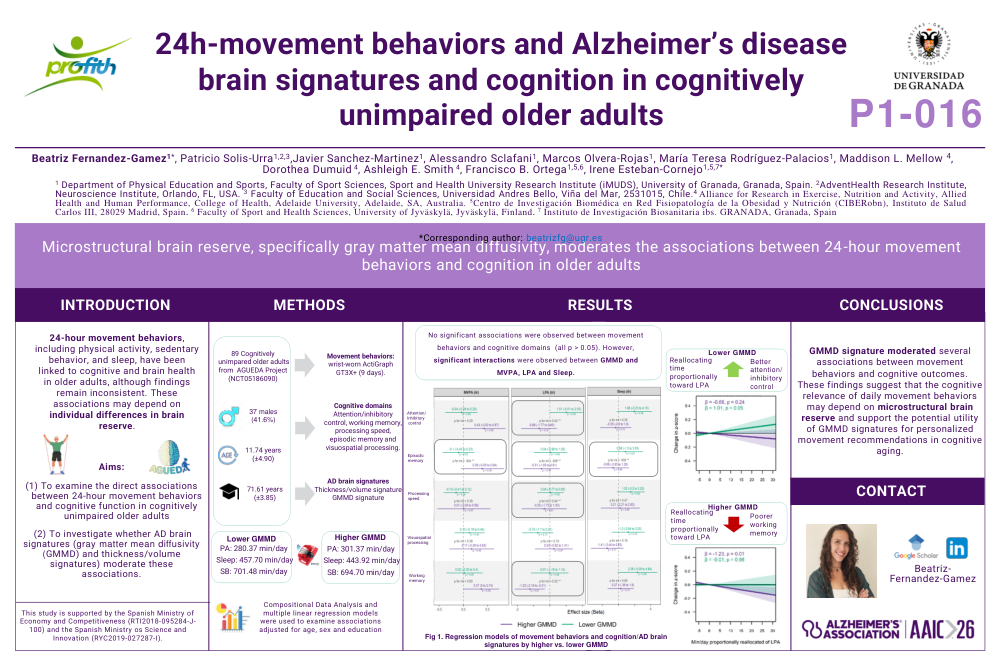
METHODS: A cross-sectional analysis was conducted within the AGUEDA trial (NCT05186090), including 89 cognitively unimpaired older adults (mean age = 71.61 ± 3.85 years; 41.6% males). 24-hour movement behaviors (moderate-to-vigorous PA [MVPA], light PA [LPA], SB and sleep) were objectively assessed using 9-day wrist-worn accelerometry. Cognitive function was assessed across several domains including attention/inhibitory control, episodic memory, processing speed, visuospatial processing and working memory. Thickness/volume and GMMD signatures were derived from cortical and hippocampal regions. Compositional linear regression was used to examine associations, adjusting for age, sex and education, with interactions between movement behaviors and AD brain signatures.
RESULTS: No associations were observed between 24-h movement behaviors and cognitive domains or AD brain signatures (all p > 0.05). However, GMMD signature was a moderator (p < 0.05). Among individuals with lower GMMD signature (indicating preserved microstructural integrity), more LPA was positively associated with attentional/inhibitory control, more SB was negatively associated with attentional/inhibitory control and working memory (βrange: −2.92 to 1.06), and more sleep was positively associated with working memory (β = 2.38). Among individuals with higher GMMD signature (greater microstructural brain disruption), greater MVPA was positively associated, while greater LPA was negatively associated with working memory, (β range: −1.21 to 0.389).
CONCLUSION Cognitive benefits of daily movement are not uniform but vary according to microstructural brain integrity, as indexed by the GMMD signature. Individuals with higher GMMD signature, greater microstructural brain disruption, appeared to benefit more from greater engagement in MVPA, whereas those with lower GMMD signature from balanced activity patterns with higher LPA, less SB, and more sleep duration. Clinically, GMMD signature may help inform personalized movement recommendations to support cognitive aging.
Comments
Email is required but is not shown publicly.
Loading comments...