4,068 posters, 219 videos, 101 topics, 69 sessions, 14,365 authors, 6,128 institutions
ePostersLive by SciGen Technologies S.A. All rights reserved.
Alzheimer's Association International Conference 2026
July 12-15, 2026 | London, United Kingdom, and Online

4623
When The Caregiver Needs Care: Identifying At-risk Profiles Of Vulnerability Through Archetypal Analysis
Poster Presenter
Authors
Martina Barbi, Isotta Trescato, Claudio Singh Solorzano, Giovanni Battista Tura, Giuliano Binetti, Massimo Marianetti, Orazio Zanetti, Michela Pievani, Cristina Festari
Affiliations
IRCCS Istituto Centro San Giovanni di Dio Fatebenefratelli, Brescia, Italy, Department of Neuroscience and the Experimental Alzheimer Center, Fatebenefratelli Roman Province, Rome, Italy
Part of Topic
INTRODUCTION:Informal caregivers are essential to dementia care, yet widely implementable strategies to support their psychological wellbeing remain limited.
Aim: To identify profiles of psychological vulnerability among informal dementia caregivers, informing early, targeted, and scalable prevention strategies in contexts where effective psychosocial and behavioral interventions may be constrained by limited resources.
METHODS:
• Cross-sectional monocentric study (IRCCS Istituto Centro San Giovanni di Dio Fatebenefratelli, Brescia, Italy);
• Data collection: June 2023 –December 2024;
• Anonymous self-reported questionnaire.
DATA ANALYSIS:
• Archetypal Analysis
• Wilcoxon rank-sum tests for pairwise distress
comparisons
RESULTS 1: Demographic characteristics
N = 474
Female: 73%
50-59 years: 38%; >= 70: 26%
Adult child: 65%; spouse: 28%
Cohabiting: 42%
Time of caregiving: 1-3 years: 43%
Hours/week caregiving: >80: 35%; 9-24: 28%
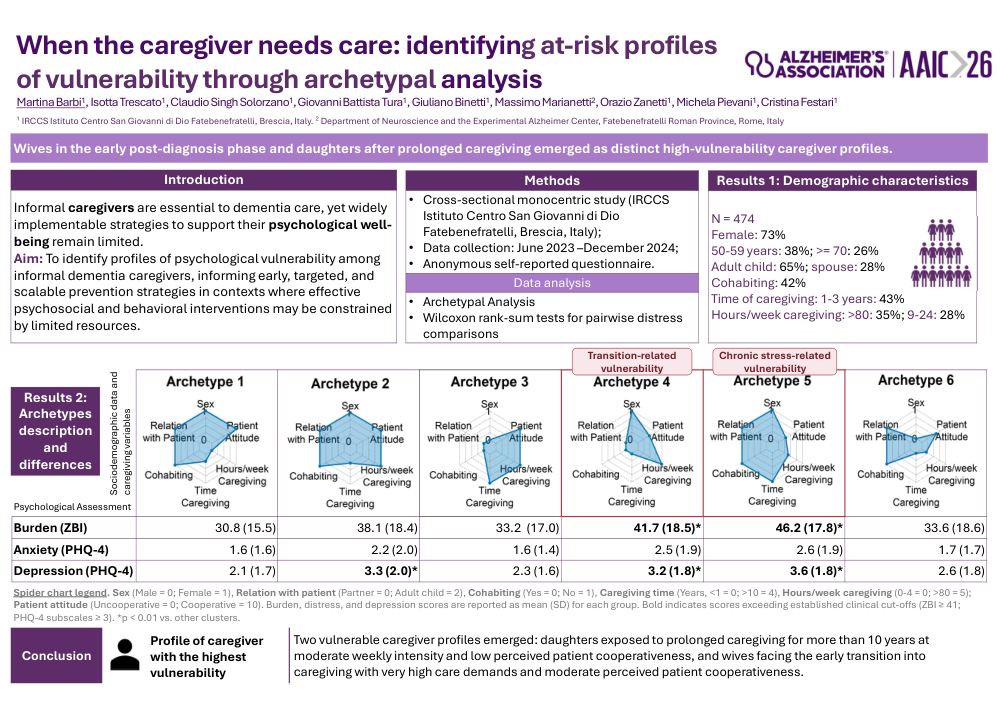
Results 2: Archetypes description and differences
Conclusion: Two vulnerable caregiver profiles emerged: daughters exposed to prolonged caregiving for more than 10 years at moderate weekly intensity and low perceived patient cooperativeness, and wives facing the early transition into caregiving with very high care demands and moderate perceived patient cooperativeness.
Take home messange: Wives in the early post-diagnosis phase and daughters after prolonged caregiving emerged as distinct high-vulnerability caregiver profiles.
Comments
Email is required but is not shown publicly.
Loading comments...