4,068 posters, 219 videos, 101 topics, 69 sessions, 14,365 authors, 6,128 institutions
ePostersLive by SciGen Technologies S.A. All rights reserved.
Alzheimer's Association International Conference 2026
July 12-15, 2026 | London, United Kingdom, and Online

1576
Rethinking Inclusion In Dementia Research Beyond Western Paradigms
Poster Presenter
Authors
Joyce Siette, Wei Liu, Van Tran, Myles Everman, Zandra Palomino Gonzalez, Laura Dodds, Diana Karamacoska, Genevieve Steiner-Lim, Freya MacMillan, Danielle Ni Chroinin, Kaarin Jane Anstey, Breanna Wright, Kay Deckers, Lee-Fay Low
Affiliations
Maastricht University, the Netherlands, Western Sydney University, Westmead, Australia, Liverpool Hospital, Liverpool, Australia, University of New South Wales, Sydney, Australia, Monash University, Melbourne, Australia, University of Sydney, Sydney, Australia
Part of Topic
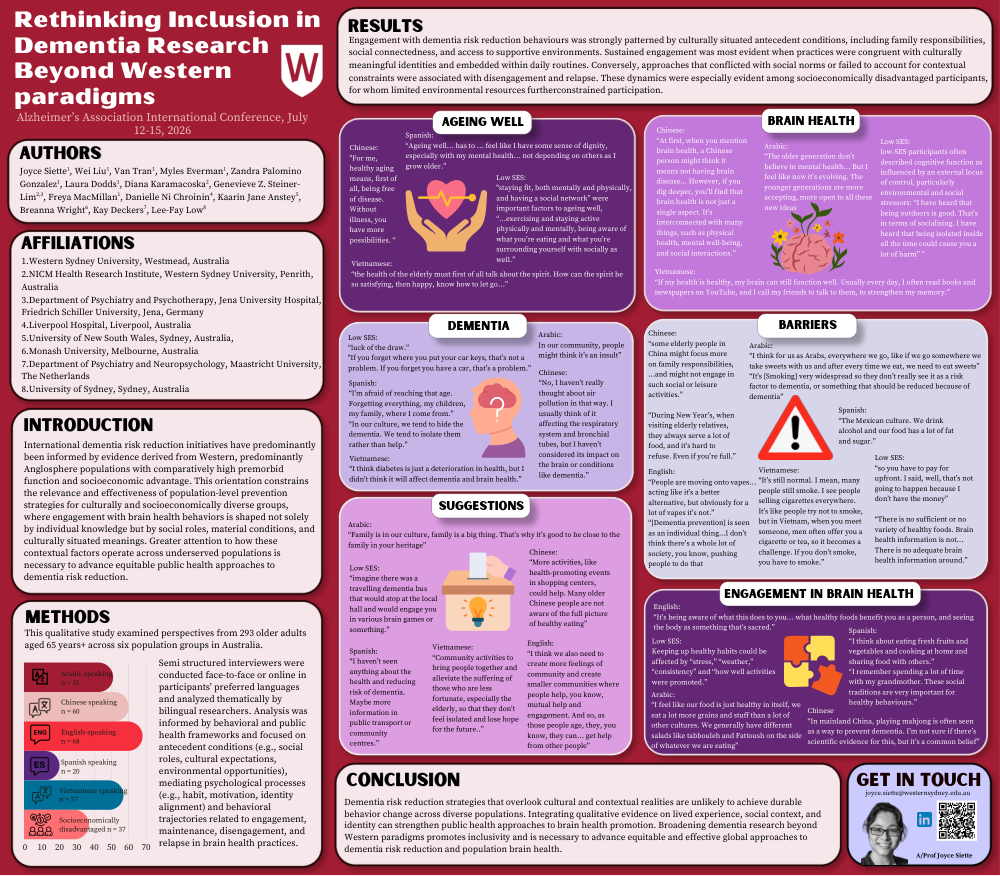
International dementia risk reduction initiatives have predominantly been informed by evidence derived from Western, predominantly Anglosphere populations with comparatively high premorbid function and socioeconomic advantage. This orientation constrains the relevance and effectiveness of population-level prevention strategies for culturally and socioeconomically diverse groups, where engagement with brain health behaviors is shaped not solely by individual knowledge but by social roles, material conditions, and culturally situated meanings. Greater attention to how these contextual factors operate across underserved populations is necessary to advance equitable public health approaches to dementia risk reduction.
This qualitative study examined perspectives from 293 older adults aged 65 years+ across six population groups in Australia. Semi-structured interviewers were conducted face-to-face or online in participants’ preferred languages and analyzed thematically by bilingual researchers. Analysis was informed by behavioral and public health frameworks and focused on antecedent conditions (e.g., social roles, cultural expectations, environmental opportunities), mediating psychological processes (e.g., habit, motivation, identity alignment) and behavioral trajectories related to engagement, maintenance, disengagement, and relapse in brain health practices.
Engagement with dementia risk reduction behaviours was strongly patterned by culturally situated antecedent conditions, including family responsibilities, social connectedness, and access to supportive environments. Sustained engagement was most evident when practices were congruent with culturally meaningful identities and embedded within daily routines. Conversely, approaches that conflicted with social norms or failed to account for contextual constraints were associated with disengagement and relapse. These dynamics were especially evident among socioeconomically disadvantaged participants, for whom limited environmental resources furtherconstrained participation.
Dementia risk reduction strategies that overlook cultural and contextual realities are unlikely to achieve durable behavior change across diverse populations. Integrating qualitative evidence on lived experience, social context, and identity can strengthen public health approaches to brain health promotion. Broadening dementia research beyond Western paradigms promotes inclusivity and is necessary to advance equitable and effective global approaches to dementia risk reduction and population brain health.
Comments
Email is required but is not shown publicly.
Loading comments...