4,068 posters, 219 videos, 101 topics, 69 sessions, 14,365 authors, 6,128 institutions
ePostersLive by SciGen Technologies S.A. All rights reserved.
Alzheimer's Association International Conference 2026
July 12-15, 2026 | London, United Kingdom, and Online

4070
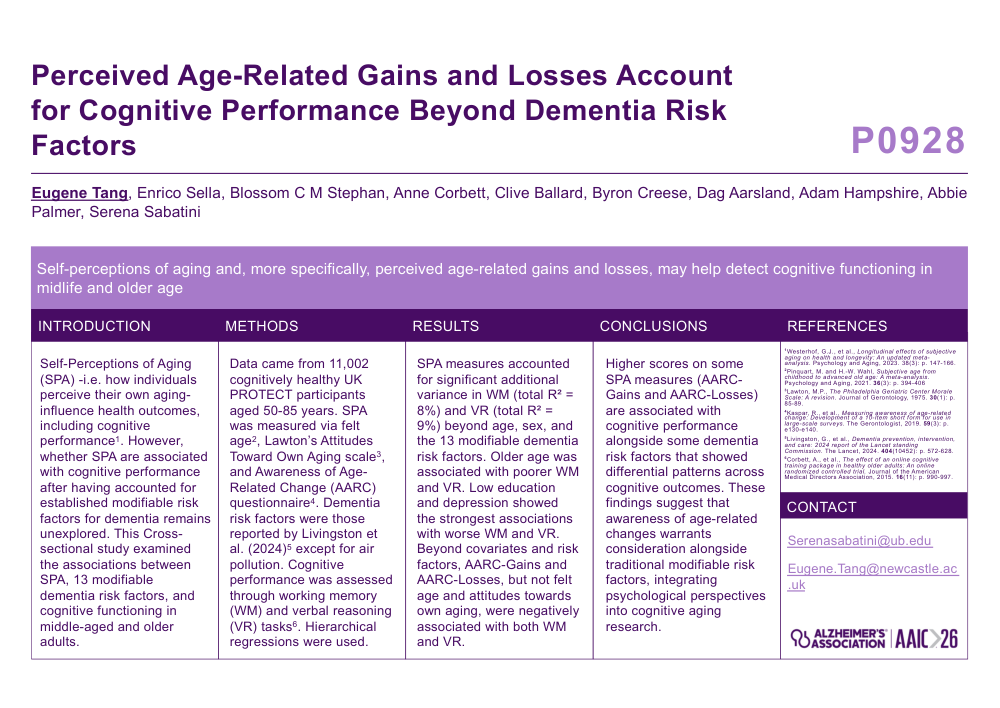
Perceived Age-related Gains And Losses Account For Cognitive Performance Beyond Dementia Risk Factors
Poster Presenter
Authors
Eugene Tang, Enrico Sella, Blossom Stephan, Anne Corbett, Clive Ballard, Byron Creese, Dag Aarsland, Adam Hampshire, Abbie Palmer, Serena Sabatini
Affiliations
Part of Topic
INTRODUCTION
Self-Perceptions of Aging (SPA) -i.e. how individuals perceive their own aging- influence health outcomes, including cognitive performance1. However, whether SPA are associated with cognitive performance after having accounted for established modifiable risk factors for dementia remains unexplored. This Cross-sectional study examined the associations between SPA, 13 modifiable dementia risk factors, and cognitive functioning in middle-aged and older adults.
METHODS
Data came from 11,002 cognitively healthy UK PROTECT participants aged 50-85 years. SPA was measured via felt age2, Lawton’s Attitudes Toward Own Aging scale3, and Awareness of Age-Related Change (AARC) questionnaire4. Dementia risk factors were those reported by Livingston et al. (2024)5 except for air pollution. Cognitive performance was assessed through working memory (WM) and verbal reasoning (VR) tasks6. Hierarchical regressions were used.
RESULTS
SPA measures accounted for significant additional variance in WM (total R² = 8%) and VR (total R² = 9%) beyond age, sex, and the 13 modifiable dementia risk factors. Older age was associated with poorer WM and VR. Low education and depression showed the strongest associations with worse WM and VR. Beyond covariates and risk factors, AARC-Gains and AARC-Losses, but not felt age and attitudes towards own aging, were negatively associated with both WM and VR.
CONCLUSIONS
Higher scores on some SPA measures (AARC-Gains and AARC-Losses) are associated with cognitive performance alongside some dementia risk factors that showed differential patterns across cognitive outcomes. These findings suggest that awareness of age-related changes warrants consideration alongside traditional modifiable risk factors, integrating psychological perspectives into cognitive aging research.
Comments
Email is required but is not shown publicly.
Loading comments...