4,068 posters, 219 videos, 101 topics, 69 sessions, 14,365 authors, 6,128 institutions
ePostersLive by SciGen Technologies S.A. All rights reserved.
Alzheimer's Association International Conference 2026
July 12-15, 2026 | London, United Kingdom, and Online

4176
The Prevalence Of Modifiable Risk Factors For Dementia In Older Adults In Northern Tanzania. The Akili Mali (Brain Wealth) Study
Poster Presenter
Authors
Charles Nye, Aloyce Kisoli, Grace Saria Anderson, Malwina Niechcial, Sabas Rite, Aurelia Malya, Sabinus Mtenga, Hadija Ulomi, Edward Mbowe, Damas Mlaki, Judith Boshe, Ssenku Safic, Hannah Humble, Connor Healy, Sunkanmi Folorunsho, Lachlan Fotheringham, Raj Kalaria, Louise Robinson, Bernard Mbwele, Richard Walker, Stella-Maria Paddick
Affiliations
Kilimanjaro Clinical Research Institute, Moshi, Tanzania, University of Dar es Salaam-Mbeya College of Health Sciences, Mbeya, Tanzania, University of Bristol, Bristol, UK, Anderson Memorial Rehabilitation and Care Organisation (AMRCO), Tanzania, Newcastle University, Newcastle upon Tyne, UK, Akili Mali Community Advisory Board, Kilimanjaro, Tanzania, Mirembe National Psychiatric Hospital, Dodoma, Tanzania, Fight Dementia and Care Organisation, Tanzania, University of Nebraska-Lincoln, USA, Cumbria, Northumberland, Tyne and Wear NHS Foundation Trust, Newcastle upon Tyne, UK, Cumbria, Northumberland, Tyne and Wear NHS Foundation Trust, Newcastle upon Tyne, UK and Newcastle University, Newcastle upon Tyne, UK, Newcastle University, Newcastle upon Tyne, UK and Gateshead Health NHS Foundation Trust, Gateshead, UK
Part of Topic
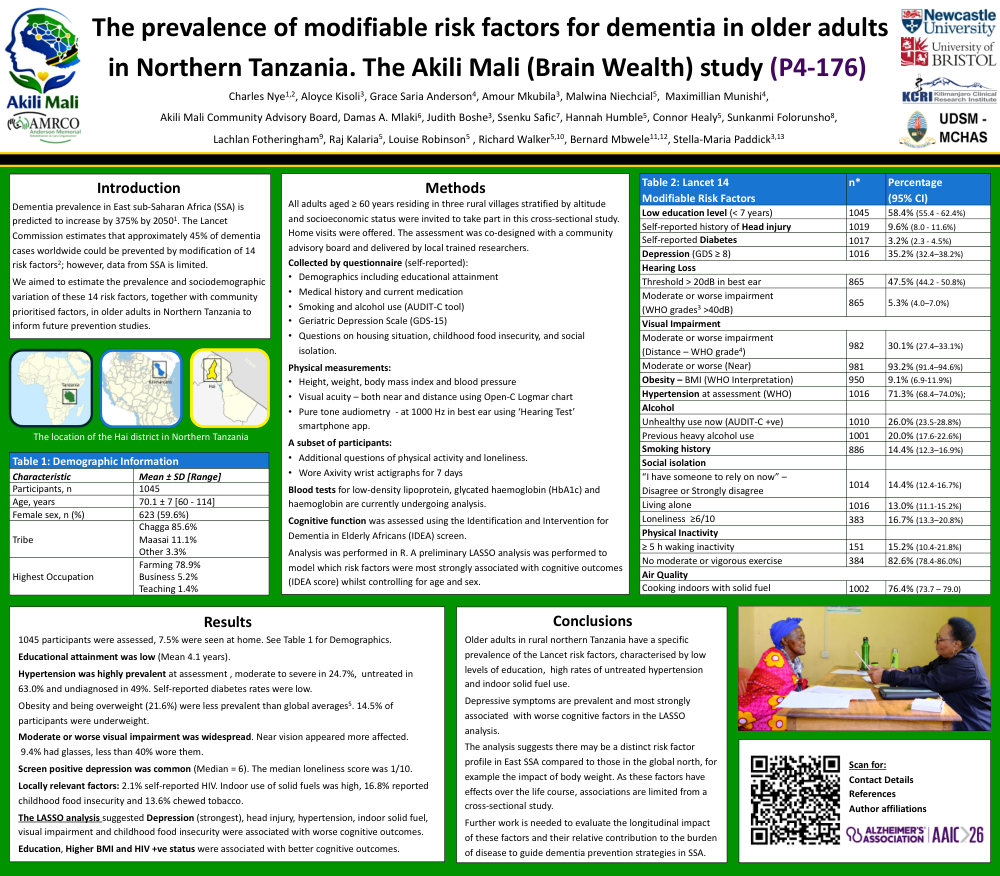
Introduction: Dementia prevalence in East sub-Saharan Africa (SSA) is predicted to increase by 375% by 20501. The Lancet Commission estimates that approximately 45% of dementia cases worldwide could be prevented by modification of 14 risk factors2; however, data from SSA is limited.
We aimed to estimate the prevalence and sociodemographic variation of these 14 risk factors, together with community prioritised factors, in older adults in Northern Tanzania to inform future prevention studies.
Methods: All adults aged ≥ 60 years residing in three rural villages stratified by altitude and socioeconomic status were invited to take part in this cross-sectional study. Home visits were offered. The assessment was co-designed with a community advisory board and delivered by local trained researchers.
Collected by questionnaire (self-reported):
Physical measurements:
A subset of participants:
Blood tests for low-density lipoprotein, glycated haemoglobin (HbA1c) and haemoglobin are currently undergoing analysis.
Cognitive function was assessed using the Identification and Intervention for Dementia in Elderly Africans (IDEA) screen.
Analysis was performed in R. A preliminary LASSO analysis was performed to model which risk factors were most strongly associated with cognitive outcomes
(IDEA score) whilst controlling for age and sex.
Results:
1045 participants were assessed, 7.5% were seen at home. See Table 1 for Demographics.
Educational attainment was low (Mean 4.1 years). Hypertension was highly prevalent at assessment , moderate to severe in 24.7%, untreated in 63.0% and undiagnosed in 49%. Self-reported diabetes rates were low. Obesity and being overweight (21.6%) were less prevalent than global averages5. 14.5% of participants were underweight. Moderate or worse visual impairment was widespread. Near vision appeared more affected. 9.4% had glasses, less than 40% wore them. Screen positive depression was common (Median = 6). The median loneliness score was 1/10.
Locally relevant factors: 2.1% self-reported HIV. Indoor use of solid fuels was high, 16.8% reported childhood food insecurity and 13.6% chewed tobacco.
The LASSO analysis suggested Depression (strongest), head injury, hypertension, indoor solid fuel, visual impairment and childhood food insecurity were associated with worse cognitive outcomes. Education, Higher BMI and HIV +ve status were associated with better cognitive outcomes.
Conclusions: Older adults in rural northern Tanzania have a specific prevalence of the Lancet risk factors, characterised by low levels of education, high rates of untreated hypertension and indoor solid fuel use.
Depressive symptoms are prevalent and most strongly associated with worse cognitive factors in the LASSO analysis.
The analysis suggests there may be a distinct risk factor profile in East SSA compared to those in the global north, for example the impact of body weight. As these factors have effects over the life course, associations are limited from a cross-sectional study.
Further work is needed to evaluate the longitudinal impact of these factors and their relative contribution to the burden of disease to guide dementia prevention strategies in SSA.
Comments
Email is required but is not shown publicly.
Loading comments...