4,068 posters, 219 videos, 101 topics, 69 sessions, 14,365 authors, 6,128 institutions
ePostersLive by SciGen Technologies S.A. All rights reserved.
Alzheimer's Association International Conference 2026
July 12-15, 2026 | London, United Kingdom, and Online

509
Dementia Knowledge, Attitudes And Practices Among Non-physician Primary Healthcare Providers In Southeast Nigeria
Poster Presenter
Authors
Laz Ude Eze, Dominic Trepel, Chigozie Jesse Uneke, Obiora Okoye, Chi Udeh-Momoh, Elizabeth Finbarrs-Bello, Rufus Akinyemi, Chukwuanugo Ogbuagu, Oladimeji Olanrewaju, Amanuel Yigezu, Ada Akwari, Donald Egwu, Chikodili Mbah, Eboreime Ejemai
Affiliations
, Aga Khan University, Nairobi, Kenya, University of Ibadan, Sub-Saharan Africa Brain Health Initiative (SSABHI), Trinity College Dublin, David Umahi Federal University of Health Sciences, Uburu, Ebonyi State, Nnamdi Azikiwe University, Awka, Sefako Magkatho University of Health Sciences, Pretoria, South Africa, Dalhousie University, Halifax, NS, Canada.
Part of Topic
Abstract
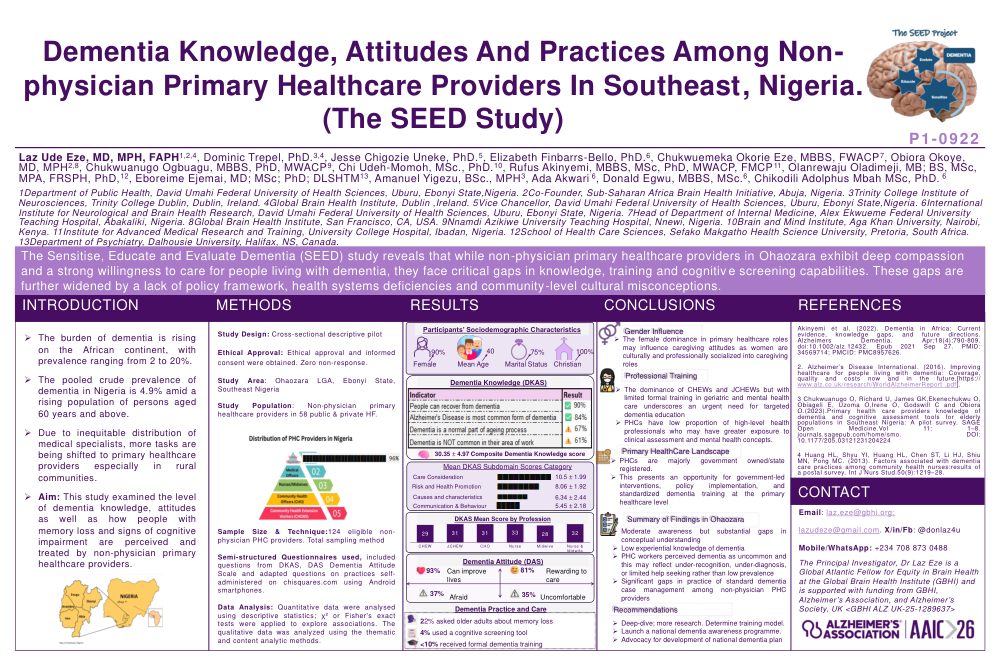
Background: The burden of dementia is rising on the African continent, with prevalence ranging from 2 to 20%. The pooled crude prevalence of dementia in Nigeria is 4.9% amid a rising population of persons aged 60 years and above. Due to inequitable distribution of medical specialists, more tasks are being shifted to primary healthcare providers especially in rural communities. This study aims to examine the level of dementia knowledge, attitudes as well as diagnostic and care practices among non-physician primary healthcare providers.
Methods: This is a pilot cross-sectional descriptive study with total sampling of all the 124 eligible non-physician primary healthcare providers from 58 health facilities in Ohaozara Local Government Area of Ebonyi State, Southeast Nigeria. Self-administered questionnaires based the Dementia Knowledge Assessment Scale, Dementia Attitude Scale and adapted questions on practices were filled out on chisquares.com using Android smartphones. Quantitative data were analysed using descriptive statistics; χ² or Fisher's exact tests were applied to explore associations. Ethical approval and informed consent were obtained.
Results: The mean DKAS score was 30.35 (SD=4.97). The subscale analysis showed that care consideration had the highest mean score 10.5 (SD=1.99) while the lowest was communications and behaviour with a mean score 5.45 (SD=2.18). 88.7% of participants agreed that it is rewarding to work with people who have ADRD, 33.9% agreed that they were afraid of people with ADRD while 49.2% agreed that they feel frustrated because they do not know how to help them. 11.3% reported that they can confidently identify early signs of dementia but only 4% reported knowing how to use any cognitive screening tool. 81.5% had no formal training in dementia diagnosis and care, and 84.7% reported non-existence of dementia screening procedures in their health facilities. The only variable significantly associated with knowledge was marital status (p = 0.044).
Conclusion: The level of knowledge among the primary healthcare providers is above average. However, many gaps were observed on the dementia-related attitudes and practices. Further qualitative studies may be conducted to explore means of addressing the identified gaps, to enhance cognitive screening, dementia diagnosis and care.
Keywords: dementia, primary care, knowledge, attitudes, practices, Nigeria.
Comments
Email is required but is not shown publicly.
Loading comments...