4,068 posters, 219 videos, 101 topics, 69 sessions, 14,365 authors, 6,128 institutions
ePostersLive by SciGen Technologies S.A. All rights reserved.
Alzheimer's Association International Conference 2026
July 12-15, 2026 | London, United Kingdom, and Online

547
Correlates of Frailty among Older Persons in Rural Eastern Uganda: A Cross-sectional Survey
Poster Presenter
Authors
Stephen Ojiambo Wandera, Shafiq Kawooya, Peter Kisaakye, Noeline Nakasujja, Monica M. Diaz
Affiliations
Department of Population Studies, School of Statistics and Planning, College of Business and Management Sciences, Makerere University, Kampala, Uganda, Department of Psychiatry, Makerere University, School of Medicine, Kampala, Uganda, Department of Neurology, University of North Carolina at Chapel Hill, School of Medicine, Chapel Hill, North Carolina, USA
Part of Topic
Correlates of Frailty among Older Persons in Rural Eastern Uganda: A Cross-sectional Survey
ABSTRACT
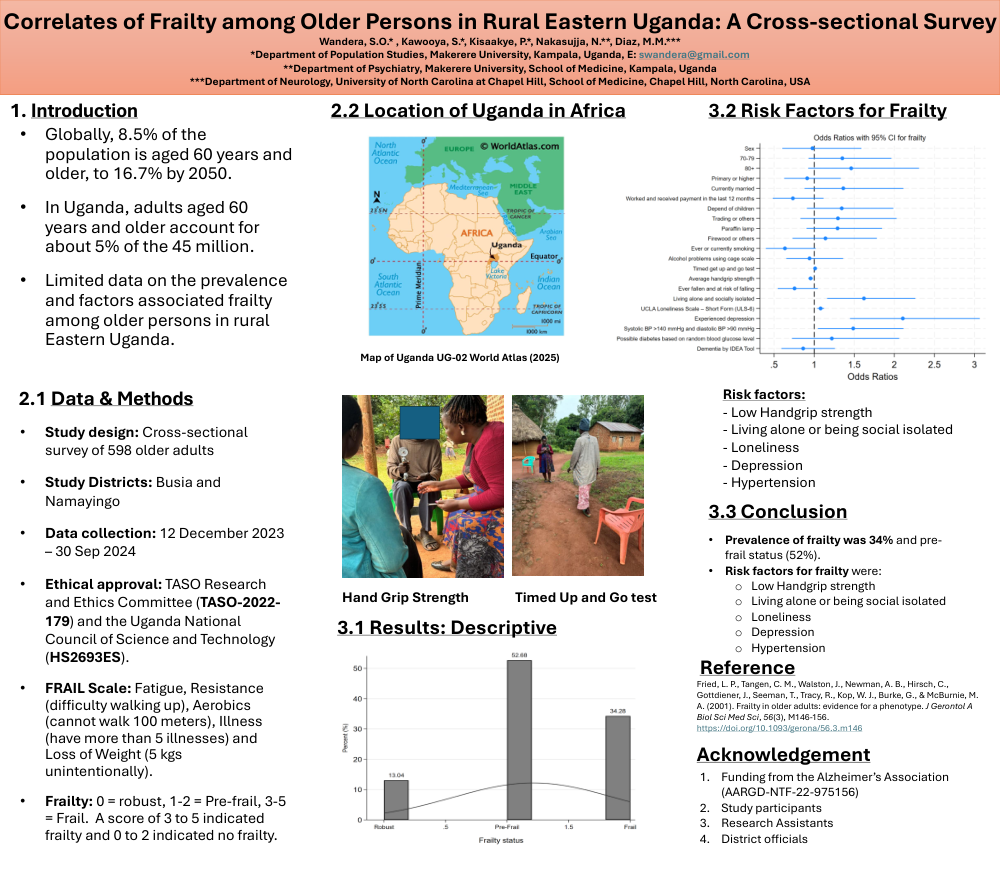
Introduction: Although frailty has been extensively studied and in high-income settings, its determinants in SSA remain poorly understood, and contextual factors may differ substantially. The study aimed to assess the prevalence and correlates of frailty among older persons in two rural districts of Eastern Uganda: Busia and Namayingo.
Methods: We used cross-sectional data from two districts of Busia and Namayingo in rural eastern Uganda among 598 older persons aged 60 years and above. Differences in characteristics by frailty status were tested using chi-square tests for categorical variables and t-tests or non-parametric equivalents for continuous variables. Using a stepwise approach, we used multivariable logistic regression analyses to examine the factors associated with frailty.
Results: The overall prevalence of frailty and pre-fail was 34.3% and 52.7% respectively. A unit decrease in average handgrip strength was associated with increased odds of frailty (OR=0.96; CI=0.93-0.98) while a unit increase in loneliness was associated with increased odds of frailty (OR=1.08; CI=1.04-1.12). Older persons who were living alone were more likely to be frail (OR=1.62; CI=1.16-2.26) than their counterparts who were not living alone. Frailty was more likely to be reported among depressed (OR=2.11; CI=1.45-3.07) or hypertensive (OR=1.49; CI=1.05-2.11) older persons than their counterparts.
Conclusions: Frailty is highly prevalent among older persons in rural Eastern Uganda and is shaped by a combination of physical, psychological, and social factors. The findings support the integration of frailty screening into primary healthcare and community-based programming, with attention to the psychosocial context of older adults.
Keywords: Frailty; Aged; Rural; Uganda; sub-Saharan Africa
Comments
Email is required but is not shown publicly.
Loading comments...