4,068 posters, 219 videos, 101 topics, 69 sessions, 14,365 authors, 6,128 institutions
ePostersLive by SciGen Technologies S.A. All rights reserved.
Alzheimer's Association International Conference 2026
July 12-15, 2026 | London, United Kingdom, and Online

5279
High-risk Conditions For Dementia Risk By Sex And Deprivation: A Cohort Study In English Primary Care Data
Poster Presenter
Authors
Hilary Shepherd, Adam Todd, Charlotte L Richardson, Andrew Kingston
Affiliations
Part of Topic
Studies examining risk of dementia in people with multiple long-term conditions (also known as multimorbidity) are commonly conducted in healthier-than-average research cohorts or outside the United Kingdom (UK). Multimorbidity has historically been associated with aging but recent research suggests over half of incidence is occurring in adults under 50.
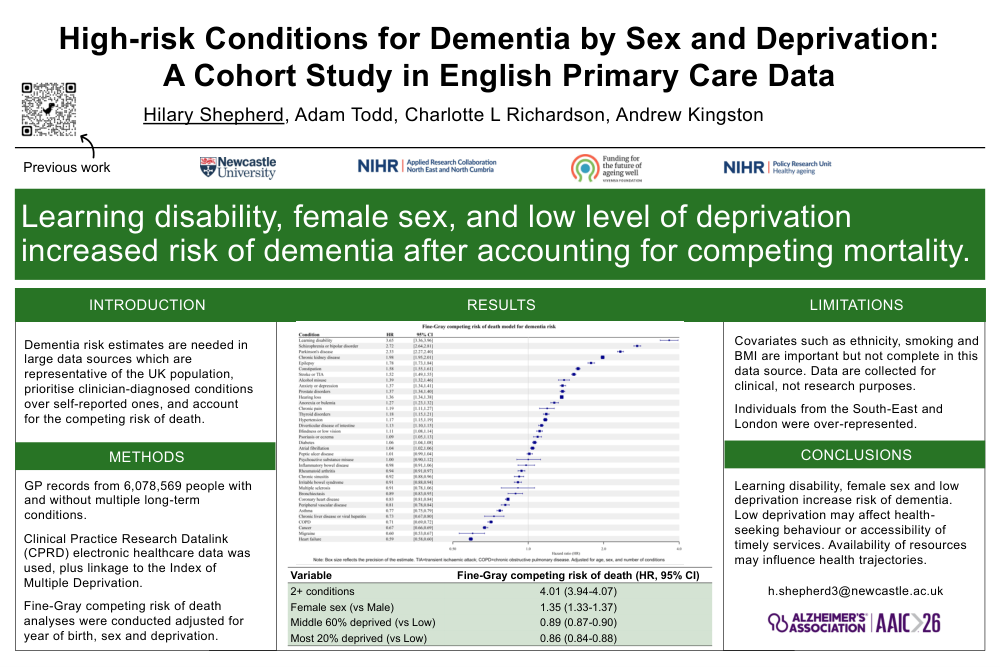
Using UK primary care data from Clinical Practice Research Datalink (CPRD) linked to the Index of Multiple Deprivation (IMD), adjusted Cox regressions and Fine-Gray competing risk of death models were conducted to determine risk of dementia in people with multimorbidity (i.e. people with 2+ chronic health conditions). Analyses were conducted overall, by health condition, and by subgroups of sex (male and female) and deprivation (low, medium and high deprivation).
Results of this study indicated that people with any kind of multimorbidity had a greater risk of dementia (HR=4.01, 95% Confidence Interval (CI) 3.94-4.07) compared to those without (i.e. 0-1 conditions). Risk was highest for women (HR=1.35, 95% CI 1.33-1.37) those with low level of deprivation, and multimorbidity which included a neurological condition such as learning disability, schizophrenia or bipolar disorder, and Parkinson's disease (see poster for adjusted hazard ratios).
Those with low deprivation (i.e. most affluent) had a greater likelihood of having a diagnosis of dementia recorded in primary care, even after accounting for those who were more likely to die prior to typical age of dementia onset. This could be due to behaviour differences, survivor bias, availability or timeliness of dementia services. Managing multimorbidity, particularly neurological conditions, is key, and could delay or reduce risk of dementia in more affluent populations and may be life extending in less affluent populations.
Comments
Email is required but is not shown publicly.
Loading comments...