4,068 posters, 219 videos, 101 topics, 69 sessions, 14,365 authors, 6,128 institutions
ePostersLive by SciGen Technologies S.A. All rights reserved.
Alzheimer's Association International Conference 2026
July 12-15, 2026 | London, United Kingdom, and Online

6492
Multimodal Brain Aging Models And Their Biophysical Mechanisms
Poster Presenter
Authors
Part of Topic
Multimodal Brain Aging Models And Their
Biophysical Mechanisms
Sebastian Moguilner1,2, Carlos Coronel-Oliveros1, and Agustin Ibanez1
1Multi-Partner Consortium to Expand Dementia Research in Latin America
2Department of Anesthesia, Massachusetts General Hospital and Harvard Medical School, Boston, MA, USA
BACKGROUND
RESULTS
• Brain clocks quantify brain-age gaps (BAGs) (predicted age
minus chronological age calculated from neural features)
• These BAGs can be used to measure accelerated aging,
monitoring deviations from healthy brain trajectories
• Most evidence comes from high-income settings, overlooking
global diversity
• Diversity shapes brain health, yet few studies pair
neuroimaging with biophysical modeling [1]
• Whole-brain models can map gaps to neural mechanisms [2]
• The biophysical mechanisms driving healthy aging deviations
remain poorly understood
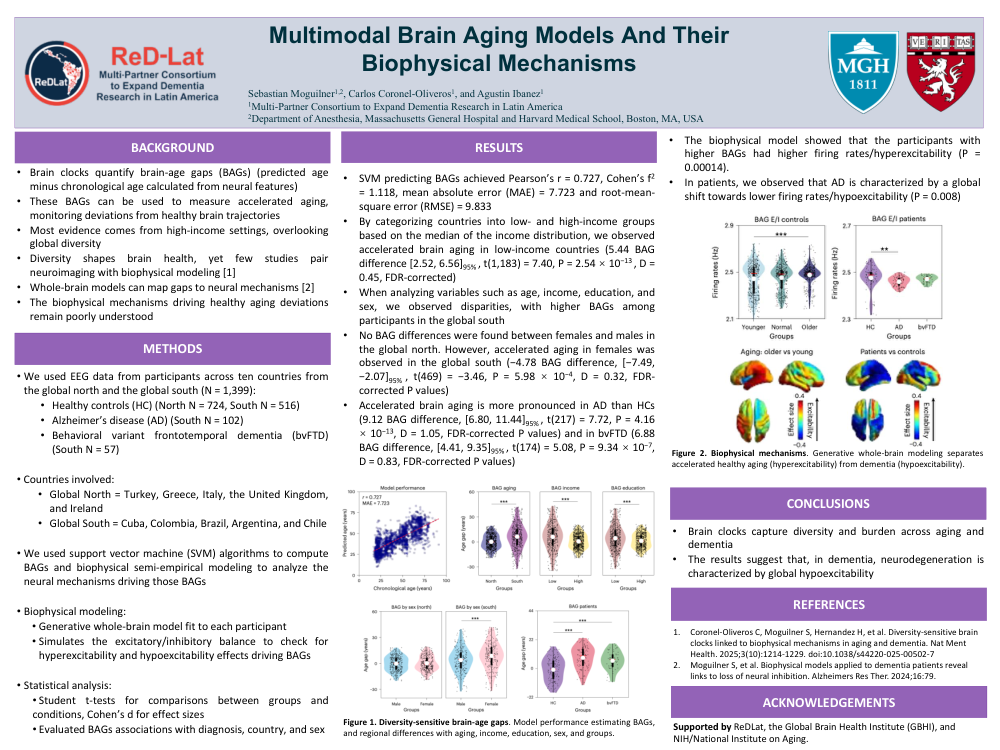
• The biophysical model showed that the participants with
higher BAGs had higher firing rates/hyperexcitability (P =
0.00014).
• In patients, we observed that AD is characterized by a global
shift towards lower firing rates/hypoexcitability (P = 0.008)
METHODS
• SVM predicting BAGs achieved Pearson’s r = 0.727, Cohen’s f2
= 1.118, mean absolute error (MAE) = 7.723 and root-mean-
square error (RMSE) = 9.833
• By categorizing countries into low- and high-income groups
based on the median of the income distribution, we observed
accelerated brain aging in low-income countries (5.44 BAG
difference [2.52, 6.56]95% , t(1,183) = 7.40, P = 2.54 × 10⁻¹³
, D =
0.45, FDR-corrected)
• When analyzing variables such as age, income, education, and
sex, we observed disparities, with higher BAGs among
participants in the global south
• No BAG differences were found between females and males in
the global north. However, accelerated aging in females was
observed in the global south (−4.78 BAG difference, [−7.49,
−2.07]95% , t(469) = −3.46, P = 5.98 × 10⁻⁴
, D = 0.32, FDR-
corrected P values)
• Accelerated brain aging is more pronounced in AD than HCs
(9.12 BAG difference, [6.80, 11.44]95% , t(217) = 7.72, P = 4.16
× 10−13
, D = 1.05, FDR-corrected P values) and in bvFTD (6.88
BAG difference, [4.41, 9.35]95% , t(174) = 5.08, P = 9.34 × 10⁻⁷
,
D = 0.83, FDR-corrected P values)
• We used EEG data from participants across ten countries from
the global north and the global south (N = 1,399):
• Healthy controls (HC) (North N = 724, South N = 516)
• Alzheimer’s disease (AD) (South N = 102)
• Behavioral variant frontotemporal dementia (bvFTD)
(South N = 57)
• Countries involved:
• Global North = Turkey, Greece, Italy, the United Kingdom,
and Ireland
• Global South = Cuba, Colombia, Brazil, Argentina, and Chile
• We used support vector machine (SVM) algorithms to compute
BAGs and biophysical semi-empirical modeling to analyze the
neural mechanisms driving those BAGs
• Biophysical modeling:
• Generative whole-brain model fit to each participant
• Simulates the excitatory/inhibitory balance to check for
hyperexcitability and hypoexcitability effects driving BAGs
• Statistical analysis:
• Student t-tests for comparisons between groups and
conditions, Cohen’s d for effect sizes
• Evaluated BAGs associations with diagnosis, country, and sex
Figure 2. Biophysical mechanisms. Generative whole-brain modeling separates
accelerated healthy aging (hyperexcitability) from dementia (hypoexcitability).
CONCLUSIONS
• Brain clocks capture diversity and burden across aging and
dementia
• The results suggest that, in dementia, neurodegeneration is
characterized by global hypoexcitability
REFERENCES
1. 2. Coronel-Oliveros C, Moguilner S, Hernandez H, et al. Diversity-sensitive brain
clocks linked to biophysical mechanisms in aging and dementia. Nat Ment
Health. 2025;3(10):1214-1229. doi:10.1038/s44220-025-00502-7
Moguilner S, et al. Biophysical models applied to dementia patients reveal
links to loss of neural inhibition. Alzheimers Res Ther. 2024;16:79.
ACKNOWLEDGEMENTS
Figure 1. Diversity-sensitive brain-age gaps. Model performance estimating BAGs,
and regional differences with aging, income, education, sex, and groups.
Supported by ReDLat, the Global Brain Health Institute (GBHI), and
NIH/National Institute on Aging.
Comments
Email is required but is not shown publicly.
Loading comments...