4,068 posters, 219 videos, 101 topics, 69 sessions, 14,365 authors, 6,128 institutions
ePostersLive by SciGen Technologies S.A. All rights reserved.
Alzheimer's Association International Conference 2026
July 12-15, 2026 | London, United Kingdom, and Online

9869
Population-based Estimates Of Cognitive Impairment Among Multiracial Older Adults In California
Poster Presenter
Part of Topic
Background: Multiracial older adults are a rapidly growing population in the U.S., yet they remain largely absent from population-based estimates of cognitive impairment. Cohort studies with detailed cognitive assessment often underrepresent Multiracial individuals, limiting population generalizability and obscuring subgroup heterogeneity. We applied methods for transporting cohort study results to a representative sample of older adults in California to estimate cognitive impairment prevalence among Multiracial individuals.
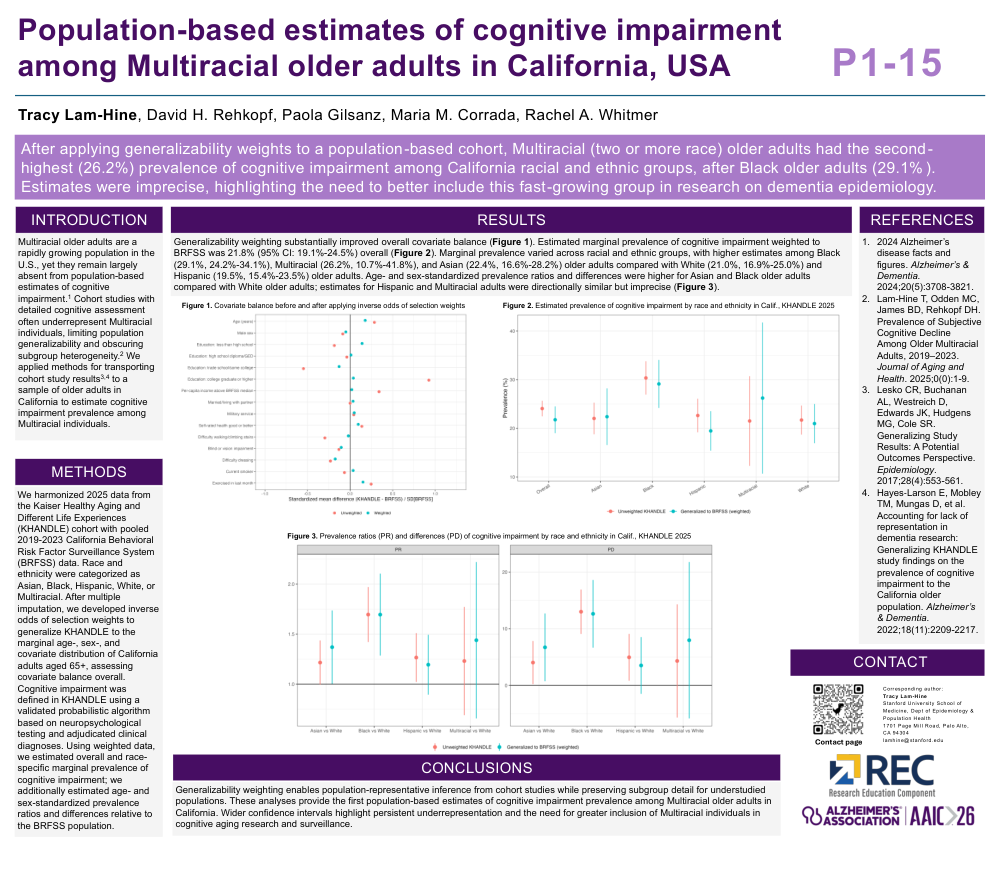
Methods: We harmonized 2025 data from the Kaiser Healthy Aging and Different Life Experiences (KHANDLE) cohort with pooled 2019-2023 California Behavioral Risk Factor Surveillance System (BRFSS) data. Race and ethnicity were categorized as Asian, Black, Hispanic, White, or Multiracial. After multiple imputation, we developed inverse odds of selection weights to generalize KHANDLE to the marginal age-, sex-, and covariate distribution of California adults aged 65+, assessing covariate balance overall. Cognitive impairment was defined in KHANDLE using a validated probabilistic algorithm based on neuropsychological testing and adjudicated clinical diagnoses. Using weighted data, we estimated overall and race-specific marginal prevalence of cognitive impairment; we additionally estimated age- and sex-standardized prevalence ratios and differences relative to the BRFSS population.
Results: Generalizability weighting substantially improved overall covariate balance (Figure 1). Estimated marginal prevalence of cognitive impairment weighted to BRFSS was 21.8% (95% CI: 19.1%-24.5%) overall (Figure 2). Marginal prevalence varied across racial and ethnic groups, with higher estimates among Black (29.1%, 24.2%-34.1%), Multiracial (26.2%, 10.7%-41.8%), and Asian (22.4%, 16.6%-28.2%) older adults compared with White (21.0%, 16.9%-25.0%) and Hispanic (19.5%, 15.4%-23.5%) older adults. Age- and sex-standardized prevalence ratios and differences were higher for Asian and Black older adults compared with White older adults; estimates for Hispanic and Multiracial adults were directionally similar but imprecise (Figure 3).
Conclusions: Generalizability weighting enables population-representative inference from cohort studies while preserving subgroup detail for understudied populations. These analyses provide the first population-based estimates of cognitive impairment prevalence among Multiracial older adults in California. Wider confidence intervals highlight persistent underrepresentation and the need for greater inclusion of Multiracial individuals in cognitive aging research and surveillance.
Comments
Email is required but is not shown publicly.
Loading comments...