4,068 posters, 219 videos, 101 topics, 69 sessions, 14,365 authors, 6,128 institutions
ePostersLive by SciGen Technologies S.A. All rights reserved.
Alzheimer's Association International Conference 2026
July 12-15, 2026 | London, United Kingdom, and Online

8722
Recruiting Multi-origin African Ancestry Populations For Research Studies In Heterogenous South Florida Communities
Poster Presenter
Authors
Tina Duke, Larry Adams, Alexia Bryan, Temi Obajimi, Bilcag Akgun, Christiane Reitz, Giuseppe Tosto, Jonathan Haines, WIlliam Bush, MIchael Cuccaro, Brian Kunkle, Adesola Ogunniyi, Rufus Akinyemi, Jeffrey Vance, Goldie Byrd, Margaret Pericak-Vance
Affiliations
Hussman Institute for Human Genomics, University of Miami Miller School of Medicine, Gertrude H. Sergievsky Center, Taub Institute for Research on the Aging Brain, Columbia University, Department of Population and Quantitative Health Sciences, School of Medicine, Case Western Reserve University & Cleveland Institute for Computational Biology, Case Western Reserve University, Hussman Institute for Human Genomics, University of Miami Miller School of Medicine; The Dr. John T. Macdonald Foundation Department of Human Genetics, University of Miami Miller School of Medicine, College of Medicine, University of Ibadan, Ibadan, Oyo State, Nigeria; Neuroscience and Aging Research Unit, Institute of Advanced Medical Research and Training, College of Medicine, University of Ibadan, Ibadan, Nigeria, Hussman Institute for Human Genomics, University of Miami Miller School of Medicine; The Dr. John T. Macdonald Foundation Department of Human Genetics, University of Miami Miller School of Medicine; The Dr. John T. Macdonald Foundation Department of Human Genetics & Department of Neurology, University of Miami Miller School of Medicine, Department of Social Sciences and Health Policy, Wake Forest University School of Medicine
Part of Topic
TITLE: Recruiting Multi-Origin African Ancestry Populations for Research Studies in Heterogenous South Florida Communities
INTRODUCTION:
•The inclusion of individuals with varied ancestral backgrounds is key to the identification of risk and protective genetic factors for Alzheimer’s disease (AD).
•The US arm of the international DAWN study (AG074865) is a multi-site community-based study focusing on the recruitment of individuals of African Ancestry (AfA) and Hispanic/Latino Ancestry (H/L). H/L recruitment includes admixed Caribbean Hispanic (CHI) populations with European, African and Amerindian ancestry. (Figure 1)
• US individuals of AfA are not monolithic populations, especially in South Florida (SF), home to individuals that identify as either African Americans (AA), Caribbean American (CA) or one of several admixed CHI populations.
•SF is comprised of a Tri-County area (Miami-Dade, Broward, and Palm Beach) that is home to a population with a considerable number of Individuals Identifying as one of these groups.
METHODS:
•We drew upon publicly available data from the U.S. Census Bureau to establish demographic context for the study area and to guide our outreach efforts.
•Our engagement strategies included presentations, literature distribution, tabling at health fairs, and community chew & chat sessions with various groups.
•During presentations information on genetics, Alzheimer’s disease and related dementias, and risk factors were reviewed. Community members engaged in Q&A with clinical staff and received details on research study participation.
•We modified verbiage and presentation materials to amplify traditionally relevant aspects of the heterogenous AfA SF population, and when possible leveraged translation. (Figure 2).
•Interested seniors completed a contact form and were called to schedule an enrollment appointment. After over 70 recruitment efforts we measured the conversion rate from interested to enrolled.
RESULTS:
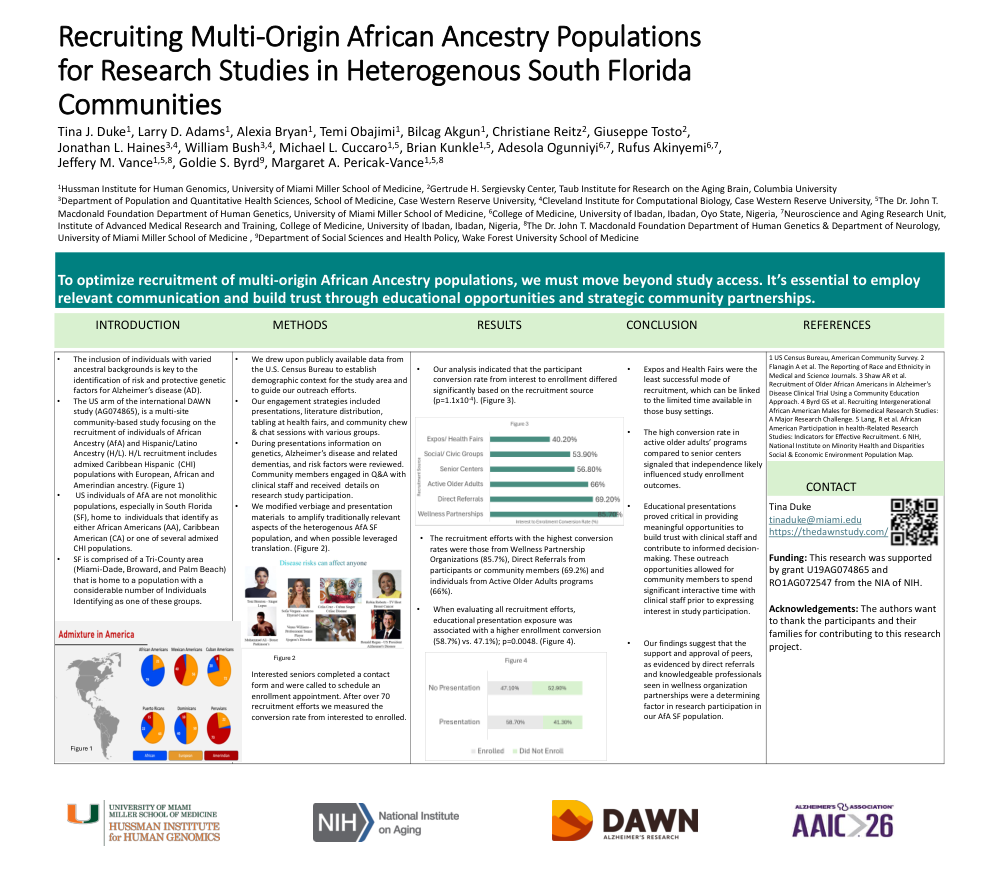
•Our analysis indicated that the participant conversion rate from interest to enrollment differed significantly based on the recruitment source (p=1.1x10⁻⁴). (Figure 3).
•The recruitment efforts with the highest conversion rates were those from Wellness Partnership Organizations (85.7%), Direct Referrals from participants or community members (69.2%) and individuals from Active Older Adults programs (66%).
•When evaluating all recruitment efforts, educational presentation exposure was associated with a higher enrollment conversion (58.7%) vs. 47.1%); p=0.0048. (Figure 4).
CONCLUSION:
•Expos and Health Fairs were the least successful mode of recruitment, which can be linked to the limited time available in those busy settings.
•The high conversion rate in active older adults’ programs compared to senior centers signaled that independence likely influenced study enrollment outcomes.
•Educational presentations proved critical in providing meaningful opportunities to build trust with clinical staff and contribute to informed decision-making. These outreach opportunities allowed for community members to spend significant interactive time with clinical staff prior to expressing interest in study participation.
•Our findings suggest that the support and approval of peers, as evidenced by direct referrals and knowledgeable professionals seen in wellness organization partnerships were a determining factor in research participation in our AfA SF population.
REFERENCES:
1 US Census Bureau, American Community Survey. 2 Flanagin A et al. The Reporting of Race and Ethnicity in Medical and Science Journals. 3 Shaw AR et al. Recruitment of Older African Americans in Alzheimer’s Disease Clinical Trial Using a Community Education Approach. 4 Byrd GS et al. Recruiting Intergenerational African American Males for Biomedical Research Studies: A Major Research Challenge. 5 Lang, R et al. African American Participation in health-Related Research Studies: Indicators for Effective Recruitment. 6 NIH, National Institute on Minority Health and Disparities Social & Economic Environment Population Map.
CONTACT:
Tina Duke
Funding: This research was supported by grant U19AG074865 and RO1AG072547 from the NIA of NIH.
Acknowledgements: The authors want to thank the participants and their families for contributing to this research project.
Comments
Email is required but is not shown publicly.
Loading comments...