4,068 posters, 219 videos, 101 topics, 69 sessions, 14,365 authors, 6,128 institutions
ePostersLive by SciGen Technologies S.A. All rights reserved.
Alzheimer's Association International Conference 2026
July 12-15, 2026 | London, United Kingdom, and Online

10401
Psychosocial And Cognitive Outcomes Among Expanded Cohort Of Forcibly Displaced Older Adults From Nagorno-Karabakh (Artsakh)
Poster Presenter
Part of Topic
Psychosocial and Cognitive Outcomes Among Expanded Cohort of Forcibly Displaced Older Adults from Nagorno-Karabakh (Artsakh)
Background
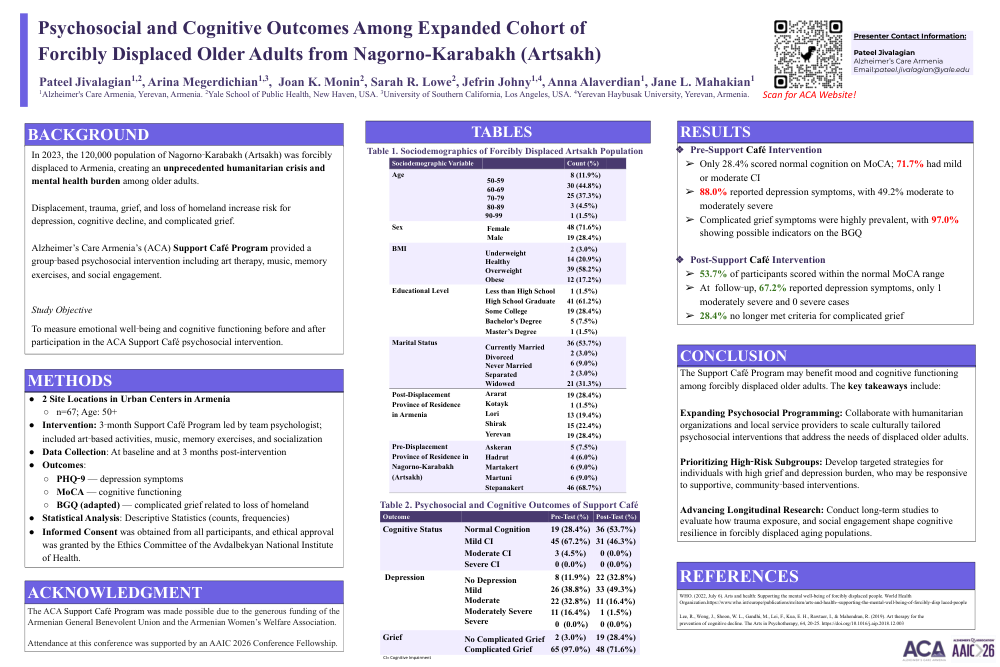
In 2023, the 120,000 population of Nagorno‑Karabakh (Artsakh) was forcibly displaced to Armenia, creating an unprecedented humanitarian crisis and mental health burden among older adults. Displacement, trauma, grief, and loss of homeland increase risk for depression, cognitive decline, and complicated grief. Alzheimer’s Care Armenia’s (ACA) Support Café Program provided a group‑based psychosocial intervention including art therapy, music, memory exercises, and social engagement. Study Objective To measure emotional well‑being and cognitive functioning before and after participation in the ACA Support Café psychosocial intervention.
Methods
2 Site Locations in Urban Centers in Armenia ○ n=67; Age: 50+
● Intervention: 3‑month Support Café Program led by team psychologist; included art‑based activities, music, memory exercises, and socialization
● Data Collection: At baseline and at 3 months post-intervention
● Outcomes: ○ PHQ‑9 — depression symptoms ○ MoCA — cognitive functioning ○ BGQ (adapted) — complicated grief related to loss of homeland
● Statistical Analysis: Descriptive Statistics (counts, frequencies)
● Informed Consent was obtained from all participants, and ethical approval was granted by the Ethics Committee of the Avdalbekyan National Institute of Health.
Results
❖ Pre-Support Café Intervention
➢ Only 28.4% scored normal cognition on MoCA; 71.7% had mild or moderate CI
➢ 88.0% reported depression symptoms, with 49.2% moderate to moderately severe
➢ Complicated grief symptoms were highly prevalent, with 97.0% showing possible indicators on the BGQ
❖ Post-Support Café Intervention
➢ 53.7% of participants scored within the normal MoCA range
➢ At follow‑up, 67.2% reported depression symptoms, only 1 moderately severe and 0 severe cases
➢ 28.4% no longer met criteria for complicated grief
The Support Café Program may benefit mood and cognitive functioning among forcibly displaced older adults.
The key takeaways include: Expanding Psychosocial Programming:
Collaborate with humanitarian organizations and local service providers to scale culturally tailored psychosocial interventions that address the needs of displaced older adults.
Prioritizing High‑Risk Subgroups: Develop targeted strategies for individuals with high grief and depression burden, who may be responsive to supportive, community‑based interventions.
Advancing Longitudinal Research: Conduct long-term studies to evaluate how trauma exposure, and social engagement shape cognitive resilience in forcibly displaced aging populations.
Acknowledgement
The ACA Support Café Program was made possible due to the generous funding of the Armenian General Benevolent Union and the Armenian Women’s Welfare Association. Attendance at this conference was supported by an AAIC 2026 Conference Fellowship
Comments
Email is required but is not shown publicly.
Loading comments...