4,068 posters, 219 videos, 101 topics, 69 sessions, 14,365 authors, 6,128 institutions
ePostersLive by SciGen Technologies S.A. All rights reserved.
Alzheimer's Association International Conference 2026
July 12-15, 2026 | London, United Kingdom, and Online

5171
Examining Users’ Experiences of Engaging with the Driving and Dementia Roadmap
Poster Presenter
Authors
Part of Topic
#5171 - Examining Users' Experiences of Engaging with the Driving and Dementia Roadmap
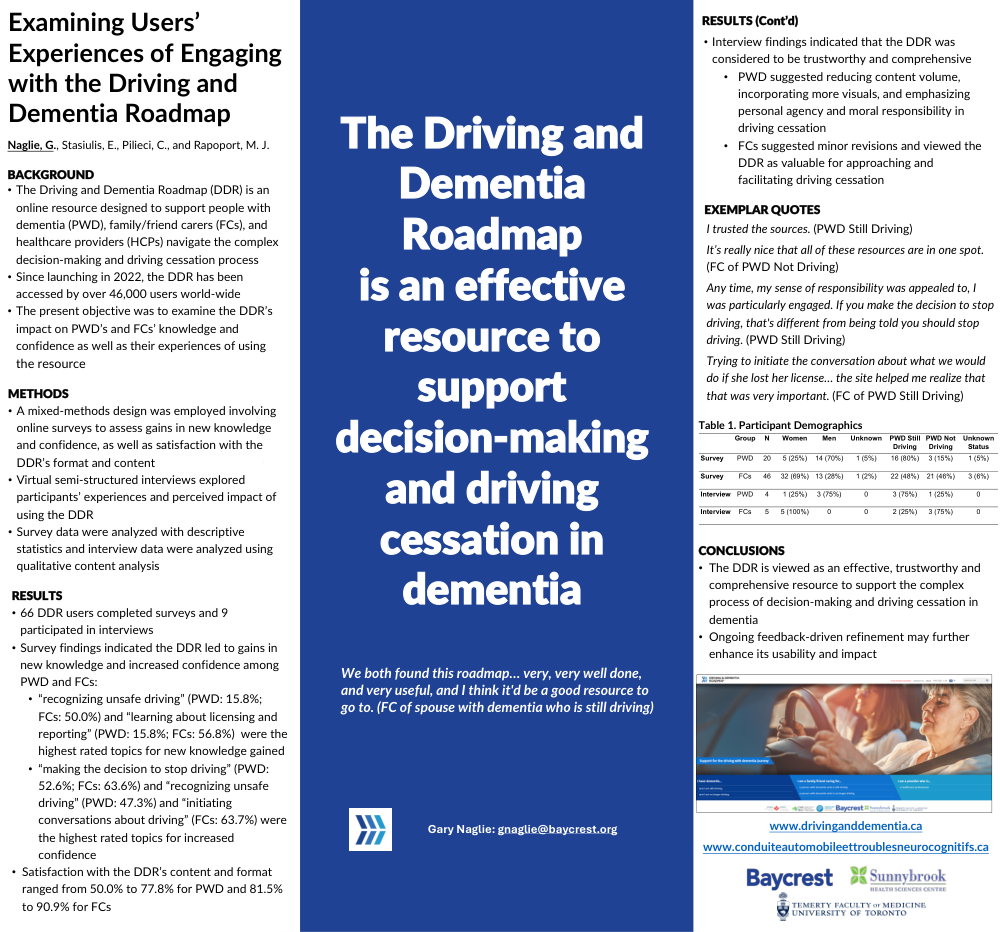
Background:The Driving and Dementia Roadmap (DDR) (www.drivinganddementia.ca) is an onlineresource designed to support people with dementia (PWD), family/friend carers (FCs), and healthcareproviders (HCPs) navigate the complex driving cessation process. Since launching in 2022, the DDR hasbeen accessed by close to 47,000 users. Our objective entails examining the DDR’s impact on users’knowledge and confidence, their satisfaction with the DDR and their experiences of using it. This analysisreports on current findings from PWD and FC participants.
Methods:A mixed-methods study was employed using online surveys and semi-structured interviews.Surveys assessed participants’ gains in new knowledge and confidence after using the DDR, as well as theirsatisfaction with its content and format. In-depth interviews explored participants’ experiences andperceived impact of engaging with the DDR. Survey data were analyzed descriptively via REDCap andinterview data were analyzed using qualitative content analysis.
Results: To date, 20 PWD and 46 FCs have completed the surveys, and 4 PWD and 5 FCs have completedthe interviews. Surveys revealed the highest rated topics for new knowledge gained included: for PWD,“recognizing unsafe driving” (15.8%) and “learning about licensing and reporting” (15.8%); and for FCs,“learning about licensing and reporting” (56.8%) and “recognizing unsafe driving” (50.0%). The highestrated topics for increased confidence included: for PWD, “making the decision to stop driving” (52.6%) and“recognizing unsafe driving” (47.3%); and for FCs, “initiating conversations about driving cessation” (63.7%)and “making the decision to stop driving” (63.6%). Satisfaction with the DDR’s content and format rangedfrom 50.0% to 77.8% for PWD and 81.5% to 90.9% for FCs. Interview findings indicated that the DDR wasconsidered to be trustworthy and comprehensive, affirming participants’ existing knowledge. PWDsuggested reducing content volume, incorporating more visuals, and emphasizing personal agency andmoral responsibility in driving cessation. FCs suggested minor revisions and viewed the DDR as valuable forsupporting recognition of unsafe driving and facilitating driving cessation.
Conclusion:The DDR is viewed as an effective resource to support the complex process of decision-making and driving cessation in dementia. Ongoing feedback-driven refinement may further enhance itsusability and impact.
Comments
Email is required but is not shown publicly.
Loading comments...