4,068 posters, 219 videos, 101 topics, 69 sessions, 14,365 authors, 6,128 institutions
ePostersLive by SciGen Technologies S.A. All rights reserved.
Alzheimer's Association International Conference 2026
July 12-15, 2026 | London, United Kingdom, and Online

4266
Exploring Lifestyle Factors And Cognition: A Structural Equation Modelling Approach To White Matter Mediation
Poster Presenter
Authors
Affiliations
Department of Psychiatry, University of Oxford | MRC Cognition and Brain Sciences Unit, University of Cambridge, MRC Cognition and Brain Sciences Unit, University of Cambridge, MRC Cognition and Brain Sciences Unit, University of Cambridge | Department of Psychiatry, University of Cambridge
Part of Topic
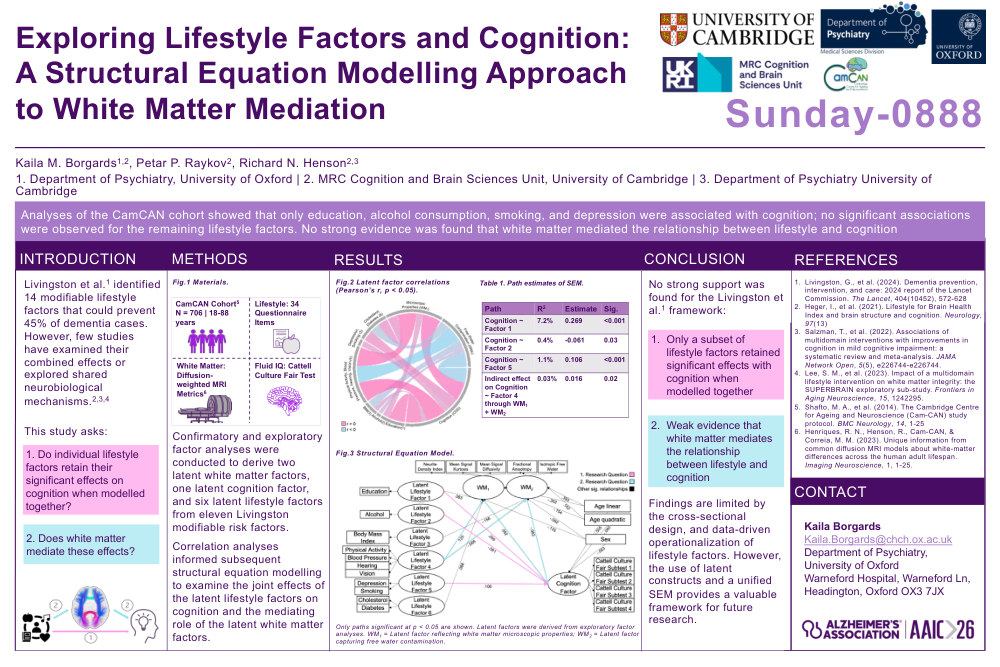
Background: The global rise in dementia has prompted increasing focus on prevention strategies targeting lifestyle factors to promote healthy ageing. A recent framework proposed by the Lancet Commission suggested that up to 45% of dementia cases may be preventable by addressing 14 lifestyle factors. However, the extent to which individual lifestyle factors independently relate to cognition when considered together, and the neurobiological mechanisms underlying these associations, remains to be elucidated. This study tested (i) which of the 14 lifestyle factors contribute uniquely to cognition when modelled simultaneously, and (ii) whether white matter integrity mediates the relationship between lifestyle factors and cognition.
Methods: Data were drawn from 706 participants in the Cam-CAN cohort (18-88 years). Latent factors for lifestyle, white matter, and cognition were derived using confirmatory and exploratory factor analyses. A structural equation model was estimated, including age and sex as covariates, to assess direct and mediated effects.
Results: Only a subset of latent lifestyle factors capturing the effects of education, alcohol consumption, depression, and smoking remained significantly associated with cognition when entered together in the model. Mediation analyses revealed that one latent factor, reflecting physical activity, blood pressure, vision loss, and hearing loss, had a significant indirect effect on cognition via white matter latent factors (Figure 3).
Conclusion: These findings indicate that modelling lifestyle factors simultaneously may alter their apparent impact on cognition, underscoring the interdependence among them. While white matter emerged as a partial mediator for one latent lifestyle factor, broader evidence for a strong mechanistic pathway was limited. These results highlight both the value and the challenges of integrating lifestyle, brain measures, and cognition into a single analytical framework, and suggest that future dementia prevention research should move beyond single-factor models toward more multivariate and mechanistically informed approaches.
Comments
Email is required but is not shown publicly.
Loading comments...