4,068 posters, 219 videos, 101 topics, 69 sessions, 14,365 authors, 6,128 institutions
ePostersLive by SciGen Technologies S.A. All rights reserved.
Alzheimer's Association International Conference 2026
July 12-15, 2026 | London, United Kingdom, and Online

10253
Cardiovascular Risk Decouples Hippocampal Structure From Cognitive Function In Amyloid-positive Adults
Poster Presenter
Part of Topic
Cardiovascular Risk Decouples Hippocampal Structure from Cognitive Function in Amyloid-Positive Adults
Sofía Fernández-Lozano, Sylvia Villeneuve, D. Louis Collins, for the Alzheimer’s Disease Neuroimaging Initiative*
BACKGROUND
• Hippocampal integrity normally tracks cognition in Alzheimer's disease.
• Cardiovascular risk is a modifiable dementia risk factor, but it is unclear whether it changes the coupling between hippocampal structure and cognition or simply affects each on its own.
• Does cardiovascular risk moderate the hippocampus-cognition relationship in amyloid-positive adults? And does this depend on sex and disease stage?
DATA
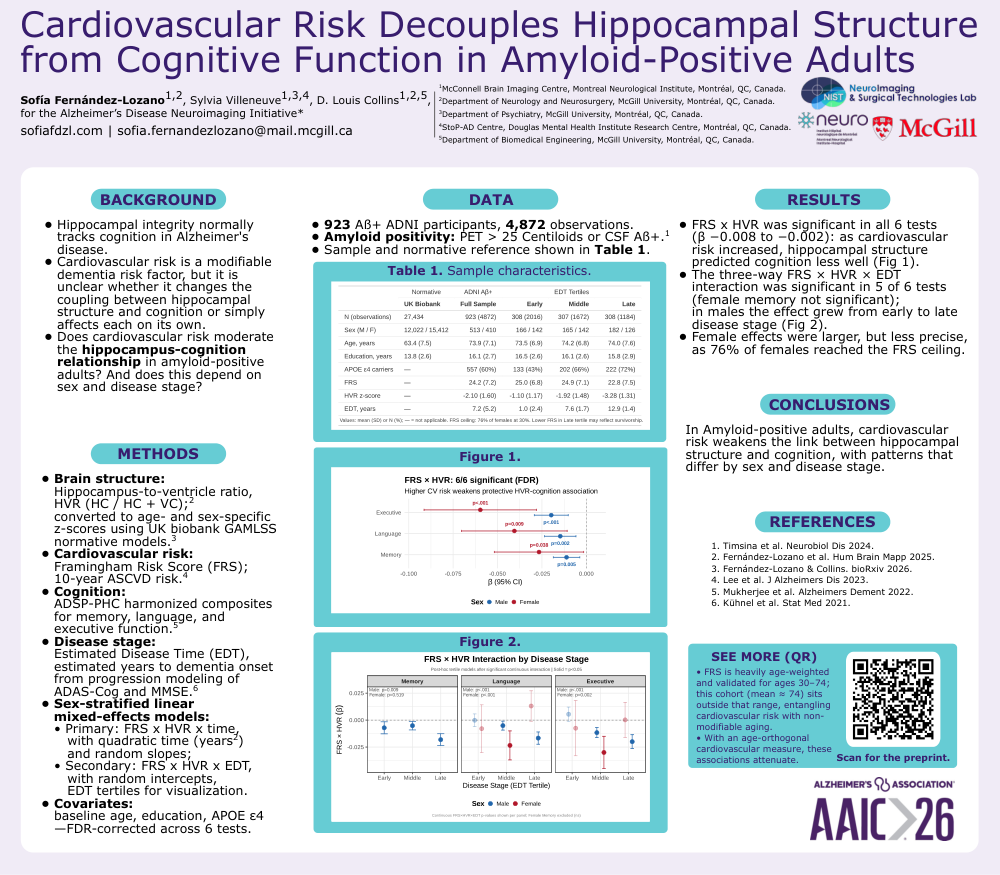
• 923 Aß+ ADNI participants, 4,872 observations.
• Amyloid positivity: PET > 25 Centiloids or CSF Aß+.1
• Sample and normative reference shown in Table 1.
RESULTS
• FRS x HVR was significant in all 6 tests (β −0.008 to −0.002): as cardiovascular risk increased, hippocampal structure predicted cognition less well (Fig 1).
• The three-way FRS × HVR × EDT interaction was significant in 5 of 6 tests (female memory not significant); in males the effect grew from early to late disease stage (Fig 2).
• Female effects were larger, but less precise, as 76% of females reached the FRS ceiling.
METHODS
• Brain structure: Hippocampus-to-ventricle ratio, HVR (HC / HC + VC);2 converted to age- and sex-specific z-scores using UK biobank GAMLSS normative models.3
• Cardiovascular risk: Framingham Risk Score (FRS); 10-year ASCVD risk.4
• Cognition: ADSP-PHC harmonized composites for memory, language, and executive function.5
• Disease stage: Estimated Disease Time (EDT), estimated years to dementia onset from progression modeling of ADAS-Cog and MMSE.6
• Sex-stratified linear mixed-effects models:
• Primary: FRS x HVR x time, with quadratic time (years2) and random slopes;
• Secondary: FRS x HVR x EDT, with random intercepts, EDT tertiles for visualization.
• Covariates: baseline age, education, APOE ε4 — FDR-corrected across 6 tests.
CONCLUSIONS
In Amyloid-positive adults, cardiovascular risk weakens the link between hippocampal structure and cognition, with patterns that differ by sex and disease stage.
REFERENCES
1. Timsina et al. Neurobiol Dis 2024.
2. Fernández-Lozano et al. Hum Brain Mapp 2025.
3. Fernández-Lozano & Collins. bioRxiv 2026.
4. Lee et al. J Alzheimers Dis 2023.
5. Mukherjee et al. Alzheimers Dement 2022.
6. Kühnel et al. Stat Med 2021.
SEE MORE (QR)
• FRS is heavily age-weighted and validated for ages 30–74; this cohort (mean ≈ 74) sits outside that range, entangling cardiovascular risk with non-modifiable aging.
• With an age-orthogonal cardiovascular measure, these associations attenuate.
Comments
Email is required but is not shown publicly.
Loading comments...