4,068 posters, 219 videos, 101 topics, 69 sessions, 14,365 authors, 6,128 institutions
ePostersLive by SciGen Technologies S.A. All rights reserved.
Alzheimer's Association International Conference 2026
July 12-15, 2026 | London, United Kingdom, and Online

10626
Examining The 2024 Lancet Commission Dementia-related Factors Among Texas Medicare Beneficiaries
Poster Presenter
Authors
Affiliations
Part of Topic
Examining The 2024 Lancet Commission Dementia-related Factors Among Texas Medicare Beneficiaries
Authors: Mukaila Raji1, Yong Shan2, Sadaf Arefi Milani3, Huey-Ming Tzeng4, Yong-Fang Kuo2.1Internal Medicine, Geriatrics, University of Texas Medical Branch, Galveston, TX, USA, 2Biostatistics & Data Science, University of Texas Medical Branch, Galveston, TX, USA, 3Epidemiology, University of Texas Medical Branch, Galveston, TX, USA, 4Nursing, University of Texas Medical Branch, Galveston, TX, USA.
Abstract:
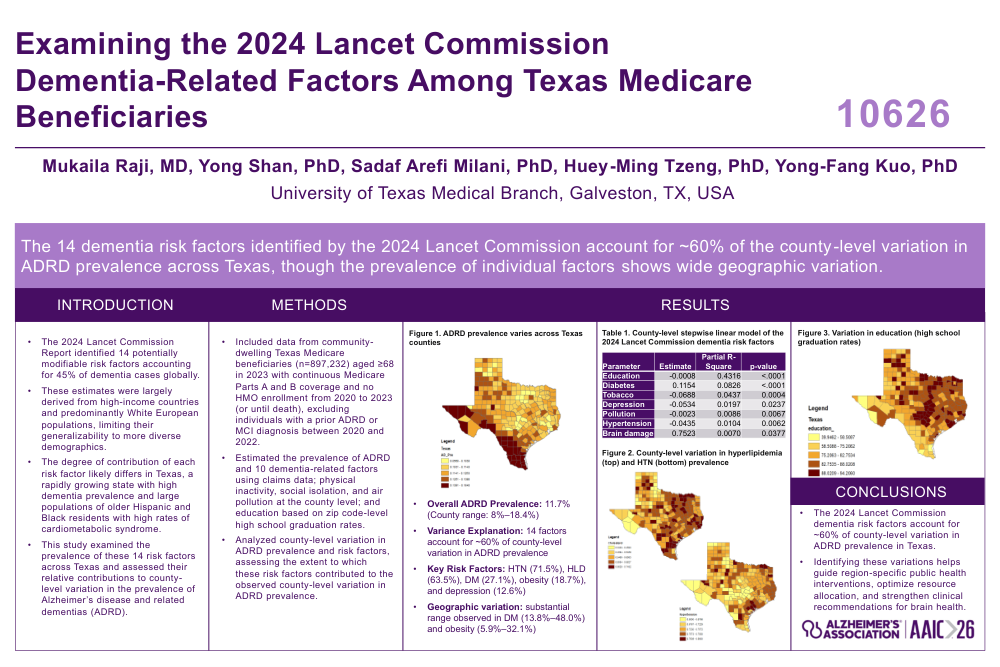
Background: The 2024 Lancet Commission Report identified 14 potentially modifiable risk factors accounting for 45% of dementia cases globally. However, these estimates were largely derived from high-income countries and predominantly White European populations, limiting generalizability. The magnitude and contribution of each factor may differ in Texas, a rapidly growing state with high dementia prevalence and large populations of older Hispanic and Black residents with high rates of hypertension, diabetes, and metabolic syndrome. We examined the prevalence of the 14 risk factors across Texas and their relative contributions to county-level variation in Alzheimer’s disease and related dementias (ADRD) prevalence. Methods: Our study included community-dwelling Texas Medicare beneficiaries aged ≥68 in 2023 with complete Medicare Parts A and B coverage and no HMO enrollment from 2020 to 2023 or until death. Beneficiaries with a diagnosis of ADRD or mild cognitive impairment from 2020 to 2022 were excluded. Ten dementia-related factors were identified from claims database: diabetes, hypertension, high cholesterol, traumatic brain injury, depression, hearing loss, visual impairment, obesity, excessive alcohol use, and smoking. Physical inactivity, social isolation, and air pollution were measured at the county level. Education was measured as high school graduation rates at the zip code level. Results: Among 897,232 Texas Medicare beneficiaries, ADRD prevalence was 11.7%, ranging from 8.0% to18.4% across counties. Prevalence of hypertension, diabetes, high cholesterol, traumatic brain injury, depression, hearing loss, visual impairment, obesity, excessive alcohol use, and smoking was 71.5%, 27.1%,63.5%, 0.2%, 12.6%, 8.1%, 0.2%, 18.7%, 1.3%, and 6.1%, respectively. Substantial geographic variation was observed, with diabetes ranging from 13.8% to 48.0%, obesity from 5.9% to 32.1%, and hearing loss from1.3% to 12.2%. Analysis using a linear model showed that the 14 risk factors explained approximately 60%of county-level variation in ADRD prevalence. Conclusion: The 2024 Lancet Commission dementia-related factors accounted for about 60% of variation in ADRD prevalence across Texas counties. Our findings on geographic variation in the prevalence of dementia-related factors can guide the design of region-specific public health interventions, inform resource allocation, and support clinical practice recommendations to promote brain health and reduce dementia risk among Texas Medicare beneficiaries.
Authors: Mukaila Raji, MD, MSc (Pharm), FACP; Yong Shan, PhD; Sadaf Arefi Milani, PhD; Huey-Ming Tzeng, PhD; Yong-Fang Kuo, PhD
The University of Texas Medical Branch, Galveston, TX, USA
Comments
Email is required but is not shown publicly.
Loading comments...