4,068 posters, 219 videos, 101 topics, 69 sessions, 14,365 authors, 6,128 institutions
ePostersLive by SciGen Technologies S.A. All rights reserved.
Alzheimer's Association International Conference 2026
July 12-15, 2026 | London, United Kingdom, and Online

9141
Perodem: A Project To Evaluate The Risk Of Dementia In Middle-aged And Older Nigerians
Poster Presenter
Authors
Adedoyin O Ogunyemi, Adedunni W Olusanya, Adedayo E Ojo, Babatunde A Akodu, Josephine Omoseni, Abisola T Omotayo, Victor Valcour, Lea T Grinberg, Njideka U Okubadejo
Affiliations
University of Lagos, University of Lagos; Global Brain Health Institute, University of California, San Francisco, United States, Cardiovascular Research Center, University of Abuja, Julius Center for Health Sciences and Primary Care, University Medical Center, Julius Global Health, Utrecht University, Utrecht, 3584 CG, The Netherlands., Global Brain Health Institute, University of California, San Francisco, United States, Departments of Laboratory Medicine and Pathology and Neurosciences, Mayo Clinic, Florida, United States, Global Brain Health Institute, University of California, San Francisco, United States, Centre for Neurological Sciences Research and Training, College of Medicine, University of Lagos, Nigeria, Department of Medicine, College of Medicine, University of Lagos, Nigeria
Part of Topic
Abstract
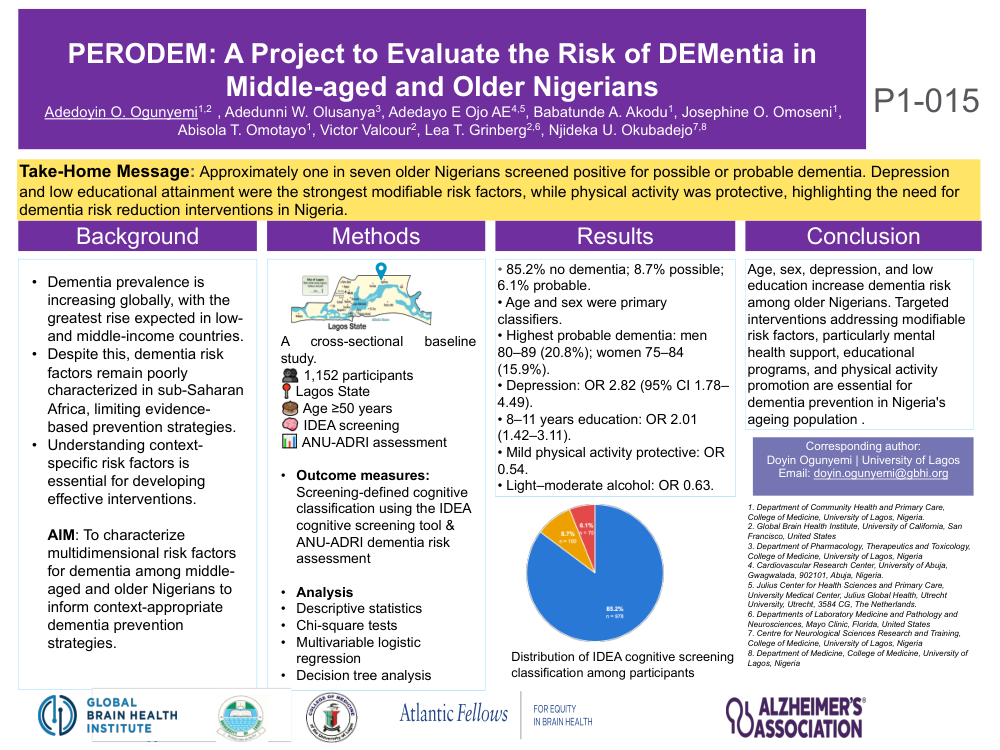
Background: Dementia prevalence is rising globally, with low-and-middle-income countries disproportionately affected. However, dementia risk factors remain poorly characterized in sub-Saharan Africa, limiting prevention strategies. This study aimed to characterize the multidimensional risk factors for dementia among middle-aged and older Nigerians to inform context-appropriate interventions for Africa's aging population.
Methods: This cross-sectional baseline study recruited 1,152 adults aged 50 years and above across Lagos State using multistage cluster sampling. The primary outcome was screening-defined cognitive classification based on the IDEA tool (no dementia vs possible/probable dementia), while the ANU-ADRI was used to assess dementia-related risk exposures. The data was analyzed using descriptive statistics, chi-square tests, and logistic regression to identify predictors of dementia risk. A decision tree analysis was employed to determine significant splitting variables for risk classification.
Results: The majority (85.2%) of participants were classified as having no dementia, while 8.7% and 6.1% showed possible and probable dementia, respectively. Decision tree analysis identified age and sex as primary predictors, with the highest prevalence of probable dementia observed in males aged 80–89 (20.8%) and females aged 75–84 (15.9%). Logistic regression revealed that depressive symptoms significantly increased the odds of dementia risk (OR: 2.82, 95% CI: 1.78–4.49, p < 0.0001), as did lower educational attainment of <8 years (OR: 2.01, 95% CI: 1.42–3.11, p < 0.0001). Conversely, protective associations were found for mild physical activity (OR: 0.54, 95% CI: 0.34–0.86, p = 0.009) and light-to-moderate alcohol consumption (OR: 0.63, 95% CI: 0.42–0.95, p = 0.028), while other factors did not significantly predict dementia risk.
Conclusion: In this study, depressive symptoms and low educational attainment were independently associated with higher odds of screening-defined cognitive impairment, while mild physical activity was associated with lower odds. These findings support context-specific dementia risk reduction strategies centred on mental health, education, and healthy ageing in primary care.
Comments
Email is required but is not shown publicly.
Loading comments...