4,068 posters, 219 videos, 101 topics, 69 sessions, 14,365 authors, 6,128 institutions
ePostersLive by SciGen Technologies S.A. All rights reserved.
Alzheimer's Association International Conference 2026
July 12-15, 2026 | London, United Kingdom, and Online

10536
Differential Lifestyle And Metabolic Risk Factor Associations In Early- Versus Late-onset Alzheimer's Disease In United States Women
Poster Presenter
Authors
Part of Topic
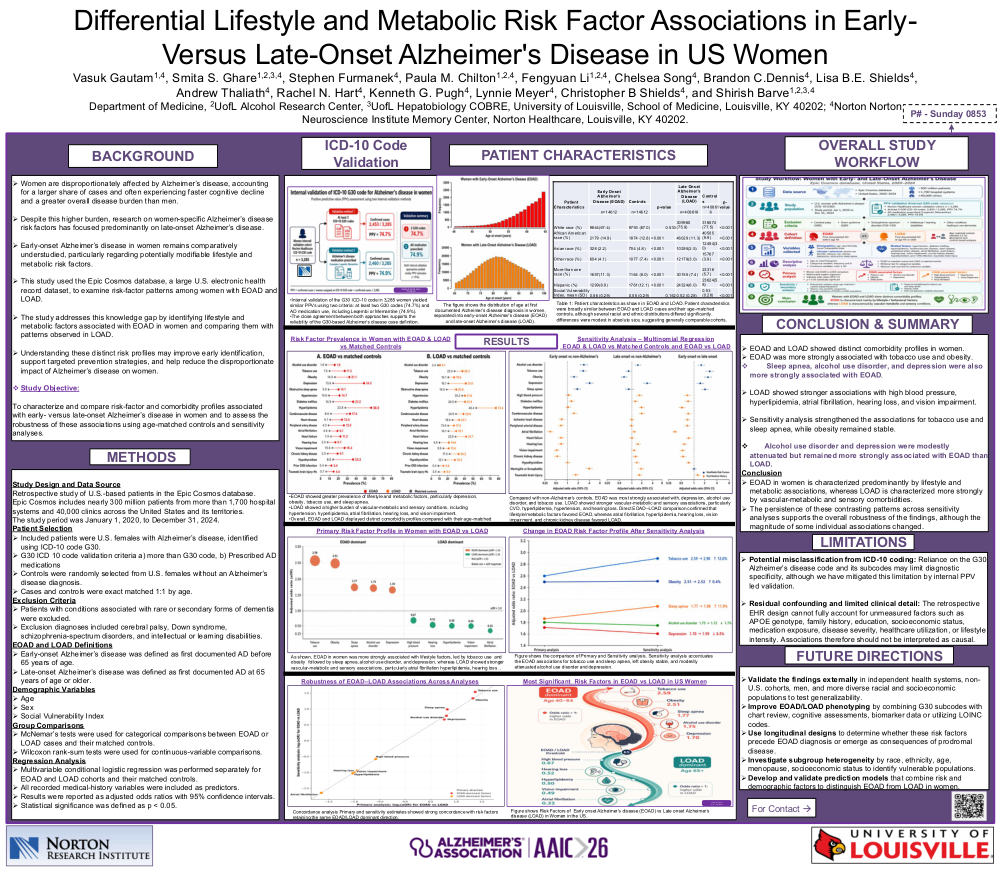
Differential Lifestyle and Metabolic Risk Factor Associations in Early- Versus Late-Onset Alzheimer's Disease in US Women
Vasuk Gautam1,4, Smita S. Ghare1,2,3,4, Stephen Furmanek4, Paula M. Chilton1,2,4, Fengyuan Li1,2,4, Chelsea Song4, Brandon C.Dennis4, Lisa B.E. Shields4, Andrew Thaliath4, Rachel N. Hart4, Kenneth G. Pugh4, Lynnie Meyer4, Christopher B Shields4, and Shirish Barve1,2,3,4
1Department of Medicine, 2UofL Alcohol Research Center, 3UofL Hepatobiology COBRE, University of Louisville, School of Medicine, Louisville, KY 40202; 4Norton Norton Neuroscience Institute Memory Center, Norton Healthcare, Louisville, KY 40202.
Background: Women exhibit a higher prevalence of Alzheimer’s disease (AD) and more rapid cognitive decline than men. Existing research on women-specific risk factors has largely focused on late-onset AD (LOAD), leaving early-onset AD (EOAD) understudied. The present work addresses this gap by determining lifestyle and behavioral risk factors relevant for EOAD in women.
Methods: We conducted a retrospective observational study using de-identified U.S. electronic health records from the Epic-Cosmos database. AD cases in women were identified by ICD-10 code G30 between January 1, 2020, and December 31, 2024. Age-matched controls without AD were randomly selected at a 1:1 ratio. AD subtypes were classified as early-onset (<65 years) or late-onset (≥65 years). AD-related lifestyle and metabolic risk factors associated with LOAD and EOAD were evaluated employing multinomial logistic regression analysis.
Results: Among 2,358,897 U.S. women, 449,431 (19.0%) had AD, including 14,991 (3.3%) with EOAD and 434, 440 (96.7%) with LOAD. A comparison between EOAD and LOAD showed distinct patterns of comorbidity associations. Specifically, women with EOAD demonstrated significantly higher adjusted odds ratios (aORs) for lifestyle-risk factors including alcohol use disorder (aOR: 1.75, 95% CI: 1.72-1.78), tobacco use (aOR: 2.59, 95% CI: 2.56-2.62), obesity (aOR: 2.51, 95% CI: 2.48-2.54), depression (aOR: 1.70, 95% CI: 1.68-1.71), and sleep apnea (aOR: 1.77, 95% CI: 1.75-1.79). In contrast, EOAD demonstrated weaker associations for high blood pressure (aOR 0.67, 95% CI 0.66–0.68), hyperlipidemia (aOR 0.50, 95% CI 0.49–0.51), atrial fibrillation (aOR 0.32, 95% CI 0.32–0.33), hearing loss (aOR 0.52, 95% CI 0.51–0.63), and vision impairment (aOR 0.49, 95% CI 0.48–0.50), indicating significantly greater risk of vascular-metabolic and sensory impairments in LOAD. Moreover, sensitivity analysis with age-matched controls further demonstrated an increase in magnitude of effect for the lifestyle and behavioral risk factors linked with EOAD.
Conclusion: Evaluation of Large-scale Epic-Cosmos database highlights distinct differences between women with EOAD and LOAD. Particularly, lifestyle and behavioral risk factors were strongly linked with EOAD, whereas vascular-metabolic comorbidities and sensory impairment were associated with LOAD. Integrating these insights into clinical practice could enhance personalized risk assessment and reduce EOAD Alzheimer’s disease burden in women.
Comments
Email is required but is not shown publicly.
Loading comments...