4,068 posters, 219 videos, 101 topics, 69 sessions, 14,365 authors, 6,128 institutions
ePostersLive by SciGen Technologies S.A. All rights reserved.
Alzheimer's Association International Conference 2026
July 12-15, 2026 | London, United Kingdom, and Online

9261
Substituting Blood-based Biomarkers For Imaging Measures In Alzheimer’S Disease Studies: Implications For Sample Size And Bias
Poster Presenter
Part of Topic
Substituting Blood-Based Biomarkers for Imaging Measures in Alzheimer’s Disease Studies
Implications for Sample Size and Bias
Sarah F. Ackley, Renaud La Joie, Michelle Caunca, Shubhabrata Mukherjee, Seo-Eun Choi, Emily H. Trittschuh, Paul K. Crane, and Eleanor Hayes-Larson, for ADNI
The Journals of Gerontology: Series A · 2026;81(5):glag068 · doi:10.1093/gerona/glag068
Key Takeaway
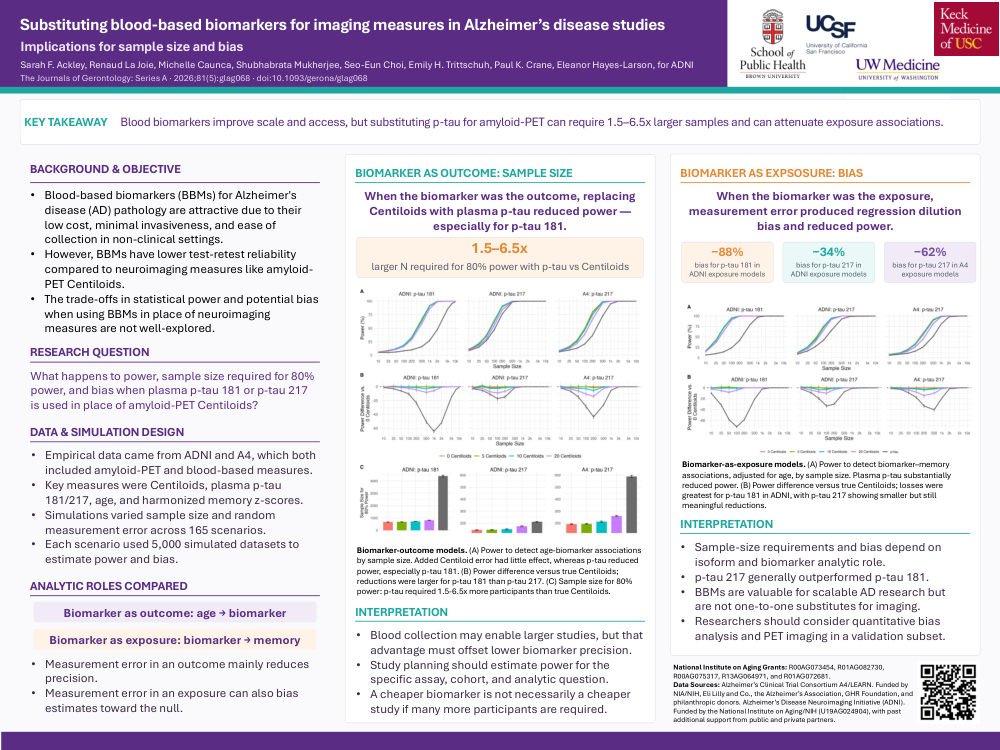
Blood biomarkers can improve study scale and access, but substituting plasma p-tau for amyloid-PET may require 1.5–6.5× larger samples and can substantially attenuate exposure associations.
Background and Objective
Blood-based biomarkers (BBMs) for Alzheimer’s disease pathology are attractive because they are lower cost, minimally invasive, and easier to collect in community and non-clinical settings.
However, BBMs have lower test–retest reliability than neuroimaging measures such as amyloid-PET Centiloids. The resulting trade-offs in statistical power and potential bias have not been well characterized.
Research Question
What happens to statistical power, the sample size required for 80% power, and bias when plasma p-tau181 or p-tau217 is used in place of amyloid-PET Centiloids?
Data and Simulation Design
-
Empirical data came from ADNI and A4, which included both amyloid-PET and blood-based biomarker measures.
-
Key measures were Centiloids, plasma p-tau181 or p-tau217, age, and harmonized memory z-scores.
-
Simulations varied sample size and random measurement error across 165 scenarios.
-
Each scenario included 5,000 simulated datasets to estimate power and bias.
Analytic Roles Compared
Biomarker as outcome:
Age → biomarker
Biomarker as exposure:
Biomarker → memory
-
Measurement error in an outcome primarily reduces precision.
-
Measurement error in an exposure can reduce precision and bias estimates toward the null.
Biomarker as Outcome: Sample Size
When the biomarker was the outcome, replacing Centiloids with plasma p-tau reduced power—especially for p-tau181.
1.5–6.5× Larger Sample Required
Plasma p-tau required approximately 1.5–6.5 times more participants than true Centiloids to achieve 80% power.
Interpretation
-
Blood collection may enable larger studies, but that advantage must offset lower biomarker precision.
-
Study planning should estimate power for the specific assay, cohort, and analytic question.
-
A cheaper biomarker is not necessarily a cheaper study when substantially larger samples are required.
Biomarker as Exposure: Bias
When the biomarker was the exposure, measurement error produced regression-dilution bias and reduced power.
| Model | Bias |
|---|---|
| p-tau181 in ADNI exposure models | −88% |
| p-tau217 in ADNI exposure models | −34% |
| p-tau217 in A4 exposure models | −62% |
Interpretation
-
Larger samples improve power but do not eliminate regression-dilution bias.
-
Sample-size requirements and bias depend on the p-tau isoform and the biomarker’s analytic role.
-
p-tau217 generally outperformed p-tau181.
Overall Interpretation
Blood-based biomarkers are valuable tools for scalable and potentially more representative Alzheimer’s disease research, but they are not one-to-one substitutes for imaging measures.
Researchers should:
-
Match the biomarker to the scientific question and analytic role.
-
Consider assay-specific power calculations during study planning.
-
Use quantitative bias analysis when biomarkers are exposures.
-
Include PET imaging in a validation subset when feasible.
Funding and Data Sources
National Institute on Aging Grants:
R00AG073454, R01AG082730, R00AG075317, R13AG064971, and R01AG072681.
Data Sources:
Alzheimer’s Clinical Trial Consortium A4/LEARN, funded by NIA/NIH, Eli Lilly and Co., the Alzheimer’s Association, GHR Foundation, and philanthropic donors.
Alzheimer’s Disease Neuroimaging Initiative (ADNI), funded by the National Institute on Aging/NIH (U19AG024904), with past additional support from public and private partners.
Comments
Email is required but is not shown publicly.
Loading comments...