4,068 posters, 219 videos, 101 topics, 69 sessions, 14,365 authors, 6,128 institutions
ePostersLive by SciGen Technologies S.A. All rights reserved.
Alzheimer's Association International Conference 2026
July 12-15, 2026 | London, United Kingdom, and Online

5792
Evaluating Food-related Practices In Post Diagnostic Community-based Group Support For People Affected By Dementia In The UK
Poster Presenter
Authors
Part of Topic
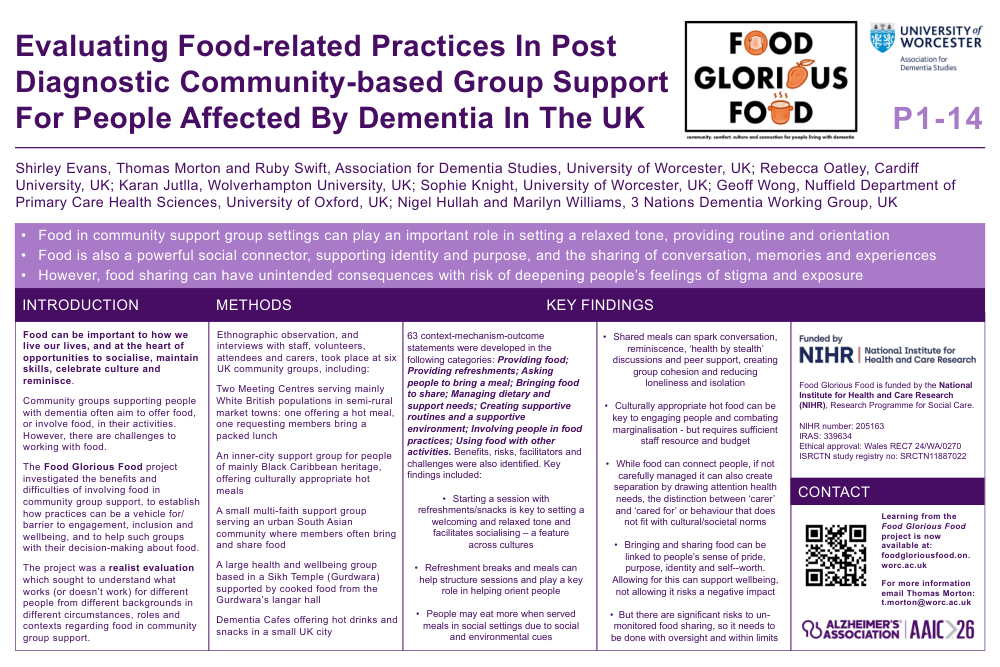
Background: The Food Glorious Food project funded by the UK National Institute for Health and Care Research (NIHR) research ran from April 2024 to November 2025. The aim was to identify and explore the impact of food-related practices within community-based group support for people living with dementia and family carers across diverse populations and circumstances; to establish how practices can be a vehicle for or barrier to engagement, inclusion and wellbeing, and identify factors impacting upon success and to develop guidance for decision-making regarding food-related practice.
Methods: A realist evaluation was implemented which involved the development of initial theories through consultation with public and practitioner stakeholders; the collection of data via ethnographic observation and interviews with staff, volunteers, attendees, and carers from six contrasting community group sites serving diverse communities and modes of food provision; interviewing attendees about experiences with food at home which was analysed using thematic analysis. A realist analysis was conducted to understand contextual factors and mechanisms behind outcomes and a co-production approach was adopted to work with stakeholders to interpret data and develop decision-making guidance.
Results: Sixty-three context-mechanism-outcome statements were developed in the following categories: Providing food; Providing refreshments; Asking people to bring a meal; Bringing food to share; Managing dietary and support needs; Creating supportive routines and a supportive environment; Involving people in food practices; Using food with other activities. Benefits, risks, facilitators and challenges were also identified under each. Themes included: Changing food roles and routines; Choice and control; The role of family and culture; The Impact of food environments; Knowledge of likes and dislikes.
Conclusion: Including food in community group support has significant and multiple potential wellbeing benefits. Food is a powerful social connector and can help overcome stigma and encourage engagement and sense of belonging, including with underserved communities. Food activity can be used to support autonomy, orientation, routine and maintenance of capabilities for people with dementia. There are complex challenges to consider, however, there are a variety of ways in which food can be beneficially incorporated into practice despite different levels of complexity and resourcing need.
Comments
Email is required but is not shown publicly.
Loading comments...