4,068 posters, 219 videos, 101 topics, 69 sessions, 14,365 authors, 6,128 institutions
ePostersLive by SciGen Technologies S.A. All rights reserved.
Alzheimer's Association International Conference 2026
July 12-15, 2026 | London, United Kingdom, and Online

1865
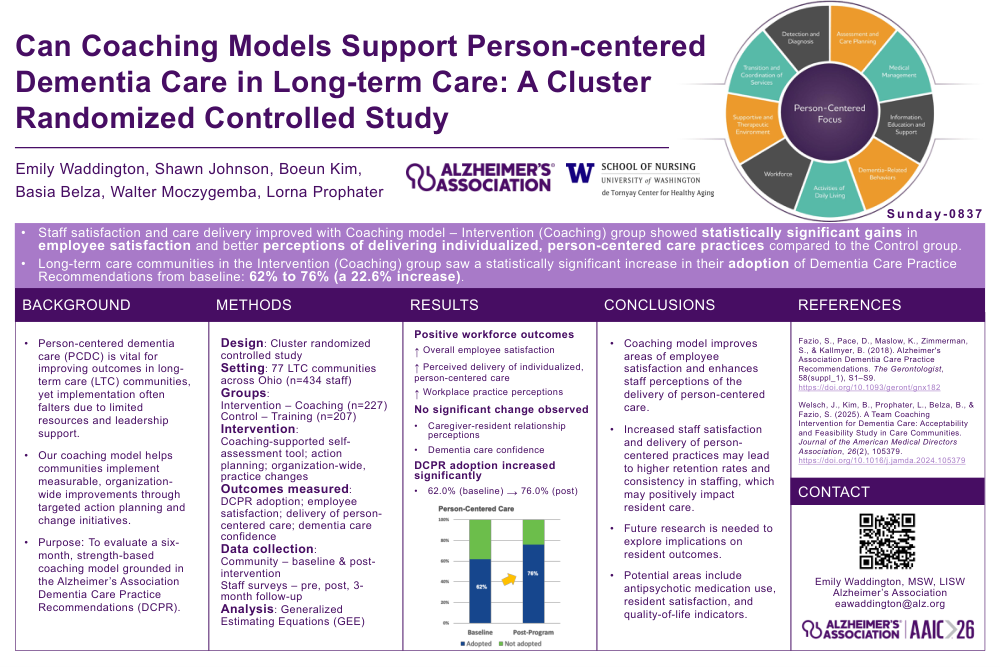
Can Coaching Models Support Person-centered Dementia Care In Long-term Care: A Cluster Randomized Controlled Study
Poster Presenter
Authors
Emily Waddington, Shawn Johnson, Boeun Kim, Basia Belza, Walter Moczygemba, Lorna Prophater
Affiliations
null,
Part of Topic
Can Coaching Models Support Person-centered Dementia Care in Long-term Care: A Cluster Randomized Controlled Study
Emily Waddington, Shawn Johnson, Boeun Kim,
Basia Belza, Walter Moczygemba, Lorna Prophater
Design: Cluster randomized controlled study
Setting: 77 LTC communities across Ohio (n=434 staff)
Groups:
Intervention – Coaching (n=227)
Control – Training (n=207)
Intervention:
Coaching-supported self- assessment tool; action planning; organization-wide, practice changes
Outcomes measured:
DCPR adoption; employee satisfaction; delivery of person-centered care; dementia care confidence
Data collection:
Community – baseline & post-intervention
Staff surveys – pre, post, 3-month follow-up
Analysis: Generalized Estimating Equations (GEE)
Results
Positive workforce outcomes
↑ Overall employee satisfaction
↑ Perceived delivery of individualized, person-centered care
↑ Workplace practice perceptions
No significant change observed
DCPR adoption increased significantly
Fazio, S., Pace, D., Maslow, K., Zimmerman, S., & Kallmyer, B. (2018). Alzheimer's Association Dementia Care Practice Recommendations. The Gerontologist, 58(suppl_1), S1–S9. https://doi.org/10.1093/geront/gnx182
Welsch, J., Kim, B., Prophater, L., Belza, B., & Fazio, S. (2025). A Team Coaching Intervention for Dementia Care: Acceptability and Feasibility Study in Care Communities. Journal of the American Medical Directors Association, 26(2), 105379. https://doi.org/10.1016/j.jamda.2024.105379
Contact
Emily Waddington, MSW, LISW
Alzheimer’s Association
eawaddington@alz.org
Comments
Email is required but is not shown publicly.
Loading comments...