4,068 posters, 219 videos, 101 topics, 69 sessions, 14,365 authors, 6,128 institutions
ePostersLive by SciGen Technologies S.A. All rights reserved.
Alzheimer's Association International Conference 2026
July 12-15, 2026 | London, United Kingdom, and Online

696
Advancing Inclusion By Transforming Dementia Narratives Through School-based Education: Lessons From Brazilian Public Schools
Poster Presenter
Part of Topic
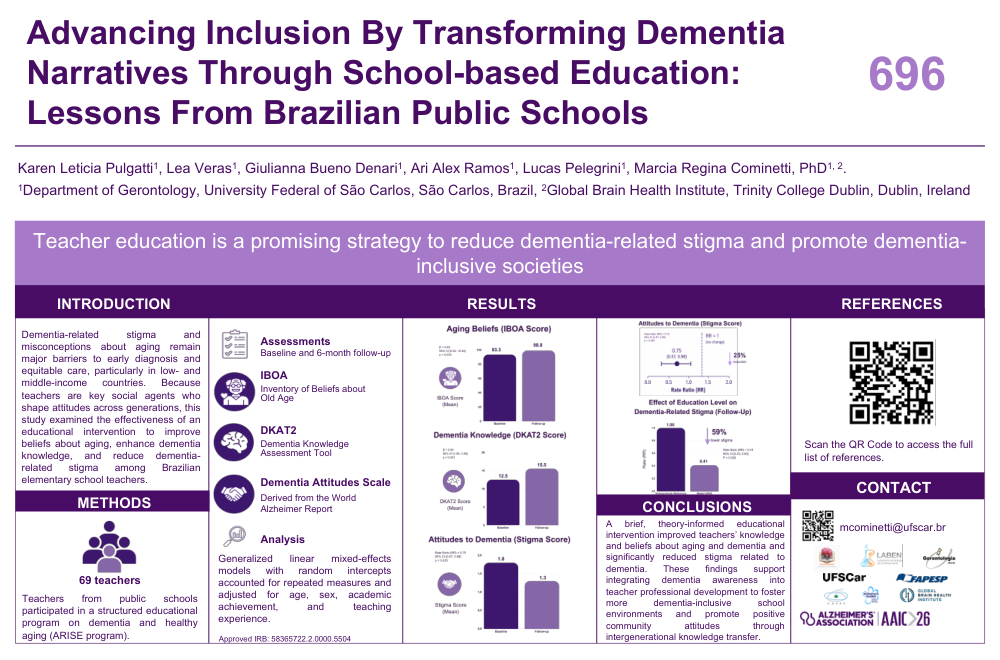
BACKGROUND: Dementia-related stigma and misconceptions about aging remain major barriers to early diagnosis and equitable care, particularly in low- and middle-income countries. Given that teachers are key social agents who shape attitudes across generations, the present study addressed the effectiveness of an educational intervention in improving beliefs about aging and dementia knowledge, and in reducing dementia-related stigma among Brazilian elementary school teachers. METHODS: Following a validated pilot implementation (doi: 10.1002/dad2.70208), this pre-post intervention study recruited 69 teachers (65% female; mean age = 47.8 years, SD = 9.4) from public schools who participated in a structured educational program on dementia and healthy aging (ARISE program). Participants completed assessments at baseline and at the 6-month follow-up using the Inventory of Beliefs about Old Age (IBOA), the dementia knowledge assessment tool (DKAT2), and the dementia attitudes scale derived from the World Alzheimer Report. We implemented generalized linear mixed-effects models with random intercepts to account for repeated measures within individuals, adjusting for age, sex, academic achievement, and years of teaching experience. RESULTS: Gaussian mixed-effects models revealed significant intervention effects on both aging beliefs and dementia knowledge. Overall, teachers showed relevant improvements in attitudes toward aging (β = 5.49, 95% CI [0.52, 10.46], p = .030) and substantial gains in dementia knowledge (β = 2.94, 95% CI [1.94, 3.95], p < .001) from baseline to follow-up. The Poisson mixed-effects model demonstrated that follow-up assessments were associated with a 25% reduction in dementia-related stigma scores compared with baseline (Rate Ratio [RR] = 0.75, 95% CI [0.57, 0.98], p = .035). Notably, teachers holding Master's or Doctoral degrees exhibited 59% lower rates of dementia-related stigma compared to those with only undergraduate education (RR = 0.41, 95% CI [0.20, 0.80], p = .009), suggesting that higher education may promote more inclusive attitudes. CONCLUSIONS: A brief, theory-informed educational intervention yielded meaningful improvements in teachers’ knowledge and beliefs about aging and dementia while significantly reducing stigmatizing dementia-related attitudes. Collectively, these outcomes support integrating dementia awareness programs into teacher professional development, potentially creating more dementia-inclusive school environments and influencing broader community attitudes through intergenerational knowledge transfer.
Comments
Email is required but is not shown publicly.
Loading comments...