4,068 posters, 219 videos, 101 topics, 69 sessions, 14,365 authors, 6,128 institutions
ePostersLive by SciGen Technologies S.A. All rights reserved.
Alzheimer's Association International Conference 2026
July 12-15, 2026 | London, United Kingdom, and Online

9516
Plasma Markers Of Microglial Activation, Axonal Degeneration, And Cognitive Functioning In A Cohort Of Cognitively Normal Black Adults
Poster Presenter
Authors
Ramkrishna K. Singh, Semere Bekena, Alexis I.B. Walker, Yiqi Zhu, Jean-Francois Trani, Ganesh M. Babulal
Affiliations
Department of Neurology, Mayo Clinic, Rochester, MN, USA, Department of Neurology, Washington University School of Medicine, St Louis, Missouri, USA, School of Public Health, Washington University in St Louis, Missouri, USA
Part of Topic
Abstract
Background
Plasma triggering receptor expressed on myeloid cells 2 (TREM2), neurofilament light chain (NfL), and C-reactive protein (CRP) reflect microglial activation, axonal injury, and systemic inflammation, respectively, and are increasingly examined in relation to cognitive performance. Although these biological processes often co-occur, biomarkers are usually studied independently, leaving unclear whether cognitive associations vary across immune and neurodegenerative contexts beyond amyloid-centered models. This gap is especially relevant for Black adults, who are disproportionately affected by dementia yet underrepresented in biomarker research. We examined whether plasma TREM2 and NfL show interactive and nonlinear associations with cognitive performance in Black adults.
Methods
Baseline data were analyzed from 334 Black adults aged ≥45 years enrolled in the Aging Research Characterizing Health Exposome via Social Drivers (ARCHES) study. Cognitive performance was assessed using the Preclinical Alzheimer Cognitive Composite (PACC). Plasma TREM2, NfL, and CRP were quantified using IP-MS and NULISA™ assays. Generalized linear models evaluated associations of TREM2 and NfL with cognitive performance, adjusting for age, sex, and education with false discovery rate correction. Sensitivity analyses included CRP, apolipoprotein E (APOE) ε4 genotype, and Area Deprivation Index (ADI). Generalized additive models assessed nonlinear effects.
Findings
Participants had a mean age of 66·9 years (SD 10·1), and 76·3% were women. TREM2 (β = −2·7 × 10⁻⁴; p=0·011; FDR p=0·020) and NfL (β = −2·2 × 10⁻⁴; p=0·001; FDR p=0·004) were independently associated with PACC scores with a significant TREM2×NfL interaction (β = 2·3 × 10⁻⁷; p=0·015; FDR p=0·021). In sensitivity analyses, the TREM2×CRP interaction was significant (β −5·0×10⁻⁸; p=0·022; FDR p=0·031), while CRP showed no significant independent association with PACC (p=0·415), and persisted after adjustment for APOE ε4 genotype (p=0·032) and ADI (p=0·030). Generalized additive models identified significant nonlinear effects for TREM2 (p=0·002) and TREM2–NfL interaction (p=0·002), with improved model fit (Δ deviance 8·84; p=0·001).
Interpretation
TREM2 shows significant interaction and nonlinear associations with NfL and CRP in relation to cognitive performance in Black adults, suggesting that biomarker–cognition associations vary across immune and neurodegenerative contexts. Integrating immune-related and neurodegeneration biomarkers may improve interpretation of blood-based cognitive risk profiles and inform preclinical risk stratification.
Table 1: Associations of Microglial Activation and Axonal Injury with Cognitive Performance
|
Predictor |
β Estimate |
Std. Error |
t value |
p value |
FDR-adjusted p |
|
Intercept |
0.667 |
0.319 |
2.087 |
0.037* |
0.037* |
|
TREM2 |
−2.700 × 10⁻⁴ |
1.100 × 10⁻⁴ |
−2.535 |
0.011* |
0.020* |
|
NfL |
−2.200 × 10⁻⁴ |
7.000 × 10⁻⁵ |
−3.263 |
0.001** |
0.004** |
|
Age (years) |
−0.016 |
0.003 |
−4.260 |
<0.001*** |
<0.001*** |
|
Sex (Male vs Female) |
−0.235 |
0.092 |
−2.573 |
0.010* |
0.020* |
|
Education (years) |
0.030 |
0.014 |
2.207 |
0.028* |
0.032* |
|
TREM2 × NfL |
2.300 × 10⁻⁷ |
9.000 × 10⁻⁸ |
2.432 |
0.015* |
0.021* |
Notes: Model N = 311; model R² = 0.157; AIC = 631. Age and education were modeled in years; sex was coded as male vs female. β (SE) denotes the estimated regression coefficient and its standard error; t value represents the test statistic from the generalized linear model. False discovery rate (FDR)–adjusted p values were calculated using the Benjamini–Hochberg procedure. The TREM2 × NfL interaction term reflects whether microglial activation modifies the cross-sectional association between axonal injury and cognitive performance.
Abbreviations: AIC, Akaike Information Criterion; FDR, false discovery rate; NfL, neurofilament light chain; PACC, Preclinical Alzheimer Cognitive Composite; SE, standard error; TREM2, triggering receptor expressed on myeloid cells 2.
*** p < 0.001; ** p < 0.01; * p < 0.05.
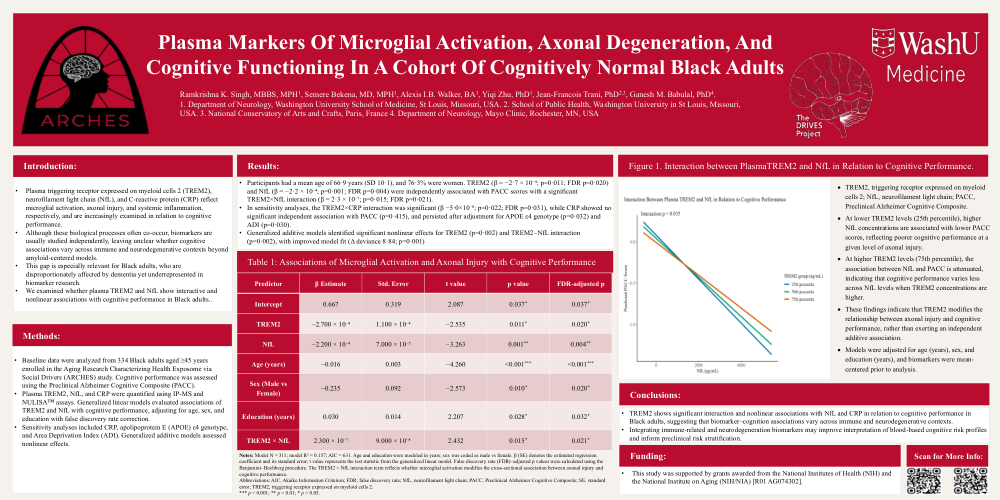
Figure 1:
- TREM2, triggering receptor expressed on myeloid cells 2; NfL, neurofilament light chain; PACC, Preclinical Alzheimer Cognitive Composite.
- At lower TREM2 levels (25th percentile), higher NfL concentrations are associated with lower PACC scores, reflecting poorer cognitive performance at a given level of axonal injury.
- At higher TREM2 levels (75th percentile), the association between NfL and PACC is attenuated, indicating that cognitive performance varies less across NfL levels when TREM2 concentrations are higher.
- These findings indicate that TREM2 modifies the relationship between axonal injury and cognitive performance, rather than exerting an independent additive association.
- Models were adjusted for age (years), sex, and education (years), and biomarkers were mean-centered prior to analysis.
Comments
Email is required but is not shown publicly.
Loading comments...