4,068 posters, 219 videos, 101 topics, 69 sessions, 14,365 authors, 6,128 institutions
ePostersLive by SciGen Technologies S.A. All rights reserved.
Alzheimer's Association International Conference 2026
July 12-15, 2026 | London, United Kingdom, and Online

2357
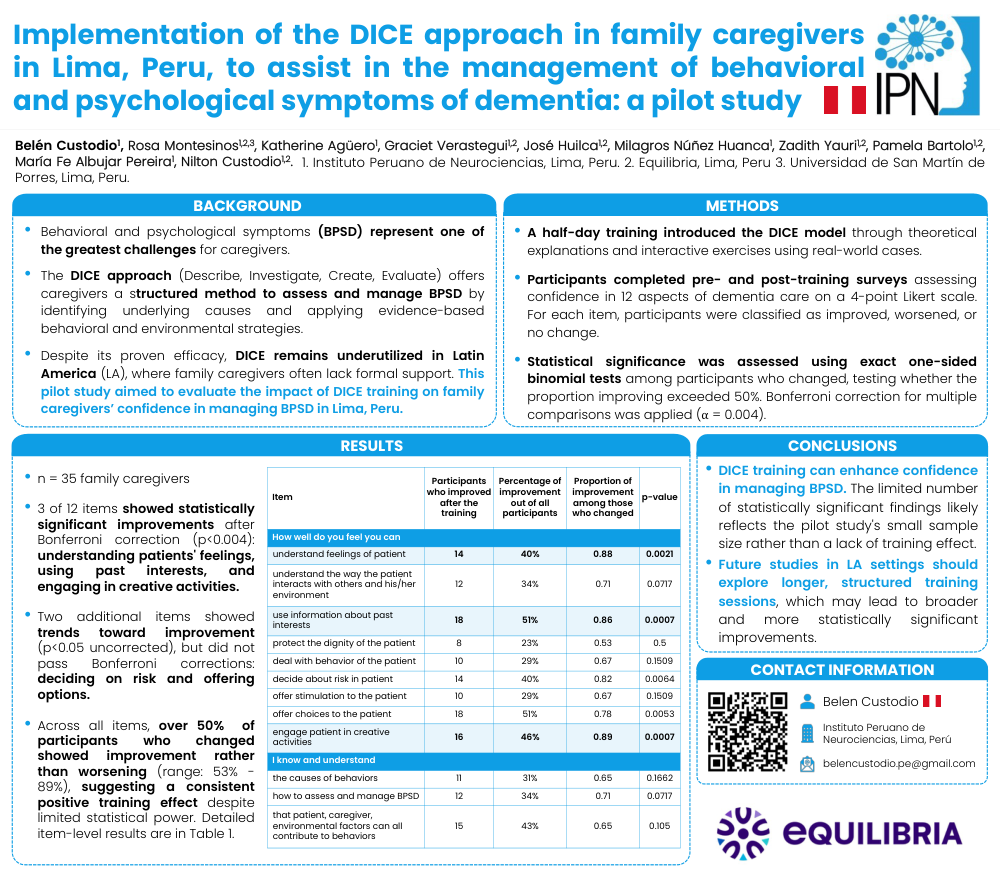
Implementation Of The DICE Approach With Family Caregivers In Lima, Peru, To Assist In The Management Of BPSD
Poster Presenter
Part of Topic
BACKGROUND
• Behavioral and psychological symptoms (BPSD) represent one of the greatest challenges for caregivers.
• The DICE approach (Describe, Investigate, Create, Evaluate) offers caregivers a structured method to assess and manage BPSD by identifying underlying causes and applying evidence-based behavioral and environmental strategies.
• Despite its proven efficacy, DICE remains underutilized in Latin America (LA), where family caregivers often lack formal support. This pilot study aimed to evaluate the impact of DICE training on family caregivers’ confidence in managing BPSD in Lima, Peru.
METHODS
• A half-day training introduced the DICE model through theoretical explanations and interactive exercises using real-world cases.
• Participants completed pre- and post-training surveys assessing confidence in 12 aspects of dementia care on a 4-point Likert scale. For each item, participants were classified as improved, worsened, or no change.
• Statistical significance was assessed using exact one-sided binomial tests among participants who changed, testing whether the proportion improving exceeded 50%. Bonferroni correction for multiple comparisons was applied (α = 0.004).
RESULTS
• n = 35 family caregivers
• 3 of 12 items showed statistically significant improvements after Bonferroni correction (p<0.004): understanding patients' feelings, using past interests, and engaging in creative activities.
• Two additional items showed trends toward improvement (p<0.05 uncorrected), but did not pass Bonferroni corrections: deciding on risk and offering options.
• Across all items, over 50% of participants who changed showed improvement rather than worsening (range: 53% - 89%), suggesting a consistent positive training effect despite limited statistical power. Detailed item-level results are in Table 1.
CONCLUSIONS
• DICE training can enhance confidence in managing BPSD. The limited number of statistically significant findings likely reflects the pilot study's small sample size rather than a lack of training effect.
• Future studies in LA settings should explore longer, structured training sessions, which may lead to broader and more statistically significant improvements.
Comments
Email is required but is not shown publicly.
Loading comments...