4,068 posters, 219 videos, 101 topics, 69 sessions, 14,365 authors, 6,128 institutions
ePostersLive by SciGen Technologies S.A. All rights reserved.
Alzheimer's Association International Conference 2026
July 12-15, 2026 | London, United Kingdom, and Online

5846
Complex Aging In Intellectual And Development Disabilities: Lessons From The Brain Health-IDD ECHO Program
Poster Presenter
Authors
Marie-Joelle Beaudoin, Mary Chiu, Taylor Manuge, Prachi Patel, Anupam Thakur, Tiziana Volpe, Nicole Bobette, Yona Lunsky
Affiliations
Azrieli Adult Neurodevelopmental Centre, Centre for Addiction and Mental Health (CAMH), Toronto, CAN., Research & Academics, Ontario Shores Centre for Mental Health Sciences, Whitby, CAN. and Faculty of Health Sciences, Ontario Tech University, Oshawa, CAN., School of Rehabilitation Therapy, Queen’s University, Kingston, CAN.
Part of Topic
Background:
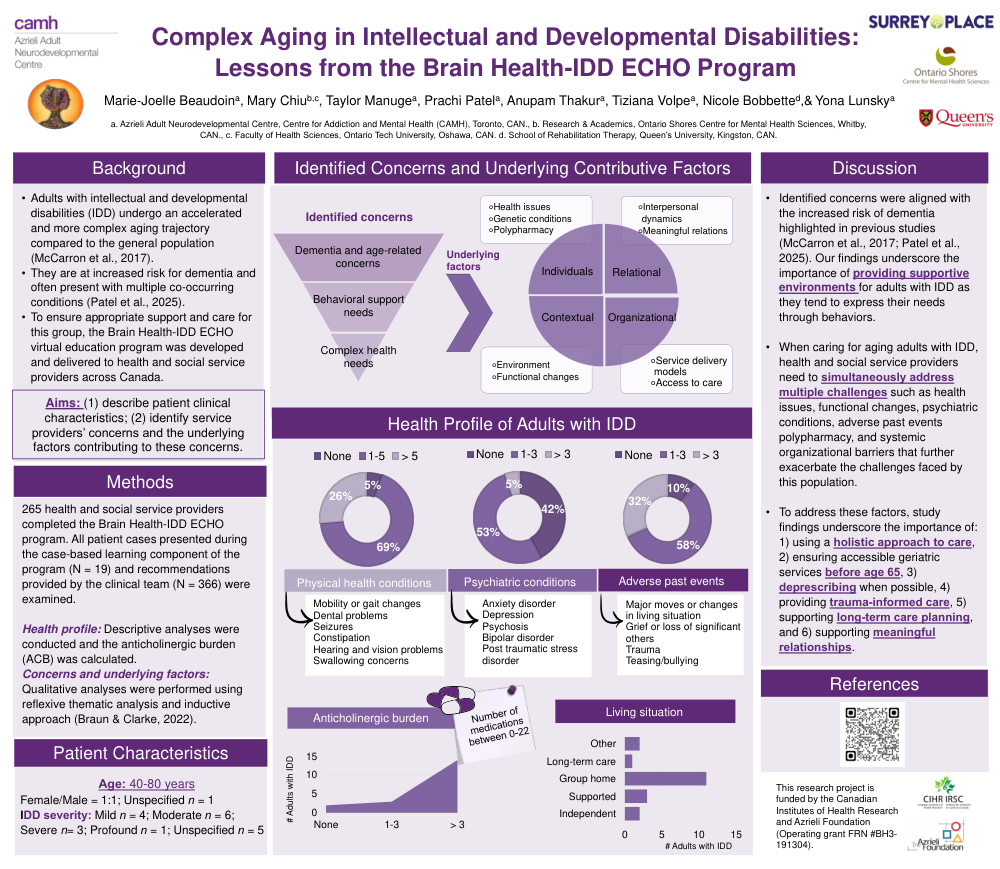
Adults with intellectual and developmental disabilities (IDD) undergo an accelerated and more complex aging trajectory compared to the general population (McCarron et al., 2017). They are at increased risk for dementia and often present with multiple co-occurring conditions (Patel et al., 2025). To ensure appropriate support and care for this group, the Brain Health-IDD ECHO virtual education program was developed and delivered to health and social service providers across Canada.
Methods:
A total of 265 health and social service providers completed the Brain Health-IDD ECHO program. This study examines all patient cases presented during the case-based learning component of the program (N=19) and recommendations provided by the clinical team (N = 366). We aim to (1) describe patient demographics and clinical characteristics; (2) identify service providers’ concerns and (3) analyze the recommendations provided by the clinical team. Descriptive analyses were conducted, anticholinergic burden (ACB) was calculated using King & Rabino’s (2024) online calculator (https://www.acbcalc.com/) and qualitative analyses were performed using a reflexive thematic approach (Braun & Clarke, 2022).
Results:
Nineteen patients with IDD, aged 40–80 years (female-to-male ratio was 9:9, with one non-identified gender), were presented by health and social services providers. Patients had between one and nine co-occurring health conditions and more than half had one comorbid psychiatric disorder. The mean ACB score was 4.79 ± 3.80 with 64% of the patients presenting a score ≥ 3. Dementia-related issues were the most frequently identified concerns, followed by behavioral challenges and complex health needs. Four overarching themes were identified as contributive factors for concerns: individual (e.g., health issues, genetic conditions, polypharmacy), contextual (e.g., environment, functional changes), relational (e.g., interpersonal dynamics) and organizational (e.g., service delivery models, access to care).
Conclusion:
Identified concerns were aligned with the increased risk of dementia highlighted in previous studies (McCarron et al., 2017; Patel et al., 2025). Our findings underscore the importance of providing supportive environments for adults with IDD as they tend to express their needs through behaviors. When caring for aging adults with IDD, health and social service providers need to simultaneously address multiple challenges such as health issues, functional changes, psychiatric conditions, adverse past events polypharmacy, and systemic organizational barriers that further exacerbate the challenges faced by this population. To address these factors, study findings underscore the importance of: 1) using a holistic approach to care, 2) ensuring accessible geriatric services before age 65, 3) deprescribing when possible, 4) providing trauma-informed care, 5) supporting long-term care planning, and 6) supporting meaningful relationships.
Comments
Email is required but is not shown publicly.
Loading comments...