4,068 posters, 219 videos, 101 topics, 69 sessions, 14,365 authors, 6,128 institutions
ePostersLive by SciGen Technologies S.A. All rights reserved.
Alzheimer's Association International Conference 2026
July 12-15, 2026 | London, United Kingdom, and Online

4930
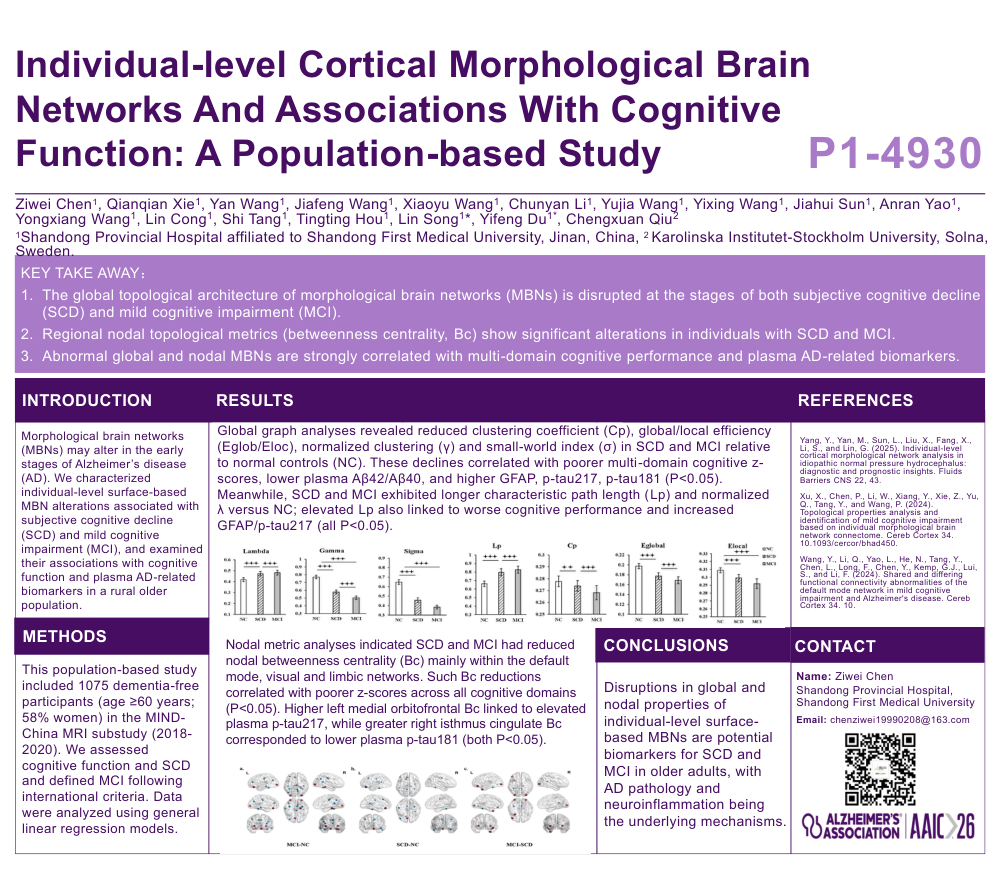
Individual-level Cortical Morphological Brain Networks And Associations With Cognitive Function: A Population-based Study
Poster Presenter
Part of Topic
Searchable Abstract for Poster Presentation (AAIC 2026)
Title: Disruption of Morphological Brain Network Topology in Subjective Cognitive Decline and Mild Cognitive Impairment: Associations with Cognition and Plasma Biomarkers
Authors: Ziwei Chen (Presenter), [Co-authors as listed: Y. Yang, M. Yan, L. Sun, X. Liu, X. Fang, S. Li, G. Lin]
Affiliation: Shandong Provincial Hospital, Shandong First Medical University
Background & Objective:
Morphological brain networks (MBNs) may serve as early indicators of Alzheimer's disease (AD) pathology. This study investigated alterations in individual-level, surface-based MBNs in older adults with subjective cognitive decline (SCD) and mild cognitive impairment (MCI) and explored their associations with multi-domain cognitive performance and plasma AD biomarkers.
Methods:
We analyzed data from 1,075 dementia-free participants (age ≥60, 58% female) from the MIND-China MRI substudy. Participants were categorized into NC, SCD, and MCI groups. Global and nodal topological properties of MBNs were computed and correlated with cognitive z-scores and plasma biomarkers (Aβ42/Aβ40, GFAP, p-tau217, p-tau181).
Key Results:
-
Global Topology: Both SCD and MCI groups exhibited significant disruptions in global network architecture (reduced clustering, efficiency, and small-worldness), with these alterations strongly correlated with poorer cognitive performance and abnormal plasma biomarker levels (all P<0.05).
-
Nodal Topology: Nodal betweenness centrality (Bc) was reduced in SCD and MCI, primarily within the default mode, visual, and limbic networks. These regional Bc reductions were linked to cognitive decline and specifically associated with plasma p-tau levels.
-
Conclusion: Disruptions in MBN global and nodal properties are potential biomarkers for SCD and MCI, with underlying mechanisms linked to AD pathology and neuroinflammation. These findings provide insights into early structural brain changes in the AD continuum.
Contact Information:
Ziwei Chen
Shandong Provincial Hospital, Shandong First Medical University
Email: chenziwei19990208@163.com
Suggested Keywords for Indexing
-
Morphological Brain Networks
-
Mild Cognitive Impairment (MCI)
-
Subjective Cognitive Decline (SCD)
-
Alzheimer's Disease Biomarkers
-
Plasma p-tau217
-
Brain Topology
-
Graph Theory
Comments
Email is required but is not shown publicly.
Loading comments...