4,068 posters, 219 videos, 101 topics, 69 sessions, 14,365 authors, 6,128 institutions
ePostersLive by SciGen Technologies S.A. All rights reserved.
Alzheimer's Association International Conference 2026
July 12-15, 2026 | London, United Kingdom, and Online

10238
Who Benefits Most? A Responder Analysis Of The Nomad Home-based Psychosocial Intervention In North Macedonia
Poster Presenter
Authors
Andrea Ivanovska, Marija Taneska, Svetlana Iloski, Antoni Novotni, Julia Fischer, Vildan Dogan, Milos Milutinovic, Ljubisha Novotni, Shpresa Hasani, Timo Grimmer, Alexander Kurz, Vesna Dimitrova, Mia Micevska, Ivan Chorbev, Boban Joksimoski, Gabriela Novotni
Affiliations
Institute for Alzheimer’s Disease and Neuroscience, Skopje, North Macedonia, Center for Cognitive Disorders, Technical University of Munich, Munich, Germany, University Clinic of Psychiatry, Skopje, North Macedonia, Faculty of Computer Science & Engineering, Ss. Cyril and Methodius University, Skopje, North Macedonia
Part of Topic
Here is the poster text exactly as extracted, with nothing added:
ALZHEIMER'S ASSOCIATION
INTERNATIONAL CONFERENCE
AAIC 2026
London, UK & Online · July 12–15, 2026
Poster aaic2026.7b30e32
Who Benefits Most?
A responder analysis of the NOMAD home-based psychosocial intervention in North Macedonia
NOMAD STUDY · North Macedonia Interprofessional Dementia Care
Andrea Ivanovska¹·² Marija Taneska¹ Svetlana Iloski¹ Antoni Novotni¹·³ Julia Fischer⁴ Vildan Dogan⁴ Milos Milutinovic³ Ljubisha Novotni³ Shpresa Hasani¹ Timo Grimmer⁴ Alexander Kurz⁴ Vesna Dimitrova⁵ Mia Micevska¹ Ivan Chorbev⁵ Boban Joksimoski⁵ Gabriela Novotni¹·⁶
¹ Institute for Alzheimer's Disease and Neuroscience, Skopje, North Macedonia ² University of Ljubljana, Ljubljana, Slovenia ³ University Clinic of Psychiatry, Skopje, North Macedonia
⁴ Center for Cognitive Disorders, Technical University of Munich, Munich, Germany ⁵ Faculty of Computer Science & Engineering, Ss. Cyril and Methodius University, Skopje, North Macedonia ⁶ University Clinic of Neurology, Skopje, North Macedonia
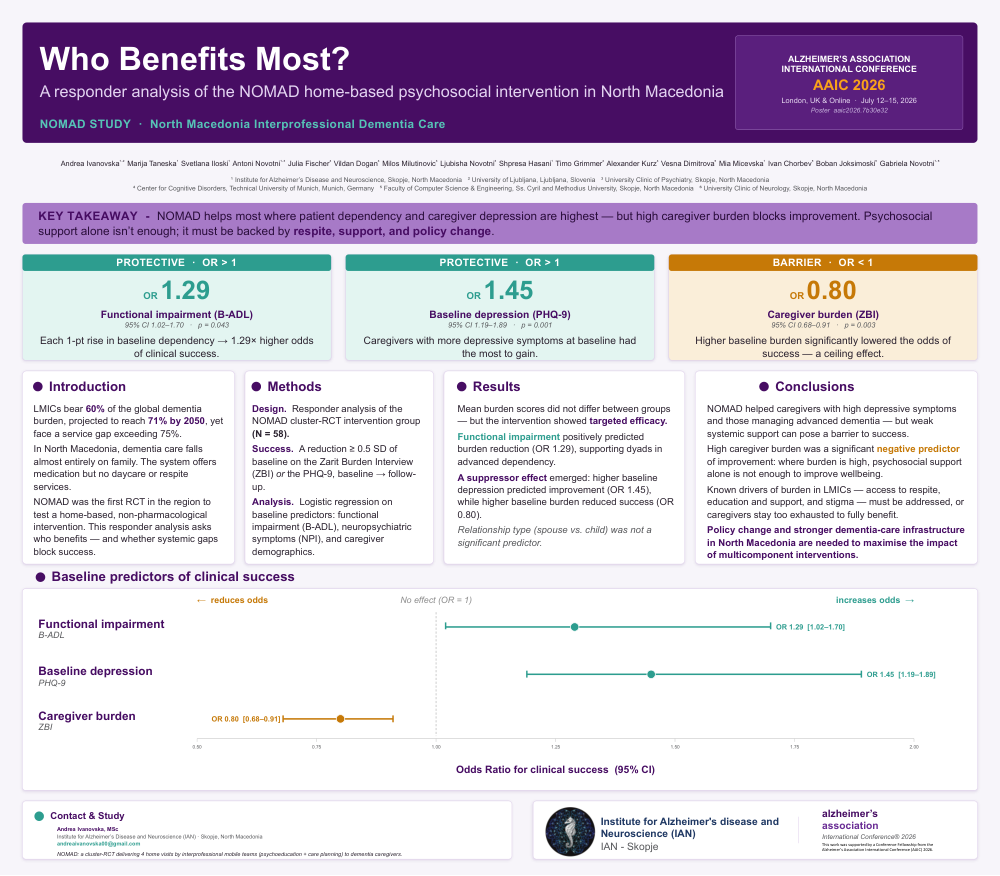
KEY TAKEAWAY - NOMAD helps most where patient dependency and caregiver depression are highest — but high caregiver burden blocks improvement. Psychosocial support alone isn't enough; it must be backed by respite, support, and policy change.
PROTECTIVE · OR > 1
OR 1.29
Functional impairment (B-ADL)
95% CI 1.02–1.70 · p = 0.043
Each 1-pt rise in baseline dependency → 1.29× higher odds of clinical success.
PROTECTIVE · OR > 1
OR 1.45
Baseline depression (PHQ-9)
95% CI 1.19–1.89 · p = 0.001
Caregivers with more depressive symptoms at baseline had the most to gain.
BARRIER · OR < 1
OR 0.80
Caregiver burden (ZBI)
95% CI 0.68–0.91 · p = 0.003
Higher baseline burden significantly lowered the odds of success — a ceiling effect.
Introduction
LMICs bear 60% of the global dementia burden, projected to reach 71% by 2050, yet face a service gap exceeding 75%.
In North Macedonia, dementia care falls almost entirely on family. The system offers medication but no daycare or respite services.
NOMAD was the first RCT in the region to test a home-based, non-pharmacological intervention. This responder analysis asks who benefits — and whether systemic gaps block success.
Methods
Design. Responder analysis of the NOMAD cluster-RCT intervention group (N = 58).
Success. A reduction ≥ 0.5 SD of baseline on the Zarit Burden Interview (ZBI) or the PHQ-9, baseline → followup.
Analysis. Logistic regression on baseline predictors: functional impairment (B-ADL), neuropsychiatric symptoms (NPI), and caregiver demographics.
Results
Mean burden scores did not differ between groups — but the intervention showed targeted efficacy.
Functional impairment positively predicted burden reduction (OR 1.29), supporting dyads in advanced dependency.
A suppressor effect emerged: higher baseline depression predicted improvement (OR 1.45), while higher baseline burden reduced success (OR 0.80).
Relationship type (spouse vs. child) was not a significant predictor.
Conclusions
NOMAD helped caregivers with high depressive symptoms and those managing advanced dementia — but weak systemic support can pose a barrier to success.
High caregiver burden was a significant negative predictor of improvement: where burden is high, psychosocial support alone is not enough to improve wellbeing.
Known drivers of burden in LMICs — access to respite, education and support, and stigma — must be addressed, or caregivers stay too exhausted to fully benefit.
Policy change and stronger dementia-care infrastructure in North Macedonia are needed to maximise the impact of multicomponent interventions.
Baseline predictors of clinical success
No effect (OR = 1)
0.50 0.75 1.00 1.25 1.50 1.75 2.00
Odds Ratio for clinical success (95% CI)
← reduces odds increases odds →
Functional impairment
B-ADL
OR 1.29 [1.02–1.70]
Baseline depression
PHQ-9
OR 1.45 [1.19–1.89]
Caregiver burden
ZBI
OR 0.80 [0.68–0.91]
Contact & Study
Andrea Ivanovska, MSc
Institute for Alzheimer's Disease and Neuroscience (IAN) · Skopje, North Macedonia
andreaivanovska00@gmail.com
NOMAD: a cluster-RCT delivering 4 home visits by interprofessional mobile teams (psychoeducation + care planning) to dementia caregivers.
alzheimer's
association
International Conference® 2026
This work was supported by a Conference Fellowship from the Alzheimer's Association International Conference (AAIC) 2026.
Institute for Alzheimer's disease and Neuroscience (IAN)
IAN - Skopje
Comments
Email is required but is not shown publicly.
Loading comments...