4,068 posters, 219 videos, 101 topics, 69 sessions, 14,365 authors, 6,128 institutions
ePostersLive by SciGen Technologies S.A. All rights reserved.
Alzheimer's Association International Conference 2026
July 12-15, 2026 | London, United Kingdom, and Online

3980
Differentials In The Quality Of Life Of Dementia Patients In The United Kingdom And Nigeria: A Comparative Analysis
Poster Presenter
Part of Topic
Title: Differentials In The Quality Of Life Of Dementia Patients In The United Kingdom And Nigeria: A Comparative Analysis
Olaoluwa POPOOLA,MB:BS, and Ayomipo ADEMILUSI, MS
United Lincolnshire Teaching Hospital Pilgrim, Boston, United Kingdom | University of Ibadan, Nigeria
KEY TAKEAWAYS
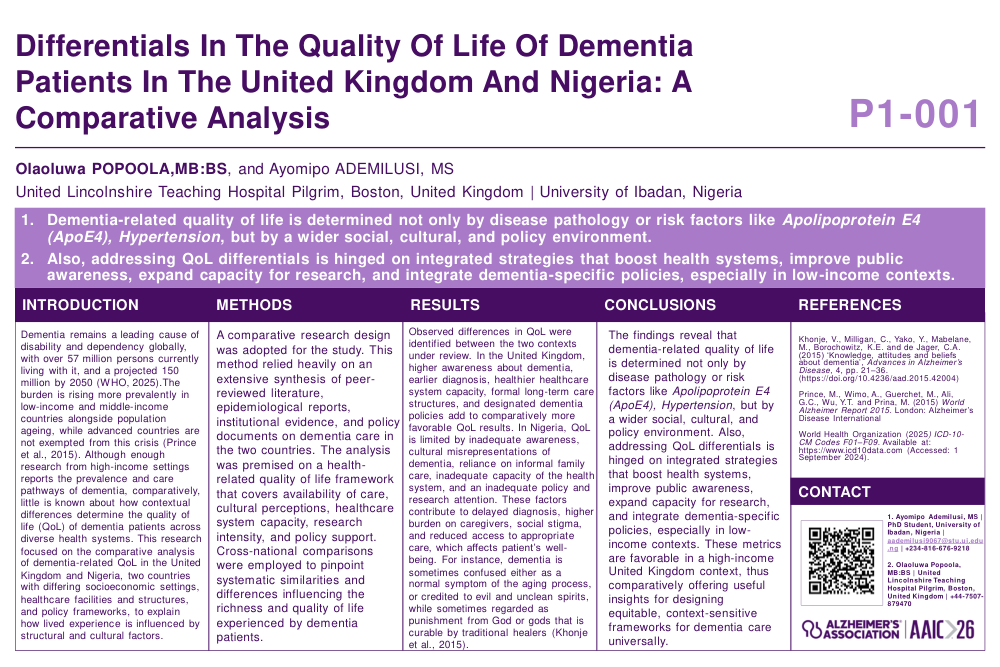
1. Dementia-related quality of life is determined not only by disease pathology or risk factors like Apolipoprotein E4 (ApoE4), Hypertension, but by a wider social, cultural, and policy environment.
2. Also, addressing QoL differentials is hinged on integrated strategies that boost health systems, improve public awareness, expand capacity for research, and integrate dementia-specific policies, especially in low-income contexts.
INTRODUCTION
Dementia remains a leading cause of disability and dependency globally, with over 57 million persons currently living with it, and a projected 150 million by 2050 (WHO, 2025).The burden is rising more prevalently in low-income and middle-income countries alongside population ageing, while advanced countries are not exempted from this crisis (Prince et al., 2015). Although enough research from high-income settings reports the prevalence and care pathways of dementia, comparatively, little is known about how contextual differences determine the quality of life (QoL) of dementia patients across diverse health systems. This research focused on the comparative analysis of dementia-related QoL in the United Kingdom and Nigeria, two countries with differing socioeconomic settings, healthcare facilities and structures, and policy frameworks, to explain how lived experience is influenced by structural and cultural factors.
METHODS
A comparative research design was adopted for the study. This method relied heavily on an extensive synthesis of peerreviewed literature, epidemiological reports, institutional evidence, and policy documents on dementia care in the two countries. The analysis was premised on a healthrelated quality of life framework that covers availability of care, cultural perceptions, healthcare system capacity, research intensity, and policy support. Cross-national comparisons were employed to pinpoint systematic similarities and differences influencing the richness and quality of life experienced by dementia patients.
RESULTS
Observed differences in QoL were identified between the two contexts under review. In the United Kingdom, higher awareness about dementia, earlier diagnosis, healthier healthcare system capacity, formal long-term care structures, and designated dementia policies add to comparatively more favorable QoL results. In Nigeria, QoL is limited by inadequate awareness, cultural misrepresentations of dementia, reliance on informal family care, inadequate capacity of the health system, and an inadequate policy and research attention. These factors contribute to delayed diagnosis, higher burden on caregivers, social stigma, and reduced access to appropriate care, which affects patient’s wellbeing. For instance, dementia is sometimes confused either as a normal symptom of the aging process, or credited to evil and unclean spirits, while sometimes regarded as punishment from God or gods that is curable by traditional healers (Khonje et al., 2015).
CONCLUSIONS
The findings reveal that dementia-related quality of life is determined not only by disease pathology or risk factors like Apolipoprotein E4 (ApoE4), Hypertension, but by a wider social, cultural, and policy environment. Also, addressing QoL differentials is hinged on integrated strategies that boost health systems, improve public awareness, expand capacity for research, and integrate dementia-specific policies, especially in lowincome contexts. These metrics are favorable in a high-income United Kingdom context, thus comparatively offering useful insights for designing equitable, context-sensitive frameworks for dementia care universally.
REFERENCES
Khonje, V., Milligan, C., Yako, Y., Mabelane, M., Borochowitz, K.E. and de Jager, C.A. (2015) ‘Knowledge, attitudes and beliefs about dementia’, Advances in Alzheimer’s Disease, 4, pp. 2136. (https://doi.org/10.4236/aad.2015.42004)
Prince, M., Wimo, A., Guerchet, M., Ali, G.C., Wu, Y.T. and Prina, M. (2015) World Alzheimer Report 2015. London: Alzheimer’s Disease International
World Health Organization (2025) ICD-10-CM Codes F01–F09. Available at: https://www.icd10data.com (Accessed: 1 September 2024).
CONTACT
1. Ayomipo Ademilusi, MS | PhD Student, University of Ibadan, Nigeria | aademilusi9067@stu.ui.edu.ng | +234-816-676-9218
2. Olaoluwa Popoola, MB:BS | United Lincolnshire Teaching Hospital Pilgrim, Boston, UKUnited Kingdom
Comments
Email is required but is not shown publicly.
Loading comments...