4,068 posters, 219 videos, 101 topics, 69 sessions, 14,365 authors, 6,128 institutions
ePostersLive by SciGen Technologies S.A. All rights reserved.
Alzheimer's Association International Conference 2026
July 12-15, 2026 | London, United Kingdom, and Online

5414
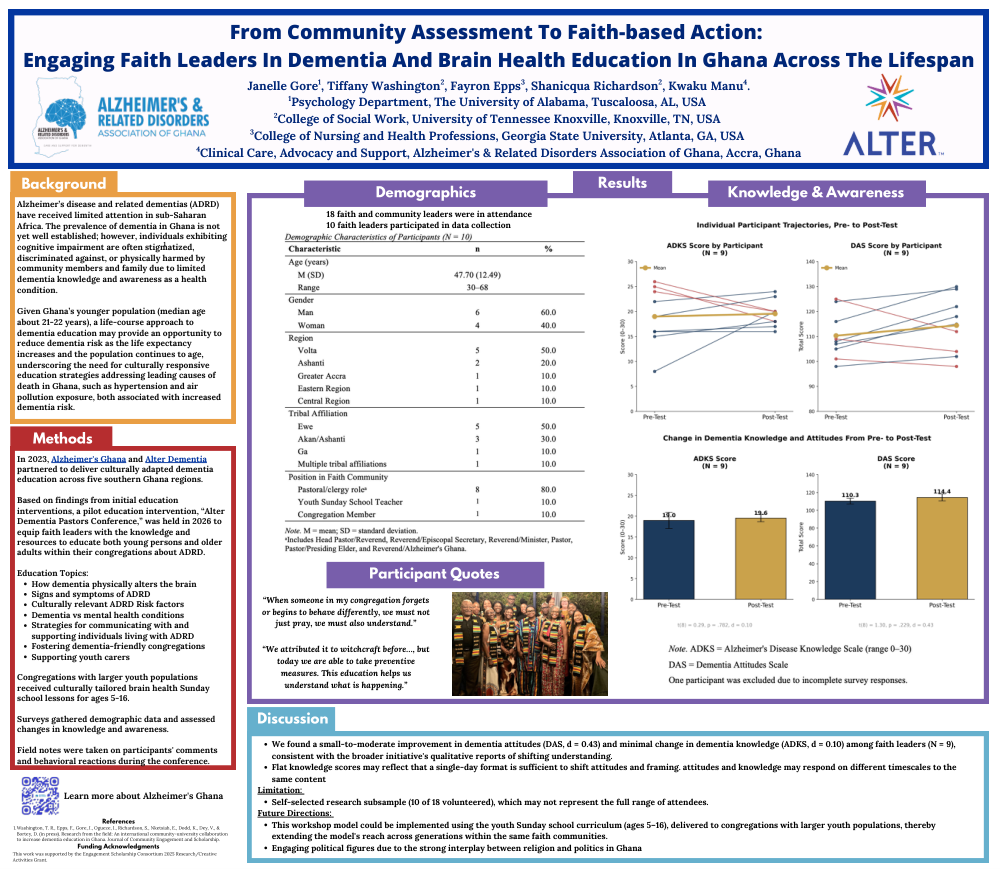
From Community Assessment To Faith-based Action: Engaging Faith Leaders In Dementia And Brain Health Education In Ghana Across The Lifespan
Poster Presenter
Authors
Janelle Gore, Tiffany Washington, Fayron Epps, Shanicqua Richardson, Kwaku Manu
Affiliations
Psychology Department, The University of Alabama, Tuscaloosa, AL, USA, College of Social Work, University of Tennessee Knoxville, Knoxville, TN, USA, College of Nursing and Health Professions, Gerogia State University, Atlanta, GA, USA, Clinical Care, Advocacy and Support, Alzheimer's & Related Disorders Association of Ghana, Accra, Ghana
Part of Topic
Background
Dementia is really understudied in sub-Saharan Africa — Ghana doesn't even have an established prevalence rate yet. But what we do know is that people with cognitive impairment there are often stigmatized, sometimes physically harmed, because symptoms get attributed to witchcraft or moral failure rather than understood as a disease.
The other piece driving this work is that Ghana has a really young population, with a median age of around 21 or 22. So there's an opportunity here to think about dementia risk across the whole lifespan, not just intervene once people are already older. A lot of the risk factors that matter in Ghana hypertension, air pollution exposure are things you can address early.
Methods
This builds on a partnership that started in 2023 between Alzheimer's Ghana and Alter Dementia, which delivered culturally adapted education across five regions in southern Ghana. Based on what worked in those earlier efforts, we ran a pilot in 2026 called the Alter Dementia Pastors Conference.
We picked faith leaders specifically because they're often the first point of contact when a family notices something's wrong, before anyone sees a doctor, they've usually talked to their pastor. So we trained them on brain physiology, signs and symptoms, culturally relevant risk factors, how to tell dementia apart from mental health conditions, communication strategies, and how to make congregations more dementia-friendly. Congregations with a lot of young members also got a Sunday school curriculum for ages 5 to 16, so kids could learn this too.
We collected demographic surveys, pre/post knowledge and attitude measures, and field notes on what people said and how they reacted during the sessions.
Demographics
Eighteen leaders attended, ten of them opted into the research component. Average age was about 48, roughly 60/40 men to women, and the group was mostly pastoral or clergy roles, with a couple of Sunday school teachers and lay members in the mix too.
Results
These are individual trajectories, one line per person, from pre-test to post-test. On knowledge, people were kind of all over the place, some went up, some went down, the group average barely moved. But on attitudes, you can see more lines trending upward, and the mean, that's the gold line, shifted more clearly.
Statistically, neither hit significance, and that's expected, we only had nine people in the final analysis after excluding one incomplete case, so this study just doesn't have the power to detect anything but a huge effect. But the effect size for attitudes was small-to-moderate, about a 0.43 Cohen's d, versus basically nothing for knowledge, at 0.10. So even without significance, there's a real signal there worth paying attention to.
Participant Quotes
This is honestly where the story is clearest. One participant told us, 'We attributed it to witchcraft before, but today we're able to take preventive measures — this education helps us understand what's happening.' Another said, 'When someone in my congregation forgets or begins to behave differently, we must not just pray, we must also understand.' That second quote really captures what we were going for — not replacing faith with medicine, but pairing them.
Discussion
A few honest caveats: this was a self-selected group — only 10 of the 18 attendees opted into the research piece, so it's probably not representative of everyone in the room. And it's a single time point with no control group, so we can't say for certain the workshop caused the shift versus something else going on.
Where we're headed next: we want to pair this adult-facing model with the youth Sunday school curriculum we already piloted, so the education reaches multiple generations in the same congregation. And because religion and politics are so closely intertwined in Ghana, there's real interest in bringing political and civic leaders into future iterations of this, not just clergy.
Anticipated Questions
Why did knowledge scores stay flat? Our best read is that a single-day format is enough to shift how people frame dementia, but not enough to move a 30-item fact-based knowledge test. Attitudes and knowledge probably change on different timelines.
Why exclude that one participant? Their survey responses were incomplete in a way that made their scores uninterpretable, so keeping them in would have distorted the analysis.
What's next for this project? Scaling to more regions in Ghana and other African contexts, using this pilot data to support funding applications to help strengthen Alzheimer's Ghana's infrastructure, and integrating the youth curriculum more fully, as Ghana has a young population (average age 22).
Comments
Email is required but is not shown publicly.
Loading comments...