4,068 posters, 219 videos, 101 topics, 69 sessions, 14,365 authors, 6,128 institutions
ePostersLive by SciGen Technologies S.A. All rights reserved.
Alzheimer's Association International Conference 2026
July 12-15, 2026 | London, United Kingdom, and Online

5336
Urban Resilience: The Rural Environment As A Protective Factor For Functionality And Quality Of Life In Patients With Cognitive Impairment.
Poster Presenter
Authors
Ignacio Flores, Mariana nastasi, Lorena Eletto, julian Fernandez Bocazzi, Maria Belen Martin Escandell, Santiago O Neill
Affiliations
null,
Part of Topic
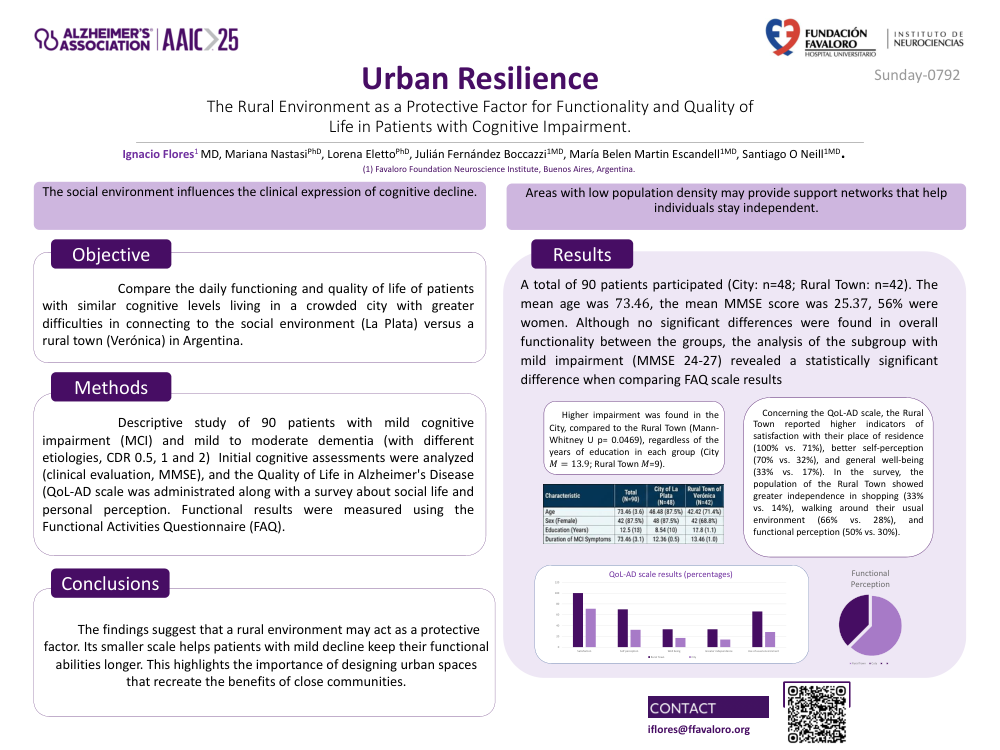
Background: The social environment influences the clinical expression of cognitive decline. Areas with low population density may provide support networks that help individuals stay independent. Our objective was to compare the daily functioning and quality of life of patients with similar cognitive levels living in a crowded city with greater difficulties in connecting to the social environment (La Plata) versus a country town (Verónica) in Argentina.
Methods: Descriptive study of 90 patients with mild cognitive impairment (MCI) and mild to moderate dementia (of different etiologies, CDR 0.5, 1 and 2). Initial cognitive assessments were analyzed (clinical evaluation, MMSE), and the Quality of Life in Alzheimer's Disease (QoL-AD) scale was administed along with a survey about social life and personal perception. Functional results were measured using the Functional Activities Questionnaire (FAQ). The statistical results were calculated using R program.
Results: A total of 90 patients participated (City: n=48; Country Town: n=42). The mean age was , the mean MMSE score was 2, 56% were women. Although no significant differences were found in overall functionality between the groups, the analysis of the subgroup with mild impairment (MMSE 24-27) revealed a statistically significant difference when comparing FAQ scale results. Higher impairment was found in the City, compared to the Country Town (Mann-Whitney U p= 0.0469), regardless of the years of education in each group (City ; Country Town ?=9). Concerning the QoL-AD scale, the Country Town reported higher indicators of satisfaction with their place of residence (100% vs. 71%), better self-perception (70% vs. 32%), and general well-being (33% vs. 17%). In the survey, the population of the Country Town showed greater independence in shopping (33% vs. 14%), walking around their usual environment (66% vs. 28%), and functional perception (50% vs. 30%).
Conclusions: These findings suggest that a rural environment may act as a protective factor. Its smaller scale helps patients with mild decline keep their functional abilities longer. This highlights the importance of designing urban spaces that recreate the benefits of close communities.
Comments
Email is required but is not shown publicly.
Loading comments...