4,068 posters, 219 videos, 101 topics, 69 sessions, 14,365 authors, 6,128 institutions
ePostersLive by SciGen Technologies S.A. All rights reserved.
Alzheimer's Association International Conference 2026
July 12-15, 2026 | London, United Kingdom, and Online

1348
Exploring The Relationship Between Loneliness And Cognitive/Functional Impairment In Unhoused Older Adults
Poster Presenter
Part of Topic
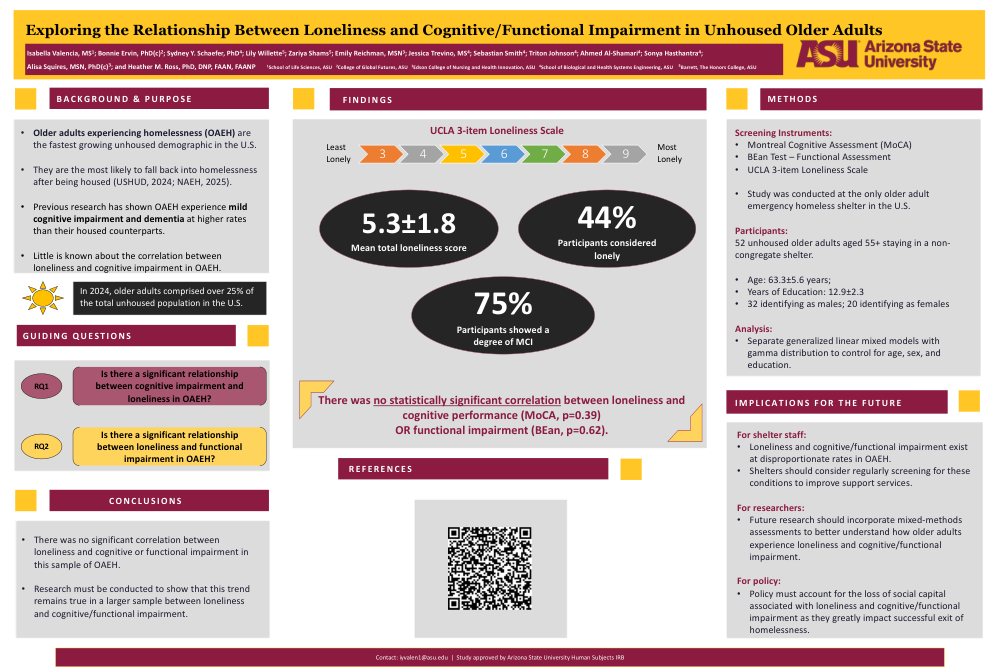
Background: Adults aged 55 and over make up the fastest growing segment of the homeless population in the United States, comprising nearly 25% of the unhoused population as of 2024. Dementia and mild cognitive impairment are noted to be disproportionately prevalent in unhoused older adults. In addition, loneliness in unhoused older adults is roughly twice as prevalent compared to housed counterparts, and is highly correlated with poor mental health. While loneliness and social isolation are known to increase the risk of dementia in community-dwelling older adults, little is known about the correlation between loneliness and cognitive impairment in the unhoused population.
Methods: The Montreal Cognitive Assessment (MoCA) was administered along with a brief performance-based measure of daily functioning (BEan) and the UCLA 3-Item Loneliness Scale to a sample of 52 unhoused older adults aged 55 and over staying in a non-congregate shelter (mean±SD age: 63.3±5.6 years; mean±SD years of education: 12.9±2.3; 32 males). The BEan was used as an alternative to other daily functioning measures that require an informant. Loneliness scores were calculated as the summed scores of the three items (“How often do you feel that you lack companionship?” “How often do you feel left out?” and “How often do you feel isolated from others?”), with a maximum loneliness score of 9. Separate generalized linear mixed models with gamma distribution were used to determine the extent to which loneliness scores were associated with MoCA scores and with BEan scores, controlling for age, sex, and education.
Results: Loneliness scores ranged from 3 to 9, with a mean±SD of 5.3±1.8. Based on published cut-off values from housed adults, 44% of the sample was considered “lonely” (score ≥6). However, loneliness scores were not significantly associated with MoCA scores (p=0.39) nor with BEan scores (p=0.62), even though 75% of participants had MoCA scores <26, suggesting some cognitive impairment.
Conclusions: In unhoused older adults in a non-congregate homeless shelter setting, there does not appear to be a significant relationship between loneliness and cognitive/functional impairment. More research is warranted to confirm this finding in a larger sample.
Comments
Email is required but is not shown publicly.
Loading comments...