4,068 posters, 219 videos, 101 topics, 69 sessions, 14,365 authors, 6,128 institutions
ePostersLive by SciGen Technologies S.A. All rights reserved.
Alzheimer's Association International Conference 2026
July 12-15, 2026 | London, United Kingdom, and Online

6475
Tolion Brain Coach: Ai-enabled Personalization For Brain Health Prevention
Poster Presenter
Authors
Affiliations
Part of Topic
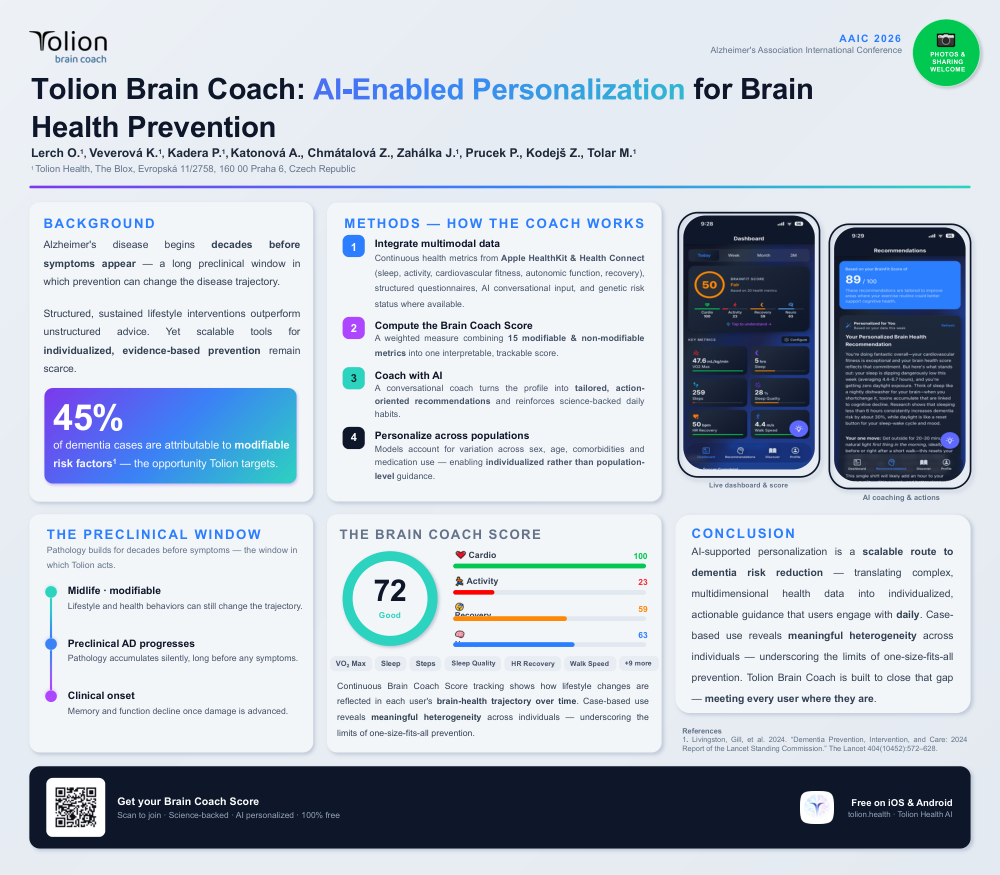
Tolion Brain Coach: AI-Enabled Personalization for Brain Health Prevention
Lerch, O.1, Veverova, K.1, Kadera, P. 1, Katonová, A., Chmátalová, Z., Zahálka, J. 1, Prucek P, Kodejs Z. Tolar, M.1
1 Tolion Health, The Blox, Evropská 11/2758, 160 00 Praha 6, Czech Republic
Background
The preclinical phase of Alzheimer's disease (AD) precedes the onset of clinical symptoms by decades, creating a substantial window for preventive interventions aimed at modifying disease trajectory. Recent evidence suggests that up to 45% of dementia cases may be attributable to modifiable risk factors, with structured and sustained lifestyle interventions demonstrating greater effectiveness than non-structured approaches. Despite this potential, scalable tools enabling individualized, evidence-based prevention strategies remain limited. Tolion Health AI developed the Tolion Brain Coach, a digital platform that delivers personalized brain health guidance grounded in current scientific evidence to support individuals in reducing their long-term risk of dementia.
Methods
The Tolion Brain Coach (i) integrates multimodal individual-level data, including continuous device-derived health metrics obtained through Apple HealthKit and Health Connect (covering sleep, physical activity, cardiovascular fitness, autonomic function, and recovery), self-reported information from structured questionnaires, AI-supported conversational input, and, where available, genetic risk status. The platform (ii) computes an individualized, weighted Brain Coach Score that combines fifteen modifiable and non-modifiable metrics into a single, interpretable measure of brain health. Using this profile, an AI conversational coach (iii) generates tailored, action-oriented recommendations targeting modifiable risk factors and reinforces science-backed daily habits. For carriers of high-risk genotypes, a dedicated APOE4 Protection Mode reframes guidance around protective behaviors. The underlying models account for variation across sex, age, comorbidities, and medication use, enabling individualized rather than population-level recommendations.
Results
The platform enables personalized risk profiling and continuous tracking of the Brain Coach Score, illustrating how targeted modifications in lifestyle and health behaviors are reflected in a user's brain health trajectory over time. Case-based use demonstrates meaningful heterogeneity in personalized recommendations across individuals, underscoring the limitations of one-size-fits-all prevention approaches.
Conclusion
AI-supported personalization may represent a scalable approach to dementia risk reduction by translating complex, multidimensional health data into individualized, actionable preventive guidance that users can engage with daily.
Comments
Email is required but is not shown publicly.
Loading comments...