4,068 posters, 219 videos, 101 topics, 69 sessions, 14,365 authors, 6,128 institutions
ePostersLive by SciGen Technologies S.A. All rights reserved.
Alzheimer's Association International Conference 2026
July 12-15, 2026 | London, United Kingdom, and Online

1893
Dementia Anti-stigma Intervention (DASI): A Lay Provider-led Approach To Enhance Awareness And Risk Reduction In Rural Kenya
Part of Topic
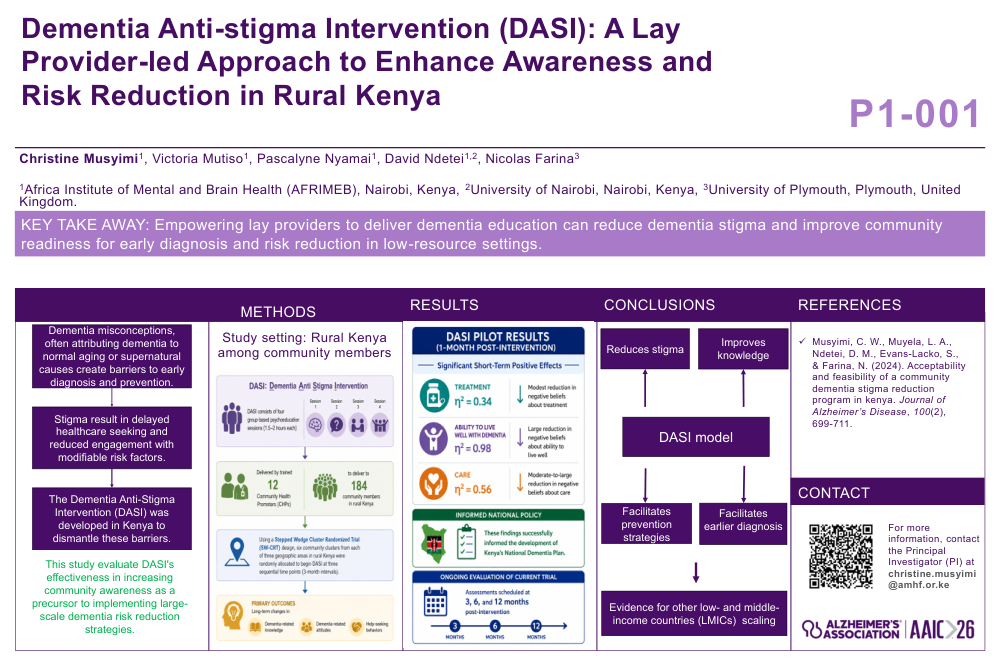
Background: In many Sub-Saharan African contexts, dementia misconceptions, often attributing dementia to normal aging or supernatural causes like witchcraft create significant barriers to early diagnosis and prevention. The social and structural stigma result in delayed healthcare seeking and reduced engagement with modifiable risk factors. The Dementia Anti-Stigma Intervention (DASI) was contextually developed in Kenya to dismantle these barriers through lay-provider-led psychoeducation. This study, funded by the Alzheimer’s Association, evaluates DASI's effectiveness in increasing community awareness as a critical precursor to implementing large-scale dementia risk reduction strategies.
Methods: DASI consists of four group-based psychoeducation sessions (1.5-2 hours each) refined through multidisciplinary workshops to address culturally specific beliefs. We trained 12 Community Health Promoters (CHPs) to deliver the intervention to 184 community members in rural Kenya. Using a Stepped Wedge Cluster Randomized Trial (SW-CRT) design, six community clusters from each of three geographic areas in rural Kenya were randomly allocated to begin DASI at three sequential time points (3-month intervals). Primary outcomes include long-term changes in dementia-related knowledge, attitudes, and help-seeking behaviors.
Results: Initial pilot data demonstrated significant short-term positive effects (one-month post-intervention), with modest-to-large reductions in negative beliefs regarding treatment (η² = 0.34), the ability to live well with dementia (η² = 0.98), and care (η² = 0.56). These findings successfully informed the development of Kenya’s National Dementia Plan. Evaluation of the current trial is ongoing, with assessments scheduled for 3-, 6-, and 12-months post-intervention to measure the sustainability of these improvements and their impact on community-level risk reduction beliefs.
Conclusion: Community-led psychoeducation via the DASI model reduces stigma, which is a vital structural prerequisite for improving dementia risk reduction strategies. By improving knowledge and dismantling cultural myths, DASI facilitates earlier diagnosis and greater community readiness for lifestyle-based prevention strategies. Findings from this trial will provide critical evidence for scaling lay-provider-led interventions across other low- and middle-income countries (LMICs) to support global brain health goals.
Comments
Email is required but is not shown publicly.
Loading comments...