4,068 posters, 219 videos, 101 topics, 69 sessions, 14,365 authors, 6,128 institutions
ePostersLive by SciGen Technologies S.A. All rights reserved.
Alzheimer's Association International Conference 2026
July 12-15, 2026 | London, United Kingdom, and Online

8942
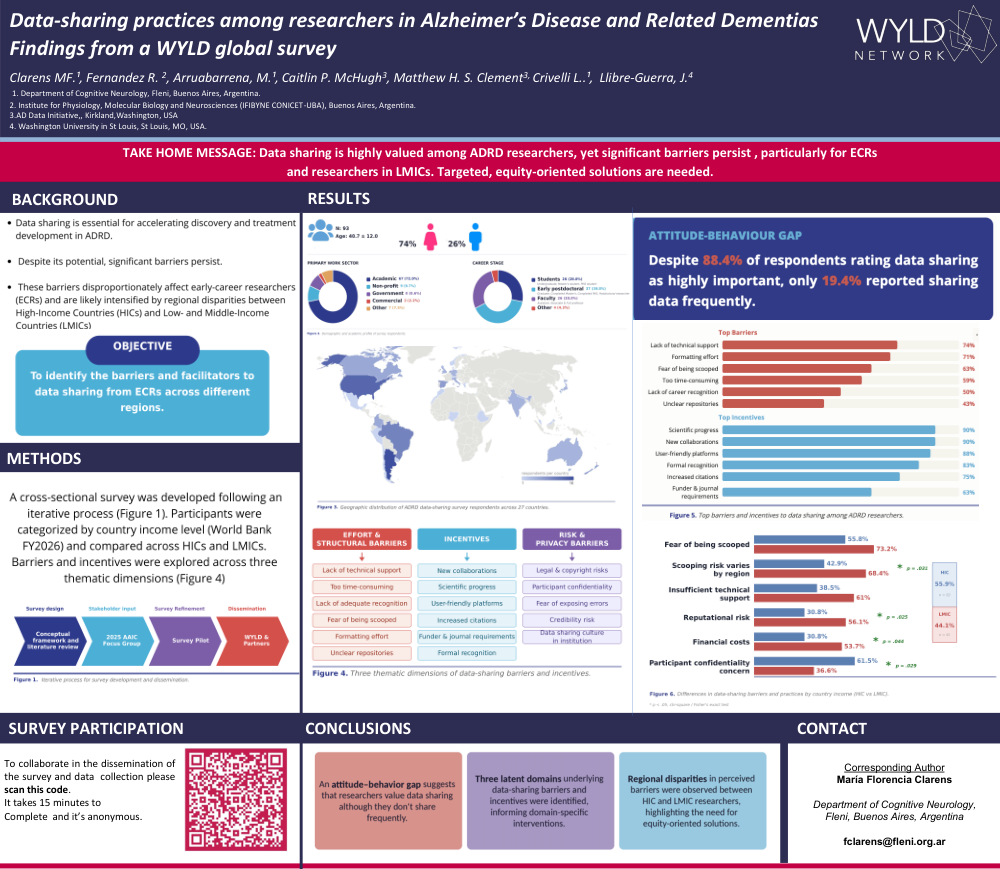
Data Sharing In Alzheimer's Disease Research: Preliminary Findings From A Wyld Global Survey
Poster Presenter
Authors
Maria Florencia Clarens, Rodrigo Fernandez, Micaela Arruabarrena, Caitlin P. McHugh, Matt HS Clement, Lucia Crivelli, Jorge Llibre-Guerra
Affiliations
Department of Cognitive Neurology, Fleni, Buenos Aires, Argentina, Institute for Physiology, Molecular Biology and Neurosciences (IFIBYNE CONICET-UBA), Buenos Aires, Argentina., AD Data Initiative, Kirkland, WA, USA, Washington University in St Louis, St Louis, MO, USA.
Part of Topic
Data-sharing practices among researchers in Alzheimer’s Disease and Related Dementias : Preliminary findings from a WYLD global survey
Clarens, MF¹; Fernandez, R2 ; Arruabarrena, M¹ ; McHugh, CP3 ; Clement, MHS 3 ; Crivelli, L¹ ; Llibre-Guerra, J4
1. Department of Cognitive Neurology, Fleni, Buenos Aires, Argentina.
2. Institute for Physiology, Molecular Biology and Neurosciences (IFIBYNE CONICET-UBA), Buenos Aires, Argentina.
3. AD Data Initiative, Kirkland, WA, USA
4. Washington University in St Louis, St Louis, MO, USA.
Background
Data sharing is essential for accelerating discovery and treatment development in Alzheimer's Disease and related dementias (ADRD). However, significant barriers persist, especially for early-career researchers (ECRs) and likely intensified by regional disparities between High-Income Countries (HICs) and Low- and Middle-Income Countries (LMICs). To better understand barriers and facilitators to data sharing among ECRs across regions, the World Young Leaders in Dementia (WYLD), in collaboration with the Alzheimer's Disease Data Initiative (AD Data Initiative), developed and disseminated a cross-sectional survey.
Methods
A cross-sectional survey was created using a conceptual framework from ADRD data-sharing literature. To ensure validity and cultural relevance, it was refined via a stakeholder focus group at AAIC 2025. The finalized survey was disseminated internationally via WYLD and partnerships with global dementia organizations. For analytic purposes, participants were categorized by country income level using the World Bank FY2026 income group classifications, and data-sharing practices and perceived barriers were compared between researchers from HICs and LMICs.
Results
The final sample included 93 respondents from 27 countries (74% women; mean age 40.7 ± 12.0 years). Although 88.4% rated data sharing as highly important, only 19.4% reported sharing frequently. The most commonly reported barriers were lack of technical support (74%), formatting effort (71%), and fear of being scooped (63%). Key incentives included scientific progress and new collaborations (both 90%), as well as the need for user-friendly platforms (88%) and formal recognition (83%). Comparative analyses revealed significant regional differences: LMIC researchers more frequently reported fear of being scooped (73.2% vs. 55.8%, p=.021) and perceived this risk as regionally dependent (68.4% vs. 42.9%, p=.021). They also reported higher rates of insufficient technical support (61% vs. 38.5%), reputational risk (56.1% vs. 30.8%, p=.025), and financial costs as barriers (53.7% vs. 30.8%, p=.044).
Conclusion
These findings highlight an attitude–behavior gap in ADRD data sharing and underscore persistent differences between HIC and LMIC researchers. Closing these gaps will likely require equity-oriented infrastructure, clearer guidance, and educational resources particularly for ECRs.
Comments
Email is required but is not shown publicly.
Loading comments...