4,068 posters, 219 videos, 101 topics, 69 sessions, 14,365 authors, 6,128 institutions
ePostersLive by SciGen Technologies S.A. All rights reserved.
Alzheimer's Association International Conference 2026
July 12-15, 2026 | London, United Kingdom, and Online

10058
User-centered Design Approach To Co-creating An Alzheimer's Disease Blood Biomarker Testing Pathway With Primary Care Providers
Poster Presenter
Authors
Affiliations
Part of Topic
Title: User-centered Design Approach To Co-creating An Alzheimer's Disease Blood Biomarker Testing Pathway With Primary Care Providers
Authors: Luis M. Gonzalez-Quizhpe1, Hayat Sherif, AB1, Fred Ketchum2.
1Center for Health Disparities Research, University of Wisconsin - Madison School of Medicine and Public Health, Madison, WI, USA, 2Department of Neurology, University of Wisconsin - Madison School of Medicine and Public Health, Madison, WI, USA.
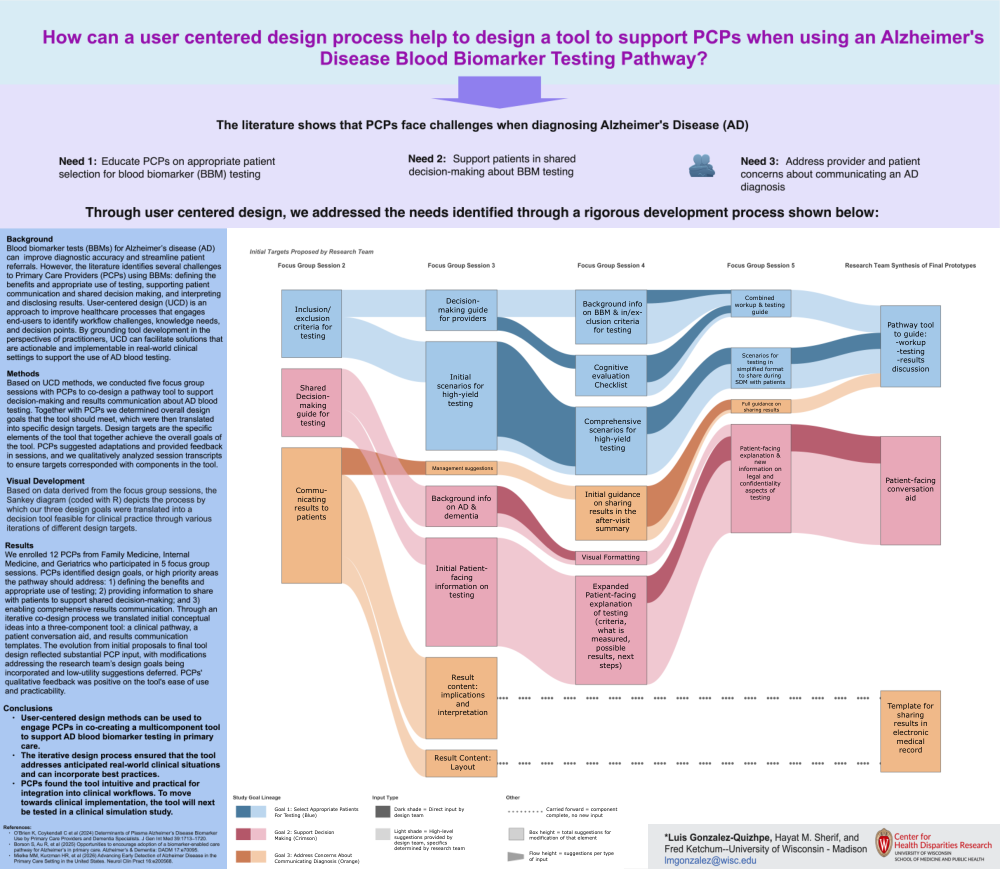
Background: Blood biomarker tests for Alzheimer’s’ Disease (AD) can significantly improve diagnostic accuracy and streamline patient referrals. However, Primary Care Providers (PCPs) lack expertise with AD blood testing and face knowledge gaps regarding clinical decision-making and patient communication. User-centered design (UCD) is an approach to improve healthcare processes that engages users to identify workflow challenges, knowledge needs, and decision points. By grounding tool development in the perspectives of practitioners, UCD can facilitate solutions that are actionable and implementable in real-world clinical settings to support the use of AD blood testing.
Methods: Based on UCD methodology, we conducted five focus group sessions with PCPs to co-design a pathway tool to support decision-making and results communication about AD blood testing. PCPs identified main areas of need, suggested adaptations, and provided feedback. We qualitatively analyzed session transcripts to identify design goals and design targets, and ensured their correspondence with tool elements. We also assessed perceived usability and feasibility of preliminary and final tool prototypes, following the fourth and fifth focus group sessions, respectively.
Results: We enrolled 12 PCPs from Family Medicine (n=4), Internal Medicine (n=7) and Geriatrics (n=1). To support clinical integration of blood biomarker testing, PCPs identified three design targets: 1) defining the benefits and appropriate use of testing; 2) providing information to share with patients to support shared decision-making; and 3) enabling comprehensive results communication. Applying UCD principles, we translated these design targets into tools that can be used in clinical encounters: clinical pathway, patient conversation aid, and results communication templates. We developed and refined materials meeting these design targets through multiple rounds of iterative feedback. Between the final two sessions, PCPs reported modestly higher usability ratings, while feasibility ratings remained high overall.
Conclusion: UCD methodology enabled co-creation of a three-component tool that PCPs anticipated would be feasible for implementation, and which supports PCPs in using blood biomarkers in their primary care practice. This study illustrates how UCD can be an effective method for addressing real-world decision and communication needs around AD diagnostic processes to improve patient-centered care.
Comments
Email is required but is not shown publicly.
Loading comments...