4,068 posters, 219 videos, 101 topics, 69 sessions, 14,365 authors, 6,128 institutions
ePostersLive by SciGen Technologies S.A. All rights reserved.
Alzheimer's Association International Conference 2026
July 12-15, 2026 | London, United Kingdom, and Online

5972
Patient Refusal And Treatment Hesitancy: Key Barriers To Alzheimer's Disease-modifying Therapy Uptake In The US
Poster Presenter
Authors
Hannah Brown, Simone Gabriele, Georgia Giannakopoulou, Amber King, Isabel Arrusi, Joseph Vindici, Sandra Teoh, Nazira Jainis, Abel Teh
Affiliations
Part of Topic
PATIENT REFUSAL AND TREATMENT HESITANCY: KEY BARRIERS TO ALZHEIMER’S MANAGEMENT IN THE US
Hannah Brown1, Simone Gabriele1, Georgia Giannakopoulou1, Amber King1 , Isabel Arrusi1, Joseph Vindici2, Sandra Teoh3, Nazira Jainis3, Abel Teh3
1Ipsos, London, United Kingdom, 2Ipsos, New York, NY, 3Ipsos, Kuala Lumpur, Malaysia
Introduction:
Despite FDA approval of disease-modifying therapies
(DMTs) for Alzheimer’s disease (AD), adoption in the US
remains relatively low. While system-level barriers are welldocumented,
patient-level factors influencing treatment
decisions require further investigation.
Objective:
This study examined barriers to DMT initiation with a focus
on patient refusal patterns and drivers.
Methods:
A multi-centre online survey was conducted among US
neurologists, geriatricians, geriatric psychiatrists and
internists specialising in geriatrics (October-December
2025). De-identified patient charts were collected from
the physicians for patients with mild cognitive impairment,
mild or moderate AD seen in the last 3 months. 123 HCPs
reported treatment status, barriers to DMT use, and patient
decision-making factors for 677 patients. Participating HCPs
were screened for specialty duration and AD caseload.
Results:
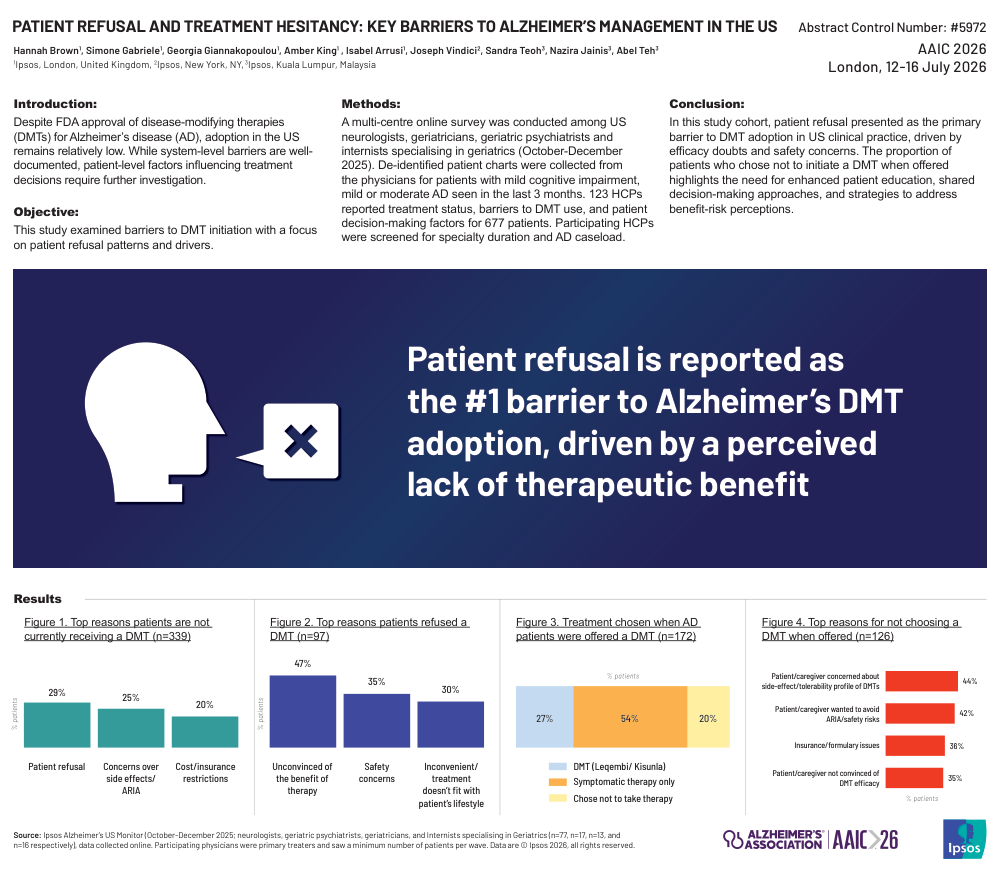
Patient refusal emerged as the leading reason why reported patients were not receiving a DMT (28.6% of n=339 patients not currently receiving a DMT), followed by concerns over treatment side effects/ARIA (24.5%), and cost/insurance restrictions (19.5%). Among patients who refused treatment (n=97), the primary reasons reported included being unconvinced of the therapeutic benefit (47.4%), safety concerns (35.1%), and lifestyle burden (29.9%).
26.7% of patients offered anti-amyloid therapies (n=172) accepted them, while 53.5% chose symptomatic treatments and 19.8% declined all treatment. Patient-specific reasons for not choosing a DMT when offered (n=126) included concerns about side effects/tolerability (44.4%), ARIA/safety risks (42.1%), and lack of conviction regarding efficacy (34.9%).
Conclusion:
In this study cohort, patient refusal presented as the primary
barrier to DMT adoption in US clinical practice, driven by
efficacy doubts and safety concerns. The proportion of
patients who chose not to initiate a DMT when offered
highlights the need for enhanced patient education, shared
decision-making approaches, and strategies to address
benefit-risk perceptions.
Key Takeaway: Patient refusal is reported as
the #1 barrier to Alzheimer’s DMT
adoption, driven by a perceived
lack of therapeutic benefit
Comments
Email is required but is not shown publicly.
Loading comments...