4,068 posters, 219 videos, 101 topics, 69 sessions, 14,365 authors, 6,128 institutions
ePostersLive by SciGen Technologies S.A. All rights reserved.
Alzheimer's Association International Conference 2026
July 12-15, 2026 | London, United Kingdom, and Online

2236
From Willingness To Enrollment: How The FTD Disorders Registry Enables Efficient Research Recruitment
Part of Topic
From Willingness to Enrollment: How the FTD Disorders Registry Enables Efficient Research Recruitment
Background
Frontotemporal degeneration (FTD) is a leading cause of young-onset dementia, yet participation in FTD research remains limited due to clinical heterogeneity, geographic dispersion, limited awareness of FTD and clinical trials among healthcare professionals, and diagnostic delays that may render individuals ineligible by the time a diagnosis is confirmed. Recruitment is further complicated by the need to engage multiple stakeholder groups, including individuals living with FTD, caregivers, biological family members, and legally authorized representatives (LARs). Despite strong interest in research participation among affected individuals and families, these barriers persist. The FTD Disorders Registry addresses them through a centralized, participant-consented platform using a privacy-preserving intermediary model to support study recruitment, with structured registry data providing actionable insights into participant willingness and eligibility to enable more effective study planning and enrollment.
Methods
Participants include diagnosed individuals, caregivers, biological family members, and LARs. Measures included self-reported willingness to participate in research, acceptable travel distance and visit frequency, and openness to research activities such as surveys, MRI, PET scans, and lumbar punctures. Registry metrics included total accounts, surveys completed, number of external studies supported, participant role distribution, and referral activity.
Results
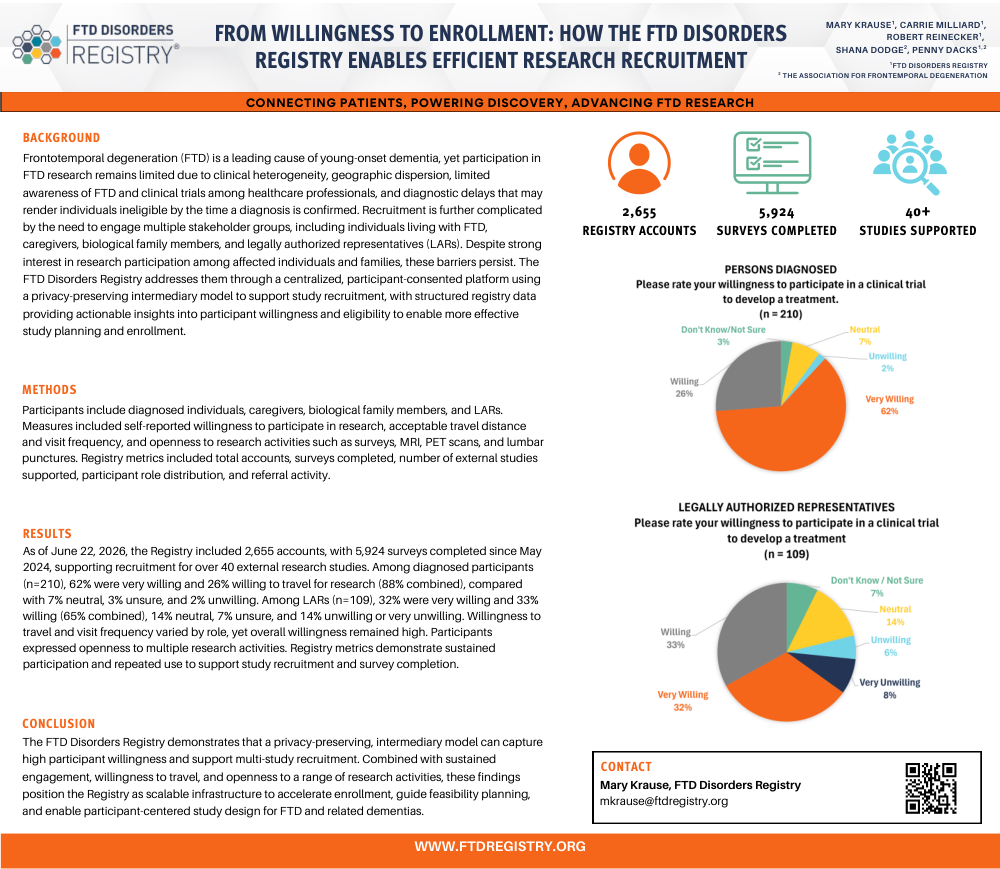
As of June 22, 2026, the Registry included 2,655 accounts, with 5,924 surveys completed since May 2024, supporting recruitment for over 40 external research studies. Among diagnosed participants (n=210), 62% were very willing and 26% willing to travel for research (88% combined), compared with 7% neutral, 3% unsure, and 2% unwilling. Among LARs (n=109), 32% were very willing and 33% willing (65% combined), 14% neutral, 7% unsure, and 14% unwilling or very unwilling. Willingness to travel and visit frequency varied by role, yet overall willingness remained high. Participants expressed openness to multiple research activities. Registry metrics demonstrate sustained participation and repeated use to support study recruitment and survey completion.
Conclusion
The FTD Disorders Registry demonstrates that a privacy-preserving, intermediary model can capture high participant willingness and support multi-study recruitment. Combined with sustained engagement, willingness to travel, and openness to a range of research activities, these findings position the Registry as scalable infrastructure to accelerate enrollment, guide feasibility planning, and enable participant-centered study design for FTD and related dementias.
Comments
Email is required but is not shown publicly.
Loading comments...