4,068 posters, 219 videos, 101 topics, 69 sessions, 14,365 authors, 6,128 institutions
ePostersLive by SciGen Technologies S.A. All rights reserved.
Alzheimer's Association International Conference 2026
July 12-15, 2026 | London, United Kingdom, and Online

1745
From Research To Clinical Practice: Consensus Guidelines For Neuroimaging AI Tools For The Memory Clinic (Neuro-AIM)
Poster Presenter
Authors
Natasha Clarke, Mathias Huybrechts, Jay Amin, Lewis Hotchkiss, James Leighs, Mathew Leming, Usman Saeed, Catherine J. Scott, Dirk Smeets, Angela Tam, Stefano Tamburin, Geert Vanhooren, Meike W. Vernooij, Jennifer C. Camaradou, David J. Llewellyn, Timothy Rittman, Rose Bruffaerts
Affiliations
University College London Hospitals NHS Foundation Trust, University of Exeter, Massachusetts General Hospital, University of Cambridge, University of Southampton, Université de Montréal, Centre de Reserche de l!Institut Universitaire de Gériatrie de Montréal, University of Antwerp, Swansea University, University of Toronro, Sunnybrook Research Institute, University College London Hospitals NHS Foundation Trust, University College London, Icometrix, Vrije Universiteit Brussel, Perceiv AI, University of Verona, Erasmus MC University Medical Center, PPIE Patient Partner, University of Antwerp, University Hospital Antwerp, Hasselt University, AZ Sint-Jan Brugge
Part of Topic
Background
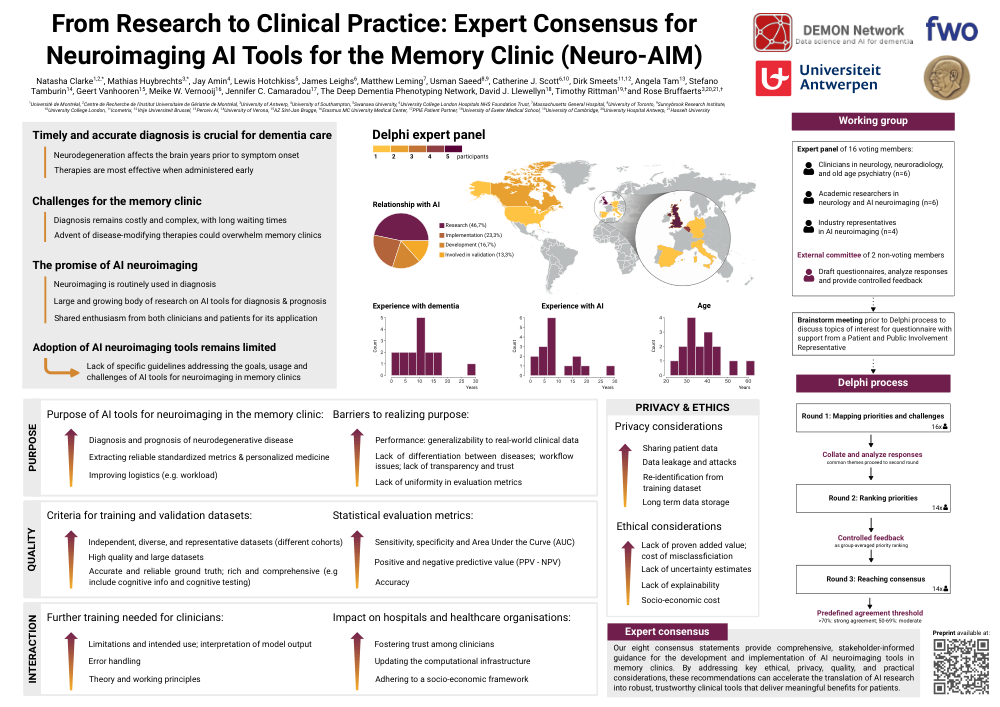
Although artificial intelligence (AI) tools may aid early diagnosis and prognosis of neurodegenerative disorders, their adoption in memory clinics remains limited. While general guidelines for the development and use of AI in healthcare exist, they are not specific to memory clinics in terms of their goals, users, and challenges, hampering their effective design and implementation. We sought to establish expert consensus for the design, development, and deployment of neuroimaging AI tools for memory clinics using a Delphi process.
Methods
We leveraged the collective knowledge of 16 experts from clinical, academic, and industry backgrounds who were recruited through the Deep Dementia Phenotyping (DEMON) network. During the Delphi process, we conducted three rounds of anonymous questionnaires, with support from a Patient and Public Involvement Representative. In the first round of the Delphi process, the panel answered open-ended questions to identify important concerns on a wide range of topics related to neuroimaging AI tools. In the second round, panelists prioritised concerns on a 7-point Likert scale. In the third round, panelists gained insight into the perspective of their peers through controlled feedback, and either agreed or disagreed with a consensus statement based on the group’s mean Likert score from the previous round.
Results
The panel reached strong (>70%) or moderate (50-69%) agreement on eight statements covering four themes: purpose, quality, interactions with clinicians and memory clinics, and privacy and ethics. Overall, the panel agreed neuroimaging AI tools can contribute to improved patient care at various levels, and identified variable individual-level performance and lack of generalisability as key barriers for implementation in memory clinics. These statements form a first step towards more comprehensive guidelines for neuroimaging AI tools for memory clinics, highlighting experts’ recommendations regarding development, reporting, evaluation, testing, education, and data handling.
Conclusion
The Neuro-AIM expert concensus establishes a comprehensive and novel range of recommendations to further the translation of AI neuroimaging tools from research to practice, improving diagnostic and care pathways for all memory clinic stakeholders.
Comments
Email is required but is not shown publicly.
Loading comments...