4,068 posters, 219 videos, 101 topics, 69 sessions, 14,365 authors, 6,128 institutions
ePostersLive by SciGen Technologies S.A. All rights reserved.
Alzheimer's Association International Conference 2026
July 12-15, 2026 | London, United Kingdom, and Online

6494
Harmonization Models Of Resting-state Eeg Features For Multisite Studies And Cost-effective Dementia Prevention Strategies
Poster Presenter
Authors
Part of Topic
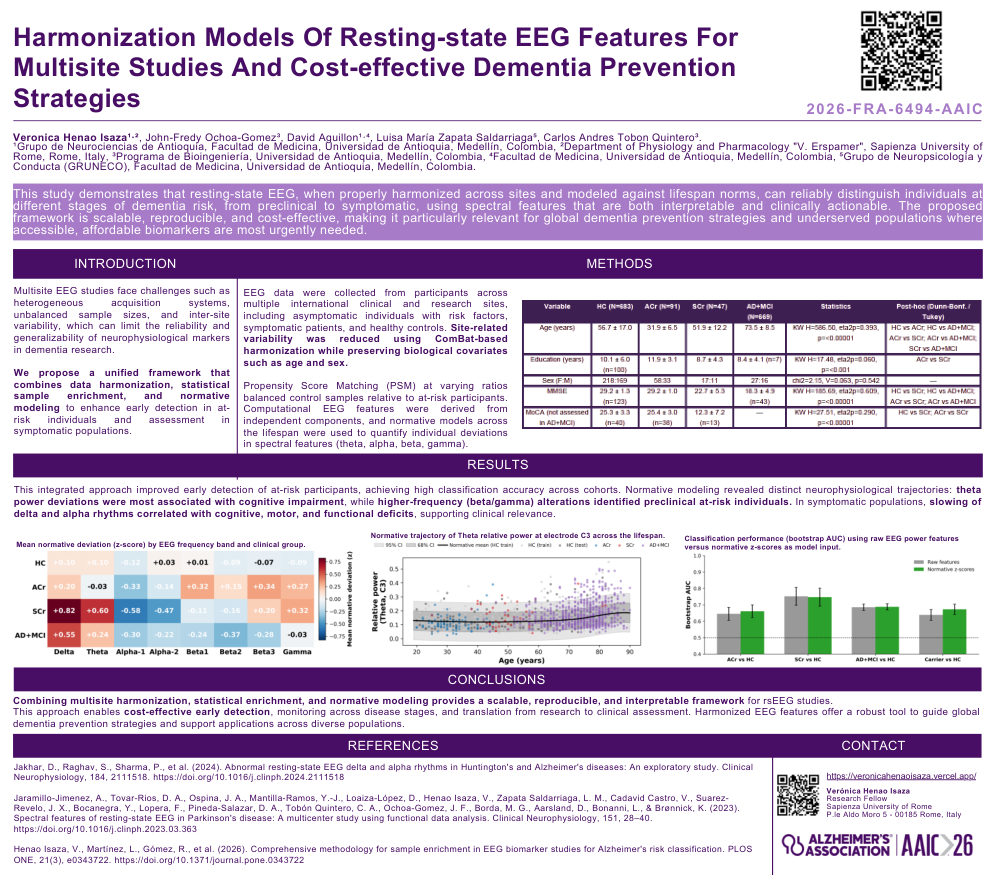
Harmonization Models Of Resting-state Eeg Features For Multisite Studies And Cost-effective Dementia Prevention Strategies
Background:
Multisite EEG studies face challenges such as heterogeneous acquisition systems, unbalanced sample sizes, and inter-site variability,which can limit the reliability and generalizability of neurophysiological markers in dementia research. We propose a unified framework thatcombines data harmonization, statistical sample enrichment, and normative modeling to enhance early detection in at-risk individuals andassessment in symptomatic populations.
Methods:
EEG data were collected from participants across multiple international clinical and research sites, including asymptomatic individualswith risk factors, symptomatic patients, and healthy controls. Site-related variability was reduced using ComBat-based harmonization whilepreserving biological covariates such as age and sex. Propensity Score Matching (PSM) at varying ratios balanced control samples relative to at-risk participants. Computational EEG features were derived from independent components, and normative models across the lifespan were usedto quantify individual deviations in spectral features (theta, alpha, beta, gamma).
Results:
This integrated approach improved early detection of at-risk participants, achieving high classification accuracy across cohorts.Normative modeling revealed distinct neurophysiological trajectories: theta power deviations were most associated with cognitive impairment,while higher-frequency (beta/gamma) alterations identified preclinical at-risk individuals. In symptomatic populations, slowing of delta and alpharhythms correlated with cognitive, motor, and functional deficits, supporting clinical relevance.
Conclusion:
Combining multisite harmonization, statistical enrichment, and normative modeling provides a scalable, reproducible, andinterpretable framework for rsEEG studies. This approach enables cost-effective early detection, monitoring across disease stages, and translationfrom research to clinical assessment. Harmonized EEG features offer a robust tool to guide global dementia prevention strategies and supportapplications across diverse populations.
Comments
Email is required but is not shown publicly.
Loading comments...