4,068 posters, 219 videos, 101 topics, 69 sessions, 14,365 authors, 6,128 institutions
ePostersLive by SciGen Technologies S.A. All rights reserved.
Alzheimer's Association International Conference 2026
July 12-15, 2026 | London, United Kingdom, and Online

3416
The Role Of Carer Burden And Caregiving Contexts In Dementia Rehabilitation: Implications For Program Design And Tailored Support
Poster Presenter
Authors
Cheng-Ya Lee, Yun-Hee Jeon, Judith Fethney, Karen Watson, Lee-Fay Low, Loren Mowszowski, Robert T Woods
Affiliations
Susan Wakil School of Nursing and Midwifery, Faculty of Medicine and Health, The University of Sydney, NSW, Australia, School of Health Sciences, Faculty of Medicine and Health, The University of Sydney, Sydney, NSW, Australia, Brain and Mind Centre and School of Psychology, Faculty of Science, The University of Sydney, Sydney, NSW, Australia, Dementia Services Development Centre (DSDC) Wales, School of Health Sciences, Bangor University, Bangor, United Kingdom
Part of Topic
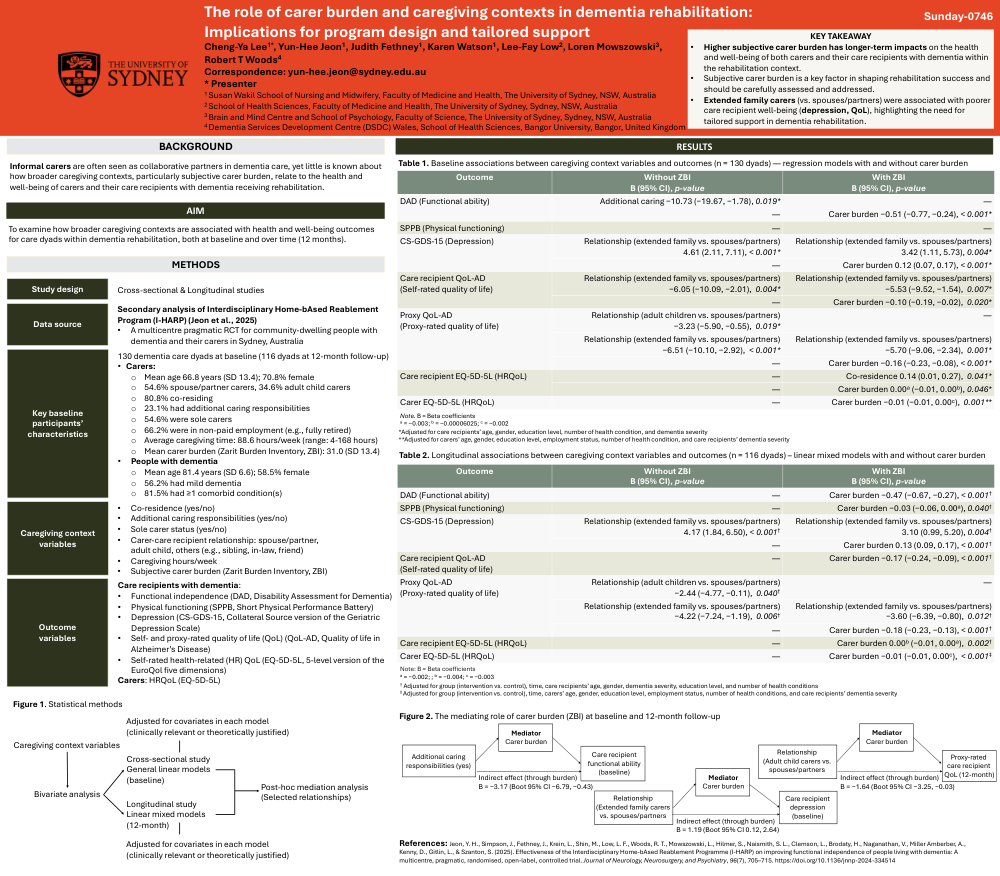
Informal carers play a vital role in post-diagnostic dementia care, including rehabilitation, yet little is known about how broader caregiving contexts, particularly subjective carer burden, relate to the health and well-being of carers and their care recipients with dementia receiving rehabilitation.
This poster presents two complementary studies examining whether broader caregiving contexts (e.g., caregiving hours, co-residence, carer-care recipient relationship, carer burden) are associated with health and well-being outcomes for care dyads within dementia rehabilitation, both at baseline and over time (12 months), using data from the Interdisciplinary Home-bAsed Reablement Programme (I-HARP), a multicentre pragmatic trial in Sydney, Australia.
Our findings suggest that cross-sectionally and longitudinally, higher subjective carer burden was the strongest caregiving context variable associated with poorer health and well-being outcomes for both carers (health-related quality of life, HRQoL) and care recipients (functional ability, depression, self- and proxy-rated quality of life, and HRQoL). Carer burden also mediated certain associations, for instance, the baseline association between additional caring responsibilities and the care recipient's functional ability. Compared to spousal/partner carers, extended family members (e.g., siblings, in-laws, friends) were associated with poorer care recipient well-being, including depression and quality of life.
These findings further highlight that subjective carer burden has both short- and longer-term effects on functional and psychosocial outcomes for care recipients and carer HRQoL within the rehabilitation context. Future rehabilitation programs should assess and address subjective carer burden within broader caregiving contexts, and tailor support to carers, particularly non-spousal carers.
Comments
Email is required but is not shown publicly.
Loading comments...