Loading...

4,068 posters, 219 videos, 101 topics, 69 sessions, 14,365 authors, 6,128 institutions

ePostersLive by SciGen Technologies S.A. All rights reserved.

Alzheimer's Association International Conference 2026

July 12-15, 2026 | London, United Kingdom, and Online

Alzheimer's Association International Conference 2026 banner

10928

Early Infection Detection In People Living With Dementia Using Passive Digital Technology
Part of Topic

BACKGROUND

•Infections are a major cause of acute deterioration and avoidable hospital admission in people living with dementia (PLWD)1.
•Atypical presentations and under-reporting of symptoms can delay diagnosis in PLWD.²
•Wearable devices can capture early signs of infection3, but poor adherence and charging demands limit their use in PLWD and elderly4.
•Under-mattress nearable sensors offer passive, contactless monitoring,⁵ yet have not been evaluated for infection detection.
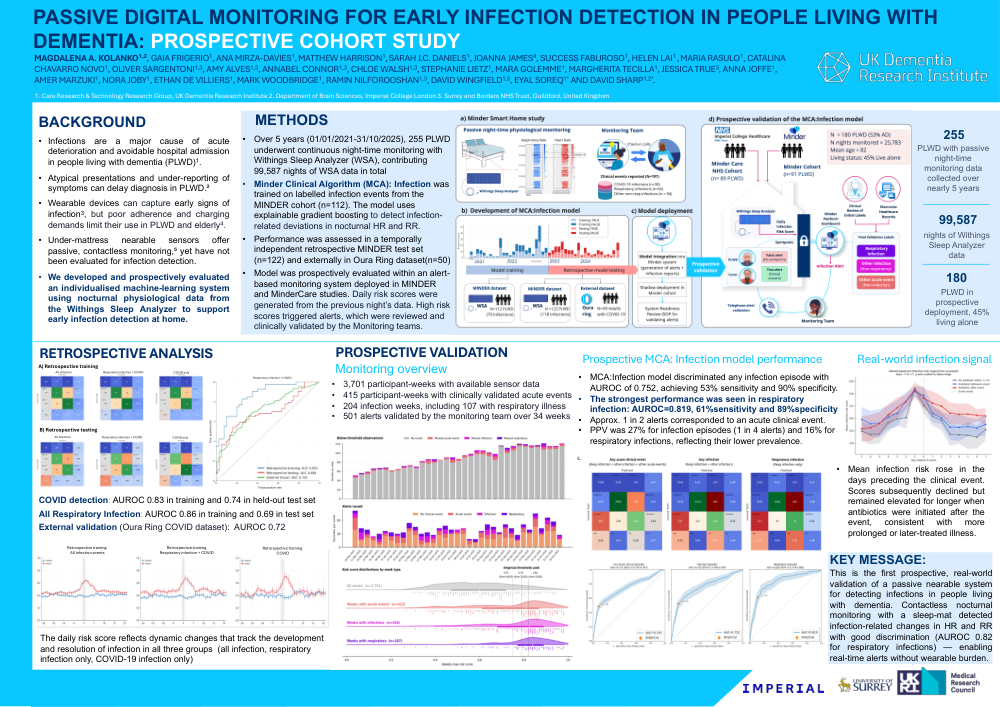
•We developed and prospectively evaluated an individualised machine-learning system using nocturnal physiological data from the Withings Sleep Analyzer to support early infection detection at home.
 

METHODS

•Over 5 years (01/01/2021-31/10/2025), 255 PLWD  underwent continuous night-time monitoring with Withings Sleep Analyzer (WSA), contributing 99,587 nights of WSA data in total
•Minder Clinical Algorithm (MCA): Infection was trained on labelled infection events from the MINDER cohort (n=112). The model uses explainable gradient boosting to detect infection-related deviations in nocturnal HR and RR.
•Performance was assessed in a temporally independent retrospective MINDER test set (n=122) and externally in Oura Ring dataset(n=50)
•Model was prospectively evaluated within an alert-based monitoring system deployed in MINDER and MinderCare studies. Daily risk scores were generated from the previous night’s data. High risk scores triggered alerts, which were reviewed and clinically validated by the Monitoring teams.
 
RESULTS
1. RETROSPECTIVE ANALYSIS

COVID detection: AUROC 0.83 in training and 0.74 in held-out test set

All Respiratory Infection: AUROC 0.86 in training and 0.69 in test set

External validation (Oura Ring COVID dataset):  AUROC 0.72

The daily risk score reflects dynamic changes that track the development and resolution of infection in all three groups  (all infection, respiratory infection only, COVID-19 infection only)


2. PROSPECTIVE ANALYSIS

Monitoring overview

•3,701 participant-weeks with available sensor data
•415 participant-weeks with clinically validated acute events
•204 infection weeks, including 107 with respiratory illness
•501 alerts validated by the monitoring team over 34 weeks
 

Prospective MCA: Infection model performance

•MCA:Infection model discriminated any infection episode with AUROC of 0.752, achieving 53% sensitivity and 90% specificity.
•The strongest performance was seen in respiratory infection: AUROC=0.819, 61%sensitivity and 89%specificity
•Approx. 1 in 2 alerts corresponded to an acute clinical event.
•PPV was 27% for infection episodes (1 in 4 alerts) and 16% for respiratory infections, reflecting their lower prevalence.
 
Real world infection signal
•Mean infection risk rose in the days preceding the clinical event. Scores subsequently declined but remained elevated for longer when antibiotics were initiated after the event, consistent with more prolonged or later-treated illness.
 

KEY MESSAGE:

This is the first prospective, real-world validation of a passive nearable system for detecting infections in people living with dementia. Contactless nocturnal monitoring with a sleep-mat detected infection-related changes in HR and RR with good discrimination (AUROC 0.82 for respiratory infections) — enabling real-time alerts without wearable burden.

Comments

Email is required but is not shown publicly.

Loading comments...

aaic2026 banner
Copyright © 2015-2026, ePostersLive® SciGen is a registered trademark of SciGen Technologies S.A. Patent pending.

This website and third-party tools we use rely on cookies for the best user experience. By selecting "I agree", you agree to cookie usage as described in our Privacy Policy.