4,068 posters, 219 videos, 101 topics, 69 sessions, 14,365 authors, 6,128 institutions
ePostersLive by SciGen Technologies S.A. All rights reserved.
Alzheimer's Association International Conference 2026
July 12-15, 2026 | London, United Kingdom, and Online

4319
Perspectives Of Different Dementia Stakeholders On Person-centred Ai-enhanced Assistive Technology For People With Dementia
Poster Presenter
Authors
Mina Aghaei, Ruth Brookman, Paul Breen, Melanie Handley, Elspeth Mathie, Celia Harris
Affiliations
The MARCS Institute for Brain, Behaviour, and Development, Western Sydney University, Sydney, NSW, Australia. School of Health, Medicine and Life Sciences / Nursing, Health and Wellbeing, University of Hertfordshire, Hatfield, United Kingdom., The MARCS Institute for Brain, Behaviour, and Development, Western Sydney University, Sydney, NSW, Australia., School of Health, Medicine and Life Sciences / Nursing, Health and Wellbeing, University of Hertfordshire, Hatfield, United Kingdom.
Part of Topic
Perspectives Of Different Dementia Stakeholders On Person-centred Ai-enhanced Assistive Technology For People With Dementia
Author Block: Mina Aghaei1,2, Ruth Brookman1, Paul Breen1, Celia B. Harris1
1The MARCS Institute for Brain, Behaviour, and Development, Western Sydney University, Sydney, NSW, Australia, 2School of Health, Medicine and Life Sciences / Nursing, Health and Wellbeing, University of Hertfordshire, Hatfield, United Kingdom.
Background: Dementia is associated with progressive cognitive decline, with prevalence increasing sharply with age. As populations age globally, there is growing interest in assistive technologies to support people living with dementia. Recent advances in artificial intelligence (AI) and smart technologies offer new opportunities to support memory, daily activities, and social engagement. However, adoption of AI-enhanced assistive technologies remains limited due to barriers including usability, trust, privacy, and concerns about over-reliance. Many existing technologies are primarily designed for caregivers, potentially misaligning with the lived experiences, and preferences of people living with dementia. Person-centred design has been widely advocated, yet evidence directly incorporating the perspectives of people living with dementia alongside other stakeholders remains limited.
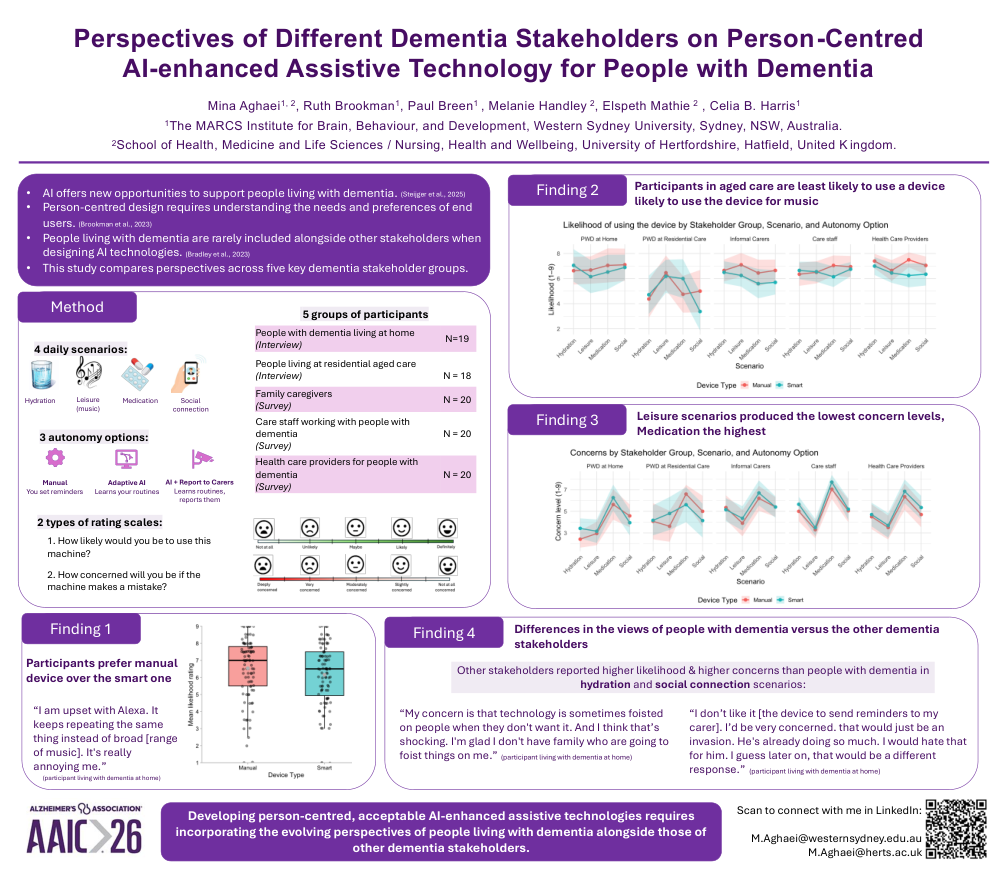
Methods: This mixed-methods study explored perspectives on person-centred AI-enhanced assistive technology among people with dementia and other key dementia stakeholders. Five groups of participants were recruited: 1. people with dementia living at home (interviews), 2. people with dementia in residential aged care (interviews), 3. informal caregivers (surveys), 4. formal care staff (surveys), and 5. healthcare professionals (surveys). Core questions were consistent across groups to enable direct comparison, with interviews adapted in a dementia-friendly manner. Data examined desired support domains, perceptions of AI-enhanced versus non-AI technologies, likelihood of use across scenarios of varying sensitivity, and concerns related to AI and data sharing.
Results: People living with dementia expressed diverse and fluctuating needs and perspectives regarding assistive technologies. Many emphasised that technology should reduce, rather than add to their cognitive burden, and support independence without undermining existing skills. Participants described tensions between automation and autonomy, concerns about over-reliance, and strong interest in technologies that address loneliness and emotional well-being. Perspectives of people living with dementia sometimes differed from those of caregivers and healthcare professionals, particularly with respect to data-sharing concerns, perceived benefits, and the emotional impact of AI-driven support, with people living with dementia generally expressing fewer concerns about sharing their own information with AI systems.
Conclusion: The findings demonstrate that it is critical to incorporate the dynamic perspectives of people living with dementia alongside the voices of other stakeholders for developing person-centred, acceptable AI-enhance assistive technologies for dementia.
Comments
Email is required but is not shown publicly.
Loading comments...