4,068 posters, 219 videos, 101 topics, 69 sessions, 14,365 authors, 6,128 institutions
ePostersLive by SciGen Technologies S.A. All rights reserved.
Alzheimer's Association International Conference 2026
July 12-15, 2026 | London, United Kingdom, and Online

7239
Bridging Blood-Based Biomarkers and Language Markers in Natural Conversations
Poster Presenter
Part of Topic
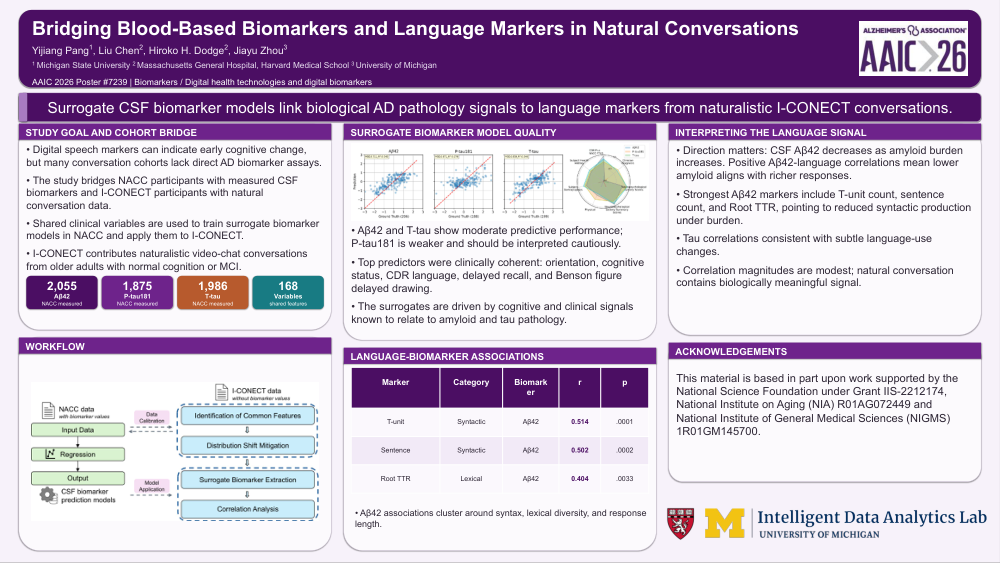
Background: Digital speech and language markers have emerged as promising non-invasive indicators of early cognitive impairment in Alzheimer’s disease (AD). However, their relationship to underlying AD neuropathology remains insufficiently understood, largely due to the scarcity of datasets containing both naturalistic speech and CSF measures. Establishing such links is critical for validating digital language markers as biologically meaningful indicators rather than proxies for clinical status alone.
Methods: We integrated two complementary datasets: the Internet-Based Conversational Engagement Clinical Trial (I-CONECT), which provides longitudinal, semi-structured conversational speech data from older adults with normal cognition or mild cognitive impairment, and the National Alzheimer’s Coordinating Center (NACC) database, which includes extensive clinical assessments and CSF biomarker measurements. Using 168 shared clinical variables, we trained machine-learning regression models on NACC data to predict CSF amyloid-β42, total tau, and phosphorylated tau (P-tau181). These models were then applied to I-CONECT participants to generate surrogate CSF biomarker estimates. Linguistic features, including lexical diversity, syntactic complexity, psycholinguistic categories, and speech fluency, were extracted from conversation transcripts and aggregated per participant. Correlation analyses assessed associations between language markers and surrogate CSF biomarkers.
Results: The surrogate biomarker models achieved moderate predictive performance and demonstrated interpretable feature importance patterns consistent with known clinical correlates of AD pathology. In I-CONECT participants, lower predicted amyloid-β42 levels were significantly associated with shorter responses and reduced syntactic complexity. Higher predicted total tau and P-tau181 levels were also correlated with lower syntactic complexity.
Conclusions: This study provides novel evidence linking naturalistic conversational language markers to surrogate CSF biomarkers of AD pathology. By bridging biological and digital measures through large-scale clinical data, our approach highlights the potential of speech-based markers as accessible, non-invasive tools for early detection and monitoring of Alzheimer’s disease. This framework supports scalable integration of digital biomarkers into population-level AD research and precision health strategies.
Comments
Email is required but is not shown publicly.
Loading comments...