4,068 posters, 219 videos, 101 topics, 69 sessions, 14,365 authors, 6,128 institutions
ePostersLive by SciGen Technologies S.A. All rights reserved.
Alzheimer's Association International Conference 2026
July 12-15, 2026 | London, United Kingdom, and Online

1548
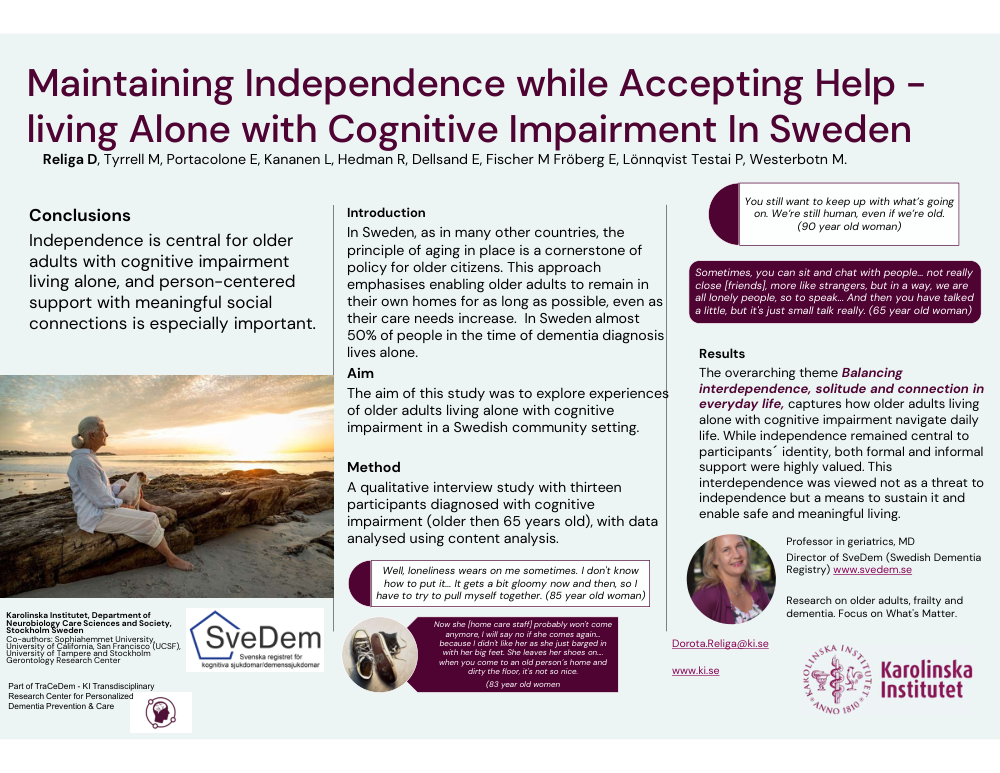
Maintaing Independence While Accepting Help -living Alone With Cognitive Impairment In Sweden
Poster Presenter
Authors
Dorota Religa, Marie Tyrrell, Elena Portacolone, Laura Kananen, Ragnhild Hedman, Eva Dellsand, Maria Fischer, Elin Fröberg, Petra Lönnqvist Testai, Margareta Westerbotn
Affiliations
Department of Nursing Science, Sophiahemmet University, Stockholm, Sweden, Institute for Health & Aging, University of California, San Francisco (UCSF), Tampere University, Finland, Karolinska Institutet, NVS, Clinical geriatrics, Stockholm, Sweden, Stockholm Gerontology Research Center, Stockholm, Sweden
Part of Topic
Video
This qualitative study explored the experiences of older adults living alone with cognitive impairment in Sweden, a country where ageing in place is a central principle of older adults care policy. Through interviews with thirteen participants aged over 65 years, the study examined how individuals manage everyday life while facing cognitive challenges and limited household support. The findings revealed that maintaining independence remained a fundamental aspect of participants’ identity and sense of self. At the same time, they recognized the importance of both formal services and informal support networks in enabling them to continue living safely and meaningfully in their own homes.
The overarching theme, described as balancing interdependence, solitude, and connection in everyday life, illustrates the complex relationship between autonomy and support. Participants did not view accepting help as a loss of independence; rather, they regarded it as a necessary means of preserving autonomy and remaining engaged in daily activities. Social relationships were highly valued, with participants expressing a strong desire to remain connected to others and to society despite experiencing periods of loneliness and isolation. The study also highlighted the importance of respectful, person-centred care, showing that the quality of interactions with care providers could influence how support was perceived and accepted.
Overall, the findings suggest that older adults living alone with cognitive impairment can maintain independence when support is tailored to their individual needs, respects their autonomy, and fosters meaningful social connections. These results emphasize the importance of person-centred approaches that help people live safely, with dignity and purpose, in their own homes.
Work is a part of TraCeDem. Dorota Religa is a director of SveDem (Swedish Dementia Refistry).
Comments
Email is required but is not shown publicly.
Loading comments...